
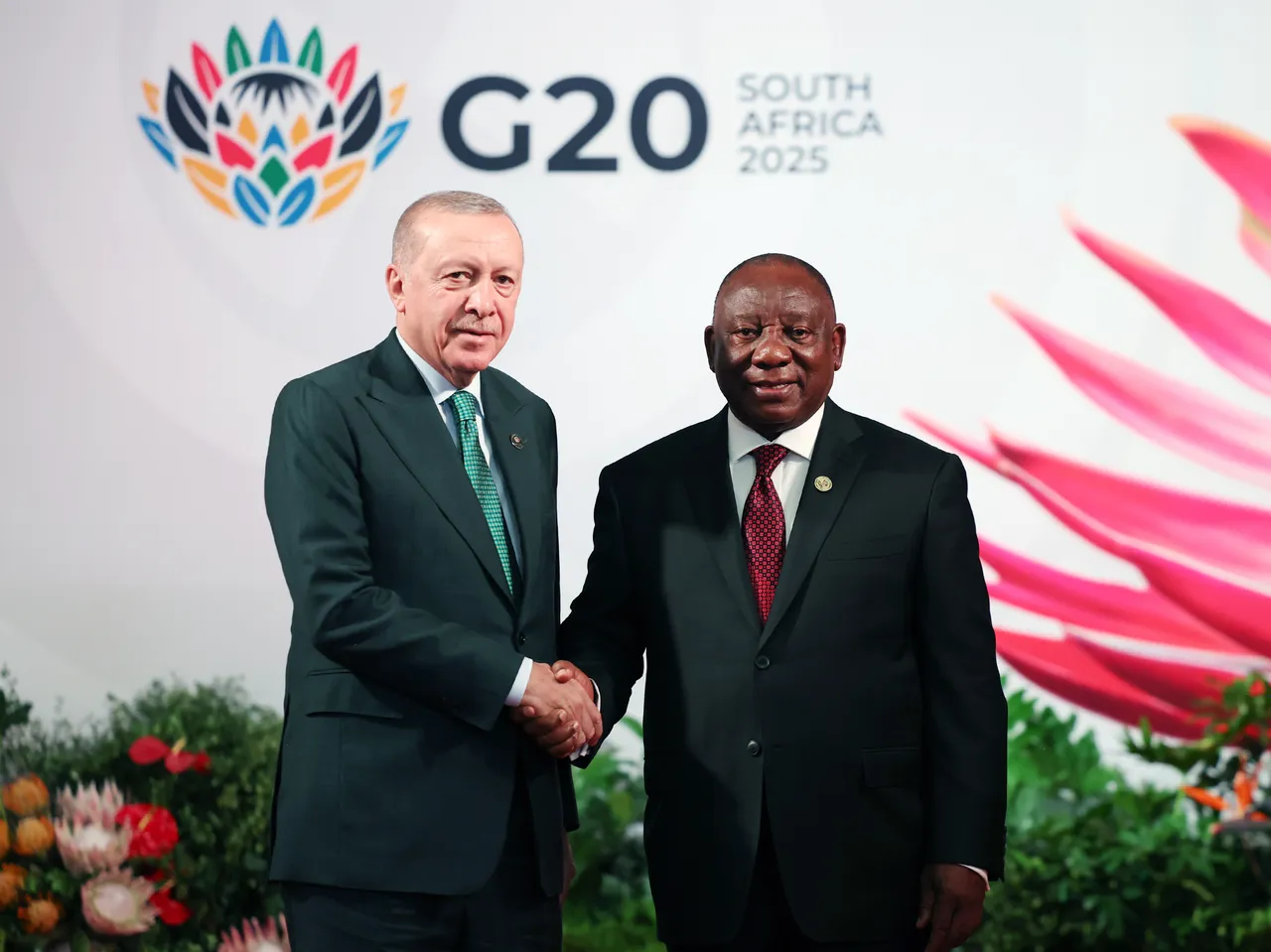
Image Credit: Turkish President Recep Tayyip Erdoğan and South African President Cyril Ramaphosa at the 2025 G20 Summit in Johannesburg. (Photo: Murat Çetinmühürdar / Anadolu Agency)
By Mehmet Furkan Keleş , Master’s student in Department of Political Science at Universitas Islam Internasional Indonesia (UIII)
As global power rivalries harden across Africa, Türkiye is testing an alternative path that does not fully align with Western liberal prescriptions nor with the purely transactional models represented by Russia and China. Instead, Ankara is constructing what it presents as an autonomous “Third Way”: a blend of military technology and state‑building, construction and energy diplomacy, humanitarian aid and educational outreach, all framed as a partnership among Global South actors rather than a new hierarchy. The question in 2025 is whether this model can genuinely expand African strategic autonomy and societal welfare, or whether it risks reproducing familiar patterns of dependency in a softer form.
From Diplomatic Opening to Strategic Architecture
The policy towards Africa by Türkiye has changed over the past two decades to be more of a diplomatic opener policy, to what Ankara now describes as an enduring strategic partnership architecture. The year 2025 is portrayed as a divide: the transition to the quantitative expansion which is in the form of more embassies, more visits, more trade and to the qualitative consolidation when diplomacy, security, the defense industry, trade, and the energy are put on the same scale as one. Instead of thinking of the continent as a chain of unrelated bilateral opportunities, Turkish policymakers are increasingly referring to Africa as a strategic basin extending through the Sahel to the Horn of Africa to the Indian Ocean where the dimensions are mutually reinforcing.
This narrative sits within a broader redefinition of Türkiye as an “Afro‑Eurasian” state that seeks to transcend traditional North–South hierarchies. By emphasizing its geographic liminality and the absence of a colonial past in Africa, Ankara seeks to differentiate itself from former European colonial powers and from extra‑regional actors perceived as instrumental and extractive. In public discourse, the slogan “the world is bigger than five” signals dissatisfaction with the existing global order and is intended to resonate with African societies that have long criticised the unequal distribution of voice and power in multilateral institutions. Against this backdrop, Türkiye’s offer of NATO‑standard military technology without overt political conditionalities, combined with a lack of colonial baggage, is presented as evidence that a different kind of partnership is possible.
Security Partnerships in Fractured Landscapes
Being challenged, and external intervention has occasionally yielded both beneficial and detrimental results, the Third Way is being put to its greatest test, especially in the Sahel and Sudan. This is dynamic as illustrated in the Sahel. With France and the United States downsizing, restructuring, or losing legitimacy in the different Sahelian states, a security vacuum has emerged in which juntas, insurgencies, and local militia vie to control power. In this regard, Türkiye has implemented a so-called Sahel pivot: a planned increase in defense and security relationships with Mali, Burkina Faso, and Niger.
In contrast to other suppliers that are confined with selling arms, Ankara presents its package as a holistic state capacity-building initiative. Bayraktar TB2 and Akinci unmanned aerial vehicles export are also accompanied by training programmes, technical support and shared operational doctrines, which combined are designed to create sustainable capabilities and not short-term solutions. The mentioned objective is to assist the local governments to fight terrorism and insurgency without developing long-term reliance on the presence of foreign ground troops or contractors. The aim of this model is to differentiate between Turkiye and Western counter-terrorism operations, which have been frequently criticised to cause dependency, and the other foreign players whose influence has sometimes only served to exacerbate instability.
In Sudan, Türkiye has taken a different yet related approach to a conflict whose ripple effects reach from the Gulf to the Red Sea. Ankara formally recognises the Sudanese Armed Forces as the core state institution, signalling support for territorial integrity and institutional continuity. At the same time, it maintains open communication channels with multiple parties, with the declared aim of preventing the conflict from escalating into a broader regional war. This dual track support for existing state structures on the one hand, engagement with various stakeholders on the other seeks to contrast with divide‑and‑rule dynamics in which external powers back competing factions to advance their own interests.
The Horn of Africa offers a further arena where this security‑diplomatic model is unfolding. Tensions between Somalia and Ethiopia over maritime access and sovereignty have given Türkiye an opportunity to position itself as a facilitator through what has been referred to as the Ankara Process. The Ankara Declaration of 2024 and subsequent technical talks suggest an attempt to institutionalise dialogue that spans border issues, maritime jurisdiction, and security cooperation, rather than relying on ad hoc crisis management. For Türkiye, successful mediation here would not only mitigate the risk of regional escalation but also consolidate its image as a reliable interlocutor capable of translating military and economic ties into credible diplomatic leverage.
Mavi Vatan, Construction, and Energy Diplomacy
Parallel to its security role, Türkiye has embedded itself in Africa’s evolving economic and energy architecture. Turkish construction companies have become ubiquitous across the continent, delivering airports, roads, housing, and public buildings, with cumulative project volumes reaching around 2,390 projects and roughly 100 billion dollars in value. This material footprint has been accompanied by a rapid increase in trade, which exceeded 37 billion dollars by 2024 and is edging toward a 40‑billion‑dollar target, reinforcing Ankara’s claim that it views Africa as a long‑term partner rather than a short‑term market.
These terrestrial engagements connect directly to a maritime vision encapsulated in the Mavi Vatan doctrine, which has gradually been projected from the Eastern Mediterranean toward the Red Sea, the Horn of Africa, and the Indian Ocean. The deployment of the Oruç Reis seismic vessel off Somalia from July 2024, completing about 78 per cent of its surveys by mid‑2025, illustrates how energy exploration and maritime strategy are being extended into African waters. For Ankara, this is not only about potential hydrocarbons; it is also about inserting itself into emerging sea‑lanes, resource governance regimes, and security arrangements that will shape regional geopolitics.
The logistical backbone of this economic and strategic presence is air connectivity. Turkish Airlines has built the most extensive African route network among non‑African carriers, flying to 63 destinations in 42 countries and linking them directly to Istanbul. These routes carry students, businesspeople, officials, pilgrims, and tourists, generating dense interpersonal and institutional ties that undergird formal agreements. In contrast to China’s widely noted model, centred on large‑scale infrastructure projects staffed heavily by imported labour and often structured as “infrastructure‑for‑resources” swaps, Türkiye increasingly markets an approach that prioritises local employment, joint ventures, and technology transfer. Plans by Turkish defence firms such as Baykar to establish production and technology hubs in North Africa suggest a shift toward co‑production, in which selected African partners become manufacturing and research sites rather than remaining mere end‑users.
Humanitarian Diplomacy and Social Legitimacy
For African citizens, however, legitimacy is not measured primarily in trade statistics or fleet sizes but in whether external partnerships deliver tangible improvements in daily life. Afrobarometer surveys demonstrate that many Africans’ core demands centre on democracy, accountability, and basic services such as clean water, electricity, and quality healthcare, which in turn shape political participation and trust in institutions. It is in this “social maze” that Türkiye’s humanitarian diplomacy attempts to anchor its Third Way in everyday realities rather than elite rhetoric.
Ankara has funded projects that are not particularly expensive but symbolically strong through TIKA (Turkish Cooperation and Coordination Agency) and a variety of humanitarian organisations. The projects like providing permanent drinking water in South African rural population by TIKA or the project in Mvezo, the home town of Nelson Mandela, address directly needs in regions where state institutions have been weak. Medical missions are made to countries such as Gambia where Turkish teams have carried out free cardiovascular and orthopaedic surgeries, which leave strong impressions in societies characterized by a health system experiencing extreme strain. Although these interventions are minor in terms of scale when compared to the continent-wide requirements, they contrast with the visibility of actors whose activity is largely based on high-value contracts or security operations.
This dimension is increased by education as a form of soft-power. Approximately over 60,000 African students are already registered in Türkiye with the help of scholarships and other schemes, and they will become the future professionals, officials, scholars, and entrepreneurs, who will be socially integrated in both territories. These alumni networks plus the Turkish media, religious, and cultural outreach have potential to create a lasting social fabric below the state-to-state relationships during a long period of time. Unlike Western models of aid that are usually seen as normative and conditional, and unlike Chinese models that have been criticized as not being particularly well integrated with the local communities, Ankara is a combination of humanitarian activities and education opportunities that is meant to present itself as a partnership that bears no colonial overtones and no political pre-conditions.
Promise and Ambiguity of the Third Way
Yet the claim that Türkiye offers a qualitatively different Third Way must be treated with careful scrutiny. For African governments, the appeal is evident: access to sophisticated defence technologies, infrastructure, and humanitarian assistance without the dense conditionalities often attached to Western aid or the resource‑for‑debt concerns associated with some other external actors. For African societies, the combination of visible service delivery, scholarship opportunities, and less paternalistic rhetoric can indeed feel like a welcome departure from older hierarchies.
At the same time, several ambiguities remain unresolved. One concerns Türkiye’s own structural position. As a NATO member intertwined with Western security architectures, Ankara cannot entirely escape Western strategic calculations, even as it seeks room for manoeuvre in the Global South. African states that adopt Turkish drones, doctrines, and training are therefore indirectly embedding themselves in a security ecosystem linked to broader transatlantic dynamics, whether they intend to or not.
Another ambiguity lies in the potential instrumentalisation of humanitarian diplomacy. As geopolitical competition across Africa intensifies, maintaining a clear boundary between aid, education, and strategic influence becomes increasingly difficult. There is a risk that projects currently perceived as altruistic may come to be read as tools of influence, especially if they intersect with contentious political questions or elite rivalries within African states.
Finally, the domestic distributive effects of Turkish engagements within African countries deserve close attention. Enhanced security capabilities can strengthen the fight against insurgencies and organised crime, but they can also be turned inward against political opponents or protest movements if democratic safeguards and oversight remain weak. Infrastructure and industrial projects may generate jobs and growth, but may also entrench new networks of patronage if transparency and public scrutiny are lacking. In such scenarios, Türkiye’s Third Way could end up reinforcing existing inequalities rather than expanding inclusive autonomy and accountability.
Ultimately, whether this model becomes a genuinely transformative option or merely another variant of external power projection will depend as much on African agency as on Turkish intent. African governments, parliaments, and civil societies will need to insist on transparency, accountability, and alignment with the priorities articulated by their own citizens, from security reform to basic service delivery. If they can leverage the competition among external actors including Türkiye, Western powers, and emerging players such as China and Russia to negotiate fairer, more socially grounded partnerships, then the Third Way could become one among several paths toward a more plural and multipolar Global South. If not, it may be remembered less as a turning point and more as another moment when the language of partnership outpaced the realities on the ground.
Mehmet Furkan Keles is a Political Science MA candidate at UIII and a History graduate from Türkiye, Ankara Hacı Bayram Veli University. He helped organize major academic events, including a symposium on continental partnership. His work analyzes the changing dynamics of global politics and Türkiye’s role in the Global South.
In this article, Dr. Angana Guha Roy argues that water...
In "Structural Aseanisation," Aniello Ianone explores Europe's strategic shift in...
In this article, Aniello Iannone critically evaluates the ten-year trajectory...
The global order is moving beyond rigid bloc politics toward...
In this article, Luo Chen Jun highlights a striking historical...
In this article, Muhamad Ferdy Firmansyah highlights how climate technology...
In his latest article, Aniello Iannone examines the gap between...
This article analyzes Indonesia's ambitious military modernization through its strategic...
DeepRare is being hailed as a major breakthrough in the...
This article analyzes President Prabowo’s decision to skip the June...
This article analyzes the phenomenon of "sibling rivalry" at the...
This article evaluates the normative frameworks offered by China’s four...
This article examines the 2025 Thailand–Cambodia border conflict to evaluate...
This article examines the May 2026 ASEAN Summit in Cebu...
This article examines the May 2026 Beijing summit between Xi...
This article examines how the rise of narcissistic foreign policy—exemplified...
In October 2025, Indonesia's President Prabowo Subianto announced that Portuguese...
This article argues that recent U.S.–Israel military actions against Iran...
This article examines Türkiye’s evolving "Third Way" in Africa, an...
This article critically examines Indonesia’s evolving role from a quiet...
This article provides a firsthand account of how Pakistan emerged...
This article examines how disruptions in the Strait of Hormuz...
This article examines Indonesia’s participation in the Board of Peace...
This article examines what the attempted sale of CK Hutchison's...


Leave A Comment