
Digital inequality, a phenomenon that describes differences in access, skills, and utilization of digital technology between different groups of people and regions in the world. It is not only about existence, but how it can be optimized for daily life, such as work, education, health, and other sectors. Today, as internet penetration increases dramatically, we can still see drastic inequality between countries and regions. A data mentions that in 2023, around 2.6 billion people from the world's population do not have internet connectivity, while high-income countries have achieved 93% of internet penetration. As an actual example, the African region is recorded to have only 30-38% of the population online.
This also has an effect on the digital skills gap. A statistic states that only about 50% of adults in the global south and developing countries have basic digital skills. One of the causes of this problem is the very limited digital infrastructure that is quality/up to date such as 4G/5G networks and fiber optic networks in global south countries. By 2024, in low-income countries, only 4% of low-income populations will have access to 5G networks, very uneven with 84% in developed/high-income countries.
Alternatives to Strengthening the Capacity of Digital Talents
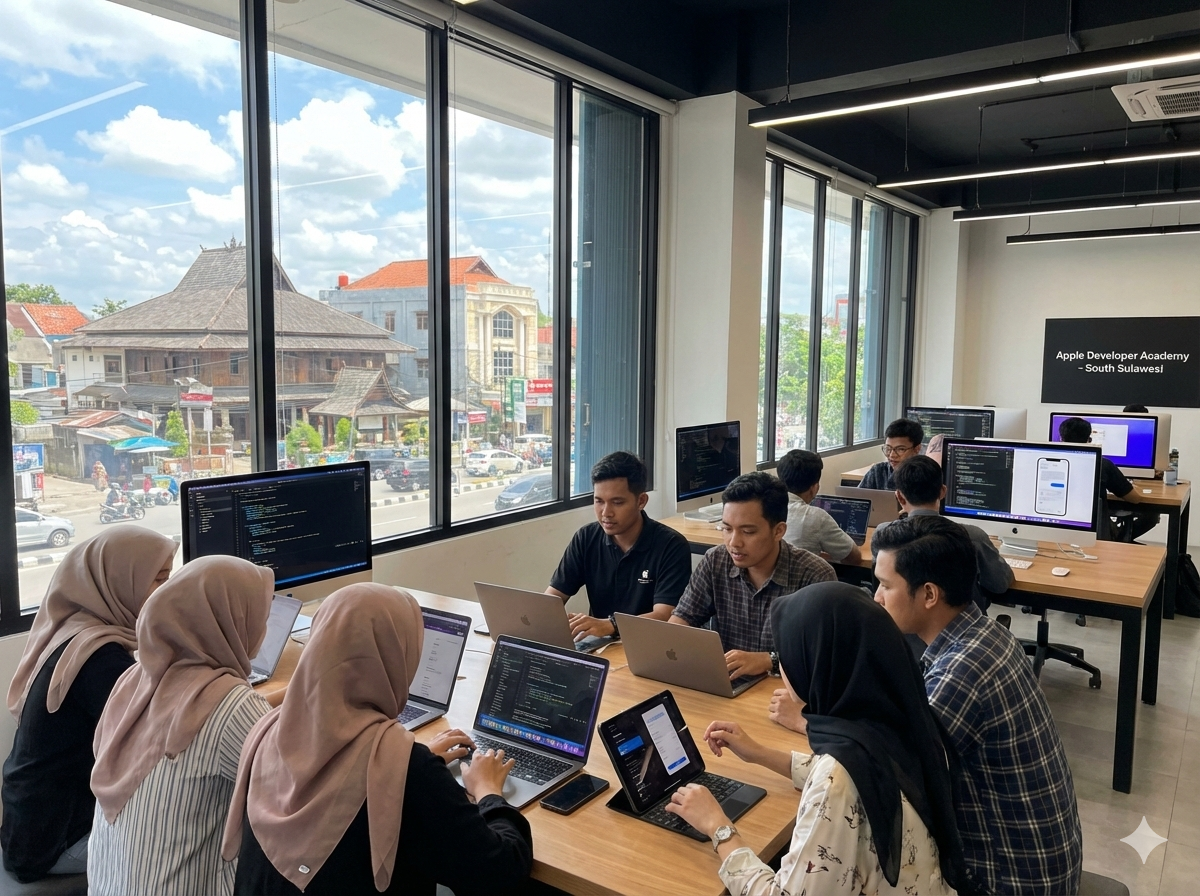
Today, global technological inequality is structural, the countries of the global south face the classic dilemma of digital development. The state lacks the capacity to provide globally standard technology education quickly and equitably, while the need to accelerate technological transformation continues to be urgent. In this situation, the Apple Developer Academy is not a single solution, but a strategic alternative to close some of the digital capability gap that has so far failed to be bridged by state policies alone. A report confirms that the challenges of developing countries have increased with the lack of intermediate and advanced digital skills, needed to enter the global digital economy value chain, no longer limited to internet access. Developing countries are facing a deficit of millions of digital talents, while formal education systems are not able to respond quickly and adaptively to the needs of the industry.
In Indonesia, especially South Sulawesi, which is part of the global south, this challenge is increasingly complex because it is located outside the island of Java. The inequality in the quality of digital human resources between regions has a direct effect on the gap in productivity and income. Therefore, intervention is needed to strengthen human capacity in digital transformation, to narrow internal inequalities. Apple Developer Academy comes as a non-state alternative that is relatively fast, flexible, and oriented to the needs of the global market. Programs like this have the potential to fill the space that the state is not fully able to fill, such as technology-intensive, practice-based, and connected to the global ecosystem.
The global south is often stuck in a short-term skill transfer model that does not build independence. The Apple Developer Academy program should be geared towards capacity building, such as the ability to solve local problems with global technology, understanding the digital ecosystem, and adaptability across platforms so that it is long-term. The applications and innovations produced must not stop at the abstract global market, but must depart from the structural problems of the global south, such as access to public services, health, education, MSMEs, and environmental sustainability. It should be emphasized that, if you want to achieve sustainability, the Apple Developer Academy program must be incorporated with public policy, so that there is connectivity to the development agenda, the creative economy/MSMEs, and the SDGs targets. This is also related to implementations that ideally involve multiactors, ranging from Apple, the government, educational institutions, especially universities, and local communities.
Opportunities for South Sulawesi
South Sulawesi's digital transformation opportunities are getting stronger because there is a clear public policy commitment as a foundation. The provincial government has active coordination in strengthening data governance and digital transformation through Satu Data Indonesia as the foundation for the integration of government data systems. There is also a coordination forum between 24 districts/cities and central institutions which marks the start of data-based development planning, and digitalization is no longer just jargon. This step is important because effective digital transformation requires standardized, integrated, and cross-sectoral data, a principle that has been a weak point for many regions in the global south.
South Sulawesi's digital transformation is also seen through the shift from the Electronic-Based Government System (SPBE) to form a more mature digital government. The maturity index of SPBE has increased significantly in recent years, this is a sign that regional bureaucracies are increasingly able to utilize technology for public services, transparency, and efficiency. In addition, the establishment of Cyber Incident Response Teams (TTIS) in almost all districts/cities is an indicator that digital security is now seen as an important part of the transformation strategy, not just a complement.
There was also a strategic discussion between the provincial government and the National Research and Innovation Agency (BRIN) showing structural efforts in strengthening digital policies and technology-based government systems. Collaborations like this help regions formulate evidence-based strategies such as human resource readiness, digital infrastructure, and appropriate budget allocation. This is an opportunity, where, digital transformation is hampered by institutional unpreparedness and a lack of technical understanding at the implementation level. Collaboration with national research institutions can reduce this gap.
Opportunities are also present in the local economy, especially MSMEs. Research across provinces (including South Sulawesi) shows that digital transformation has a significant impact on the revenue, market reach, and operational efficiency of MSMEs. On the other hand, regions with weak digital adoption, lagging behind in their contribution to regional economic growth, this data shows that investments in digital literacy, online marketing technology, and digital infrastructure significantly increase the competitiveness of MSMEs, as well as open up untapped economic inclusion opportunities.
In addition to local policies, infrastructure, and economy, South Sulawesi's biggest opportunity is human resources. Digital transformation will not happen without mass improvement of people's digital skills, especially the younger generation and MSME actors. Programs such as digital training collaborations and digital literacy strengthening (including various government and community initiatives) point in the right direction. This opens up space for greater collaboration between governments, the private sector, and educational institutions to leverage programs like the Apple Developer Academy as a catalyst for local digital competence.
Challenge
A report shows that developing countries are facing serious gaps in high-quality internet connection infrastructure. Globally, only 25% of the population in low-income countries has fast and stable internet access, a stark gap between high-income countries that reach 80%. Indonesia, despite experiencing an increase in national internet penetration, still shows a sharp regional inequality between the western and eastern regions. Data from the Central Statistics Agency (BPS) shows that the percentage of households with internet access in Sulawesi is still below the average of Java and Bali, especially in non-urban areas. In many districts in South Sulawesi, internet access still depends on mobile networks with fluctuating quality.
In addition to physical infrastructure, the affordability of internet and digital devices is also a serious challenge. In many developing countries, the cost of data plans still exceeds the international affordability threshold of 2% of monthly revenue, which is recommended as the safe limit of inclusive digital access. In Indonesia, although data prices are relatively cheaper than some other global south countries, the cost of hardware (laptops, tablets, high-capacity mobile phones) remains relatively high and is a barrier for low-income households. This has a direct impact on who can take advanced tech training and who is left behind reinforcing social inequality in the digital economy.
The challenges of infrastructure and access must be understood not limited to technical problems, this is already a matter of justice. Without serious policy intervention, digital transformation risks widening social inequality, digital talent only grows in certain pockets, and the global south remains in a peripheral position in the global digital economy. Therefore, the success of programs such as the Apple Developer Academy in South Sulawesi cannot be separated from the state's responsibility to expand quality broadband infrastructure, ensure affordability of access costs, and integrate digital development with the equitable distribution agenda of regional development.
Closing
The digital inequality experienced by global southern countries, including Indonesia and South Sulawesi, is basically a tangible form of an unequal global structure in the distribution of knowledge, capital, and access to innovation, it is broader than just the problem of technological delay. In this context, the Apple Developer Academy cannot be understood as a technocratic solution alone, but as a strategic intervention space that has the potential to shift the position of the global south from an object of technology consumption to a subject of digital innovation creators.
However, this transformation will only be meaningful if the existence of this academy is placed in the realm of digital justice, so that conscious efforts are made to ensure that technological mastery is not centered on urban-elitist groups, but is able to expand social, economic, and political opportunities for people who have been marginalized by infrastructure and access inequality. Digital justice demands more than just an increase in the number of digital talents, it requires the active involvement of the state in equitable distribution of infrastructure, the courage of local governments to integrate digital training with local development agendas, and the responsibility of global corporations not to reproduce the old patterns of technological dependence.
The opportunities for digital transformation in South Sulawesi do not lie in the region's target time to pursue the global north standards, but in the extent to which technology is used to build local capacity, narrow the gap, and strengthen the position of the global south as a sovereign actor in the global digital ecosystem. If managed critically and inclusively, the Apple Developer Academy can be one of the important bridges from inequality to digital justice not as an end goal, but as part of the long process of technological emancipation of the global south.

Matthew Anggi Halomoan Napitupulu is an International Relations student at Universitas Kristen Indonesia
Aniello Iannone examines Malaysia's repatriation of Myanmar nationals, revealing how...
In this article, Dr. Angana Guha Roy argues that water...
In "Structural Aseanisation," Aniello Ianone explores Europe's strategic shift in...
In this article, Aniello Iannone critically evaluates the ten-year trajectory...
The global order is moving beyond rigid bloc politics toward...
In this article, Luo Chen Jun highlights a striking historical...
In this article, Muhamad Ferdy Firmansyah highlights how climate technology...
In his latest article, Aniello Iannone examines the gap between...
This article analyzes Indonesia's ambitious military modernization through its strategic...
DeepRare is being hailed as a major breakthrough in the...
This article analyzes President Prabowo’s decision to skip the June...
This article analyzes the phenomenon of "sibling rivalry" at the...
This article evaluates the normative frameworks offered by China’s four...
This article examines the 2025 Thailand–Cambodia border conflict to evaluate...
This article examines the May 2026 ASEAN Summit in Cebu...
This article examines the May 2026 Beijing summit between Xi...
This article examines how the rise of narcissistic foreign policy—exemplified...
In October 2025, Indonesia's President Prabowo Subianto announced that Portuguese...
This article argues that recent U.S.–Israel military actions against Iran...
This article examines Türkiye’s evolving "Third Way" in Africa, an...
This article critically examines Indonesia’s evolving role from a quiet...
This article provides a firsthand account of how Pakistan emerged...
This article examines how disruptions in the Strait of Hormuz...
This article examines Indonesia’s participation in the Board of Peace...


















Leave A Comment