
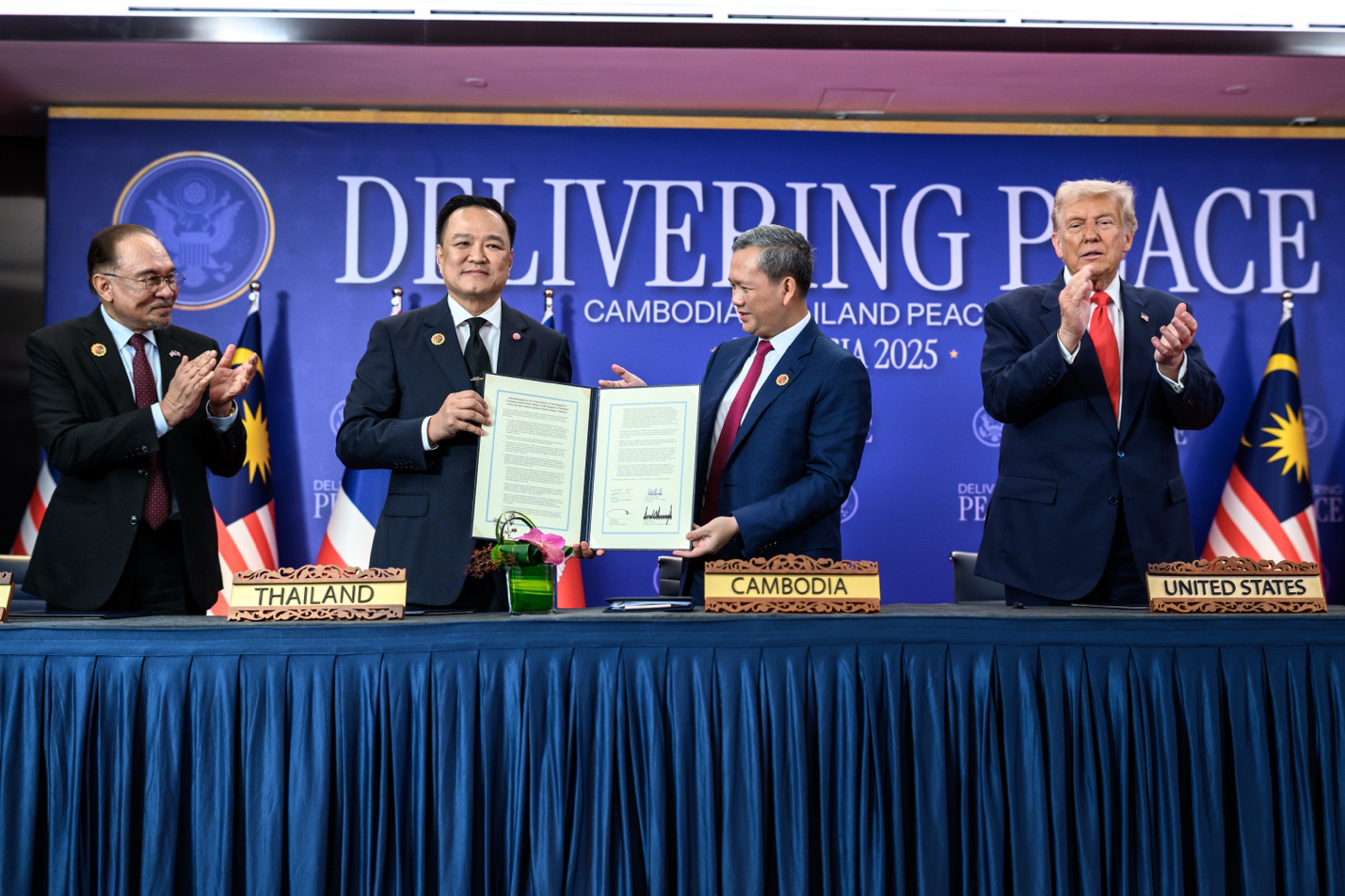
Image Credit: President Donald Trump, Malaysian Prime Minister Seri Anwar Ibrahim, Cambodian Prime Minister Hun Manet, and Thailand’s Prime Minister Anutin Charnvirakul sign the Kuala Lumpur Accord. Photo by Daniel Torok / The White House via Wikimedia Commons
The 2025 Thailand–Cambodia border conflict tested the ASEAN Way as a regional approach to conflict management. ASEAN succeeded in reducing tensions through dialogue and consensus-building, preventing the conflict from escalating into a wider regional crisis. However, the return of armed clashes only a few months after the first ceasefire also exposed the limitations of ASEAN’s non-coercive approach. The conflict highlighted the deeper pattern: ASEAN remains effective in facilitating short-term de-escalation, but it still struggles to ensure long-term compliance when disputes between member states remain unresolved.
Historical roots of the conflict
The conflict was rooted in a long-standing territorial dispute dating back to the French colonial period and the 1962 International Court of Justice ruling on the Preah Vihear Temple. Although the ruling recognized the temple as Cambodian territory, several surrounding border areas remained disputed. Over time, tensions over sovereignty and historical symbolism continued to shape relations between Thailand and Cambodia. The border issue remained politically sensitive for both governments and closely tied to nationalist sentiment in each country.
These tensions escalated throughout 2025. Armed confrontations took place along border areas in the Thai provinces of Surin, Si Sa Ket, and Ubon Ratchathani, as well as Cambodia’s Preah Vihear and Oddar Meanchey provinces. The first major escalation occurred in May 2025 after a clash between Thai and Cambodian troops near the border. Tensions intensified again in July when a Thai soldier was reportedly injured by a landmine during a patrol operation. Both governments accused each other of provoking the violence, while troop deployments increased across disputed areas.
Escalation and humanitarian impact
Thailand later launched artillery attacks and air operations against Cambodian military positions. ASEAN responded diplomatically through mediation led by Malaysian Prime Minister Anwar Ibrahim as ASEAN Chair. Negotiations held in Putrajaya resulted in a ceasefire agreement in July 2025, to stop the fighting. ASEAN observers were also involved in monitoring ceasefire implementation and keeping channels open.
Although the ceasefire reduced violence, several commitments were never fully implemented. Mine clearance, troop reductions progressed slowly, leaving distrust in place between the Thai and Cambodian militaries. These post-ceasefire frictions contributed to renewed violence later in the year.
A brief skirmish between Thai and Cambodian forces occurred on 7 December 2025, but the major escalation began on 8 December when Thailand launched F-16 airstrikes and expanded ground operations after accusing Cambodian forces of violating the ceasefire. The fighting quickly spread across several border sectors and created a major humanitarian crisis. According to Reuters, Thailand reported that around 26 soldiers and one civilian were killed during the December clashes, while Cambodian authorities stated that at least 30 civilians died because of Thai military operations. Reuters and Al Jazeera also reported that the renewed violence displaced over 500,000 people in Cambodia and roughly 400,000 in Thailand.
ASEAN once again convened its foreign ministers to reduce tensions. A second ceasefire agreement was reached in late December 2025 under growing regional and international pressure. Throughout the crisis, ASEAN pushed for restraint, dialogue instead of sanctions or coercive measures. This reflected the organization’s preference for consensus-based diplomacy rather than punitive enforcement.
The conflict showed that the ASEAN Way still matters. Rather than acting like a military alliance, ASEAN positioned itself as a facilitator that encouraged communication between the two sides. This approach reflected ASEAN’s traditional diplomatic principles: non-interference, consensus-based decision-making, informal diplomacy.
The strengths of the ASEAN Way
The principle of non-interference was clearest during the mediation process. ASEAN avoided publicly blaming either Thailand or Cambodia for starting the conflict. Instead, the organization focused on encouraging both sides to stop fighting and return to negotiations. ASEAN statements emphasized restraint and peaceful settlement. This approach helped preserve political trust between ASEAN and its member states.
Consensus-building also played a major role in ASEAN’s response. ASEAN member states supported diplomatic engagement while trying to preserve regional unity. Thailand and Cambodia agreed to ceasefires through negotiation. This helped ASEAN maintain credibility in the eyes of both governments. The organization therefore succeeded in creating political space for dialogue without forcing either side into public humiliation.
Informal diplomacy was key during the crisis. Malaysia, acting as ASEAN Chair, facilitated communication through behind-the-scenes discussions and face-saving negotiations. This style of diplomacy has long been associated with Southeast Asian regional politics. Quiet diplomacy allowed both governments to continue negotiations while reducing domestic political pressure.
The limits of non-coercive regionalism
The return of violence in December 2025 revealed the limits of ASEAN’s non-coercive framework. While ASEAN was effective in reducing immediate escalation, it lacked enforcement mechanisms to ensure long-term compliance with ceasefire agreements. Continued troop mobilization, incomplete military withdrawal showed how fragile voluntary cooperation can become during prolonged interstate conflict.
The Thailand–Cambodia conflict reflects a broader challenge within ASEAN regionalism. The ASEAN Way still works in managing short-term crises and preventing conflicts from escalating further. However, the same principles that make ASEAN politically acceptable to its member states, especially non-interference and consensus, also limit its ability to enforce conflict resolution. ASEAN can facilitate dialogue and reduce tensions, but it is constrained when underlying political and territorial disputes remain unresolved.
The 2025 Thailand–Cambodia conflict showed that ASEAN still has diplomatic value in Southeast Asia. However, it also highlighted the growing pressure on ASEAN to strengthen its role in regional security governance. As tensions in Southeast Asia become more complex, ASEAN will need to complement its traditional diplomatic approach with stronger mechanisms for monitoring, compliance. The Thailand–Cambodia conflict showed that while the ASEAN Way remains relevant, its future effectiveness will depend on whether ASEAN can adapt its diplomatic model to address more difficult regional security challenges.

Izzul Fatchu Reza is an academic and researcher at Polytechnic STIA LAN Jakarta and currently a PhD student in Politics at Universitas Islam Internasional Indonesia (UIII). His research focuses on coastal adaptation policy, particularly in relation to sea-level rise in northern coastal Java, Indonesia. His broader academic interests include public policy, environmental governance, and international security
In "Structural Aseanisation," Aniello Ianone explores Europe's strategic shift in...
In this article, Aniello Iannone critically evaluates the ten-year trajectory...
The global order is moving beyond rigid bloc politics toward...
In this article, Luo Chen Jun highlights a striking historical...
In this article, Muhamad Ferdy Firmansyah highlights how climate technology...
In his latest article, Aniello Iannone examines the gap between...
This article analyzes Indonesia's ambitious military modernization through its strategic...
DeepRare is being hailed as a major breakthrough in the...
This article analyzes President Prabowo’s decision to skip the June...
This article analyzes the phenomenon of "sibling rivalry" at the...
This article evaluates the normative frameworks offered by China’s four...
This article examines the 2025 Thailand–Cambodia border conflict to evaluate...
This article examines the May 2026 ASEAN Summit in Cebu...
This article examines the May 2026 Beijing summit between Xi...
This article examines how the rise of narcissistic foreign policy—exemplified...
In October 2025, Indonesia's President Prabowo Subianto announced that Portuguese...
This article argues that recent U.S.–Israel military actions against Iran...
This article examines Türkiye’s evolving "Third Way" in Africa, an...
This article critically examines Indonesia’s evolving role from a quiet...
This article provides a firsthand account of how Pakistan emerged...
This article examines how disruptions in the Strait of Hormuz...
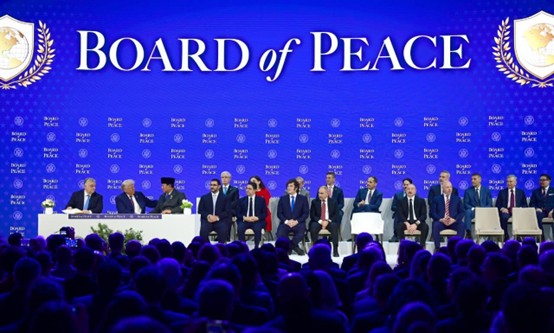
This article examines Indonesia’s participation in the Board of Peace...
This article examines what the attempted sale of CK Hutchison's...
This article examines the Kudankulam Nuclear Power Plant as a...





Leave A Comment