
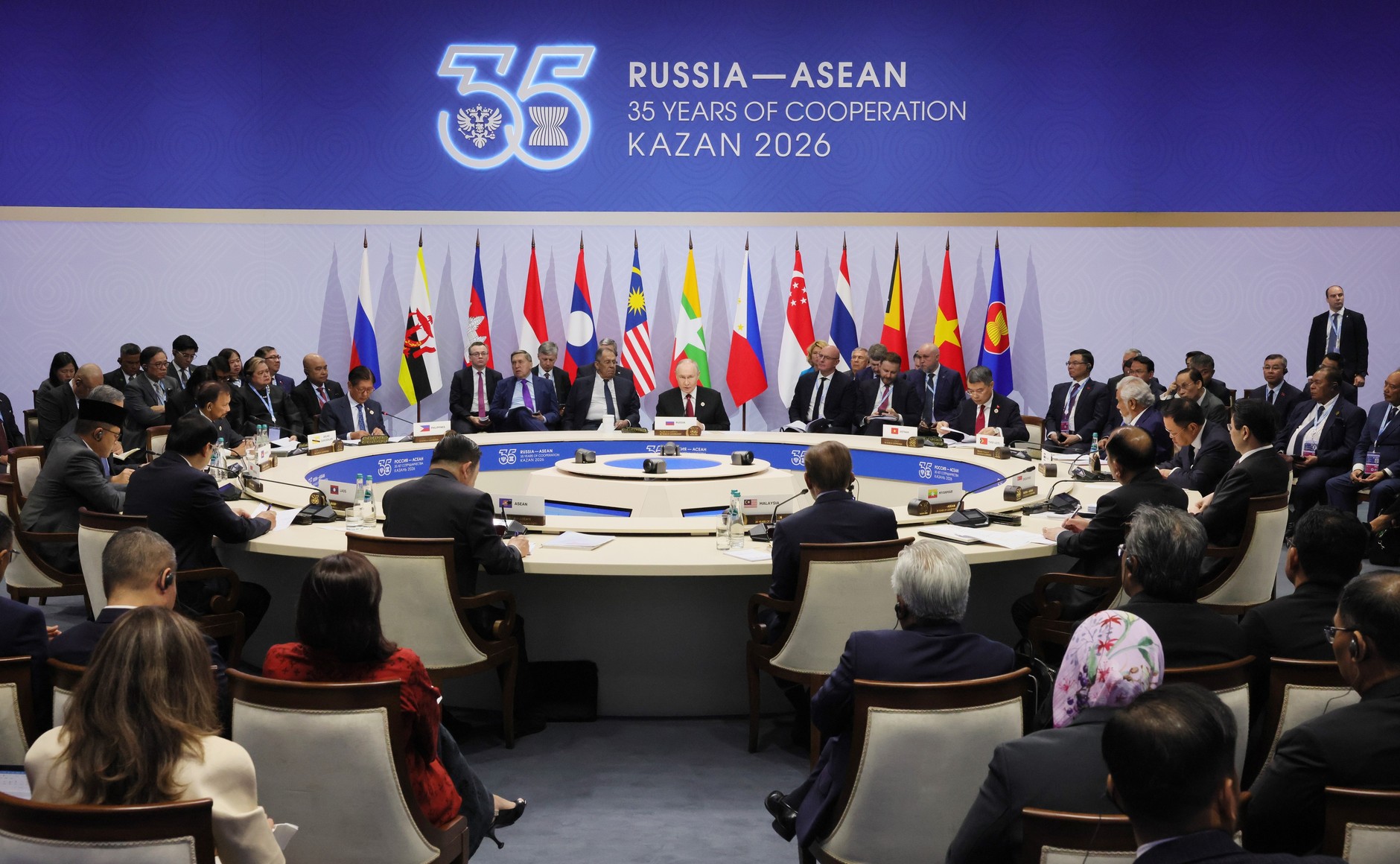
Delegations from ASEAN and Russia attend the ASEAN–Russia Commemorative Summit in Kazan, Russia, June 2025.
Photo source: Russian Presidential Executive Office / Kremlin.ru
When Mohammad Hatta set out the principles of Indonesian foreign policy in 1948, he reached for an image that belonged to the archipelago itself. Indonesia, he argued, should row between two reefs, mendayung antara dua karang, refusing to let either the American or the Soviet bloc dictate its course. The formula later hardened into bebas aktif: Indonesia would decide where it stood, and it would remain an active participant in world affairs while doing so. Behind the metaphor sat a larger claim about sovereignty. Cooperation, in Hatta‘‘
President Prabowo Subianto‘‘
The official explanation, that Prabowo preferred to concentrate on domestic affairs, was brief to the point of opacity. The temptation is to read the empty chair through the familiar grammar of hedging: engage without committing, cooperate while preserving the option to reverse course, send the minister so that the president‘‘‘
Indonesia‘
On 12 June, around 1,500 students demonstrated in Jakarta against higher fuel prices, the rising cost of living and spending they considered wasteful, marching under the warning that Indonesia was heading towards bankruptcy. The immediate trigger was concrete: the government had let the price of Pertamax, the non-subsidized fuel favored by the urban middle class, rise by more than 30 per cent. The rupiah had meanwhile breached 18,000 to the dollar, its weakest level on record, after trading closer to 16,000 earlier in the year, while the Jakarta stock market had shed roughly a third of its value since January. Similar protests followed in other cities, and their targets widened to include the expanding role of the military in civilian institutions. Prabowo‘
The energy crisis sharpened the dilemma because it forced choices. Money spent cushioning fuel prices could not be spent elsewhere. Cutting subsidies risked the streets; protecting the meals program invited the charge that the administration was defending the president‘‘‘‘‘
The interesting question, then, is not whether Indonesia is drifting toward Russia in some broad diplomatic sense. It is what kinds of dependence Jakarta is prepared to accept in order to secure energy, protect the budget and preserve political authority. Officials like to present bebas aktif as a doctrine that has survived the Cold War, the New Order, democratization and the US-China rivalry with its meaning intact. But non-alignment has never been exercised in conditions of freedom. During the Cold War, superpower competition imposed risks while also creating bargaining space: aid, recognition and support could be sought from more than one direction, and the rivalry itself gave non-aligned governments leverage. The decades that followed offered a different kind of room, in which Indonesia could deepen economic ties with China, keep defense relations with the United States, work with Japan and Europe, and maintain channels to Moscow without every transaction carrying the weight of a permanent geopolitical choice. That room is closing. Sanctions, export controls, financial restrictions and technology bans now reach into decisions that were once ordinary commerce. Supply chains have become instruments of security policy, and payment systems and technical standards carry geopolitical consequences that stay invisible until a crisis exposes them. The Russian oil deal illustrates the point more sharply than any theoretical statement could. Months after it was announced, the arrangement was still snagged on regulatory and logistical constraints: a shortage of tankers willing to move sanctioned crude, long and costly shipping routes, and Pertamina‘
Nuclear infrastructure operates on an entirely different timescale. The conversations in Kazan have not yet produced a binding technological relationship, but if they move into contracts and construction, they will tie Indonesia to maintenance systems, training pipelines, fuel arrangements, regulatory standards and specialist expertise for decades. Dependence of this kind requires no formal political control. It sits inside the infrastructure itself: in who holds the knowledge, who performs the repairs, who writes the software and who supplies the fuel. This is where the distinction that matters comes into focus. Crude oil and nuclear technology bind a peripheral economy to external powers on different time horizons, and infrastructural dependence is the stickier of the two, because it embeds foreign expertise, standards and maintenance regimes into the productive base of the country itself. The point extends well beyond Russia. Chinese technology, Japanese finance, American security systems or South Korean nuclear expertise would each generate their own asymmetries, because no major infrastructure agreement is politically neutral. A country can multiply its suppliers and still lose room for action. Decisions taken under crisis conditions have a way of hardening into arrangements that later become prohibitively expensive to alter, and that is the quiet mechanism by which emergency management turns into durable structure.
For these reasons I would resist celebrating the empty chair in Kazan as evidence of strategic finesse. What it revealed is less flattering and considerably more important. Indonesian foreign policy is now conducted under conditions in which external shocks reach domestic politics faster than ever, while the very instruments used to manage those shocks generate new forms of dependence.
Indonesia retains real agency. Its market is large, its diplomatic standing is intact, and it can engage several partners while refusing formal alignment. But autonomy cannot be measured by counting the capitals with which Jakarta maintains relations. It depends on whether the state can absorb shocks, finance its own choices, regulate the foreign technology operating on its territory, and prevent emergency measures from congealing into permanent constraint. ASEAN provides diplomatic cover for this balancing act, offering member states a regional umbrella under which to engage competing powers. It has done far less to reduce the material vulnerabilities that make such engagement costly in the first place, which is a familiar pattern in the organization’s history: procedural centrality without structural capacity. The Kazan summit fit the pattern precisely, producing a declaration, a plan of action and a joint statement on energy cooperation, while the hard constraints, the refineries and tankers and bond covenants, sat untouched on the national ledger of every member state. Hatta’s metaphor still captures Indonesia’s determination to avoid subordination. It says nothing about who builds the boat, who insures the voyage, where the fuel comes from, or what happens when the engine cannot be repaired without foreign assistance. Indonesia can still choose its direction. It has progressively less control over the conditions of the journey. And it is in that gap, between the freedom to choose and the capacity to sustain the choice, that the future of bebas aktif, and of non-alignment across the Global South, will be decided.

Aniello Iannone is a Lecturer in International Political Economy at President University, Indonesia. He holds a PhD in International Relations and International Political Economy from Universitas Airlangga. His research examines Southeast Asian political economy, Indonesian domestic politics and foreign policy, ASEAN regionalism, and Taiwan-Indonesia relations. A central focus is transnational labour exploitation, migrant worker governance, and platform labour dynamics. He has developed the concept of "lordly capitalism" to analyse Indonesia's oligarchic political economy, where modernization coexists with personalized domination and quasi-feudal labour relations, and has written on ASEAN's "paralyzed regionalism" for the Lowy Institute. His work combines critical approaches to international political economy with empirically grounded analysis of how structures of power reshape institutions, labour regimes, and regional orders.
In "Structural Aseanisation," Aniello Ianone explores Europe's strategic shift in...
In this article, Aniello Iannone critically evaluates the ten-year trajectory...
The global order is moving beyond rigid bloc politics toward...
In this article, Luo Chen Jun highlights a striking historical...
In this article, Muhamad Ferdy Firmansyah highlights how climate technology...
In his latest article, Aniello Iannone examines the gap between...
This article analyzes Indonesia's ambitious military modernization through its strategic...
DeepRare is being hailed as a major breakthrough in the...
This article analyzes President Prabowo’s decision to skip the June...
This article analyzes the phenomenon of "sibling rivalry" at the...
This article evaluates the normative frameworks offered by China’s four...
This article examines the 2025 Thailand–Cambodia border conflict to evaluate...
This article examines the May 2026 ASEAN Summit in Cebu...
This article examines the May 2026 Beijing summit between Xi...
This article examines how the rise of narcissistic foreign policy—exemplified...
In October 2025, Indonesia's President Prabowo Subianto announced that Portuguese...
This article argues that recent U.S.–Israel military actions against Iran...
This article examines Türkiye’s evolving "Third Way" in Africa, an...
This article critically examines Indonesia’s evolving role from a quiet...
This article provides a firsthand account of how Pakistan emerged...
This article examines how disruptions in the Strait of Hormuz...
This article examines Indonesia’s participation in the Board of Peace...
This article examines what the attempted sale of CK Hutchison's...
This article examines the Kudankulam Nuclear Power Plant as a...


Leave A Comment