
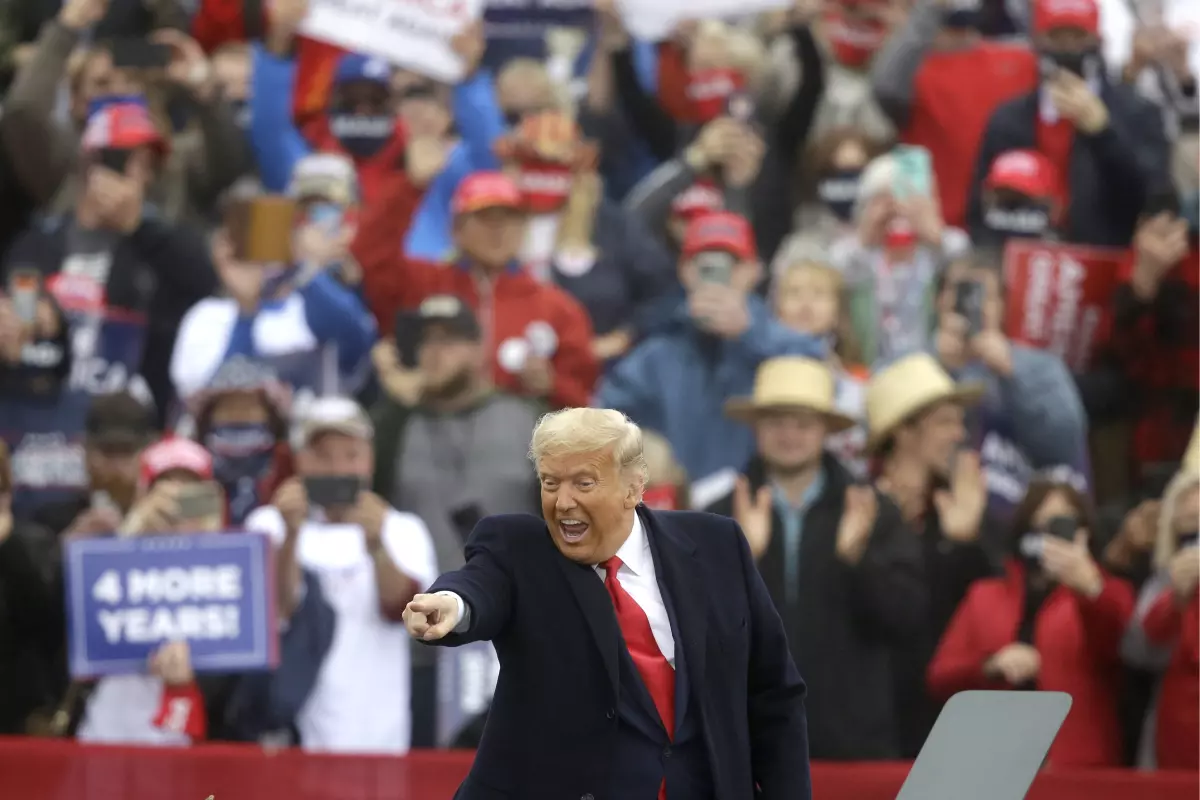
Caption: President Trump exits the stage after a campaign rally.
Photo Credit: Jacqueline Larma / Associated Press.
Sometimes, an archrival of the state is not a foreign party perceived as a threat, but arrogance that positions itself as if it were invincible. Indeed, the trait does not appear out of nowhere. It is shaped over a long time with one stark attribute: the conceit. Such a dominant stance is gradually internalized and manifests as a state disposition in which the relative might of the state is judged as the only foundation of the structure in international politics. The state, in such circumstances, is often arrogant, overconfident, and puts itself above all else. They are unaware that state relationships should be managed in a prudent way. With those behaviors, however, they can precisely damage state interactions.
One’s state reputation is more likely to crumble since the policies implemented reflect personal ego rather than rationality and consensus-based policy. International laws are invariably violated. The omnipotence is attached as a custom. Partners and allies prefer to part ways over time because they are inclined to be bullied. They are frequently humiliated, and more often than not, their voices are barely heard. Friends in the minds of the narcissistic dominant powers are merely objects of exploitation and a gratifier of their ambition. Subordination is the code of conduct for friendship they only offer.
In international relations, as in real life, the state has similar features to humans. The state exists and shares a human’s personality. As long as the state is steered by humans, the policies the state implements must reflect the psychology of its leaders. The more erratic the mentality of the state leaders, the more irrational the state policies they craft. In a definition, an irrational policy is built on a decision that is far from a feasible calculation. It advances the exhibition rather than the essence. It prioritizes sensation compared to substance. The leader assumed that coverage was more important than the accomplishment and outcomes. Provocative rhetoric was therefore regularly stated to keep the spotlight. The political stage and dominance are two elements that they persistently pursue. State policies are decided as bombastically as possible. The rationality is marginalized while visibility is prioritized. In a nutshell, a leader’s personality plays more or less a significant role in deciding whether a government's policies are viable or not.
Avoiding Narcissistic Policies
This is what befalls the US in the current situation. Trump’s big victory with its jargon “Make America Great Again” is actually pushing the country into regression. Since occupying the White House, Trump has conducted various irrational foreign policies. Stretching from renaming the Gulf of Mexico into the Gulf of the US to the plan of annexing Greenland that has elicited the rupture among US allies. Not to mention the reckless current invasion over Iran in which Trump has committed without thorough calculations and no moral compass in guiding such action. The majority of Trump’s policies can be said to prioritize visibility over the substance he intends to accomplish. Trump is motivated to get constant attention, be admired as a hero, and obtain as much headline coverage as possible. Those motives serve to fulfill his craving upon recognition and validity.
The rejection of his demand is likely equated with the neglect of the great identity of the state. Familiar with the experience told by Thucydides in the tale of the Peloponnesian War, Trump, with his attitude, explicitly suggests that it is normal norm if the US emphasizes its will to the last breath. Refusal to the US demand constitutes humiliation to its great destiny. Trump is merely a small example of the narcissistic leader emerging concurrently with the prevalence of populist leaders. Indeed, such a leader is a hunter of attention. The show and coverage are the ultimate aim of their policies. Thus, due to having no clear aim, such a policy is expected to invite pros and cons, with the worst consequence being impeachment. Trump is not immune to the issue, where the US Congress has desperately consolidated to topple him.
The Anatomy of Narcissistic Foreign Policies
Categorizing Trump's foreign policies as narcissistic ones is not a rumor. It is based on scientific research, referring to a study revealed by Stoffel and Y. Herzberg in 2025. Both conclude Trump’s foreign policy is an anomaly. Even though, as a political entity, they said, the state differs to humans, the identification of the narcissistic policies possessed by the state could be detected with seven behavioral patterns attributed to patients who suffer from NPD (Narcissistic Personality Disorder).
Seven patterns of narcissistic foreign policies, according to their results are featuring more superiority and coercion in the show; seeking public attention and spotlight as much as possible; conducting vindictive action by lowering others both verbally or physically when their dignity is perceived to be harassed; exploiting the partners for its own interest; inflicting the fault on others (anti-self-introspection); desiring to control the rule of the road and sphere of influence thus the laws is frequently breached and multilateral forum is marginalized; risking whatever policy without well-developed calculations.
Those patterns, based on Stoffel and Y. Herzberg's findings, are identifiable in the form of the current US-EU relationship. Such actions are reflected in the exclusivity of the conflict’s handling of the Russia-Ukraine war, tariff wars, and the Greenland issue. In these three consecutive cases, all show some narcissistic elements such as demonstrating dominance and control, favoring visibility to gain validity, and confirming his identity as superior. No substance attached to the actions; all were the lunacy to maintain the spotlight.
Identical leaders to Trump are now prevalent in the era of populism. The populist leaders do put visibility behind the priority. A policy crafted is nothing more than a short appearance to boast its great identity. While the essence, value, and rational consideration are set aside amidst the process. Therefore, narcissistic leaders would desperately avoid the weakness and failure shown in the public arena because visibility matters. Even if they fail, the failure of the policy will be imposed on others. They never recognize the error in the system they build. The only method they will exploit is to frame ‘others’ as the scapegoats.
The Critics of Our Domestic Policies
To be sure, we are witnessing the kind of narcissistic patterns in our government policies. Joining a member of the Board of Peace (BOP) is a setback, damaging our tradition of maintaining a free, active foreign policy. No urgency is needed with any rational consideration to justify sitting together with Israel on the board, hiding under the pretext and on behalf of the peaceful Gaza. This is an artificial excuse other than to obtain the spotlight on the international stage. Not to mention the Free Nutritious Meals (MBG) program, which was launched in a rush, without gradual and cautious measures. This indicated carelessness and simply seeking hype for politics. The problem is, many inputs for the program are just strewn on the table of the government office. MBG really matters, but it is not more critical than the structural and fundamental issues that touch the taproot of our educational problem, such as dehumanizing teacher salaries and the unsuitability of school buildings.
Furthermore, narcissistic policy is also reflected in the recurring statement by the president, called ‘aseng’. ‘Aseng’ is always charged as if to be the perpetrator who must be responsible for the political unrest and the policy error caused by the government. Rather than committing self-introspection, assigning blame to others is considered common as a consequence of a sense of infallibility. This is the set of signs that the narcissistic policy resides among us. If the government is unaware that such an act is urgent to be corrected, it is likely that public discontent will compound from time to time. The turbulence toward that direction is now more and more felt. Voices of resistance are now increasingly heard, even though in a vague way.
The government, therefore, must recognize its faults and rectify its narcissistic policies for the sake of the people. The people need the essence of the mature policy that fits with their aspirations, not the narcissistic ones launched with excessive hype. Amidst global uncertainty, people only need the safety guarantee that the state is capable of bringing them to escape from economic difficulty. Endless global conflict was fairly making us worry, but something that made us terrified was the way in which the state managed the uncertainty through rash policy. The hype policy must be stopped. It is time for the state to correct itself. The Trump model is not to follow but rather useful for self-reminding.
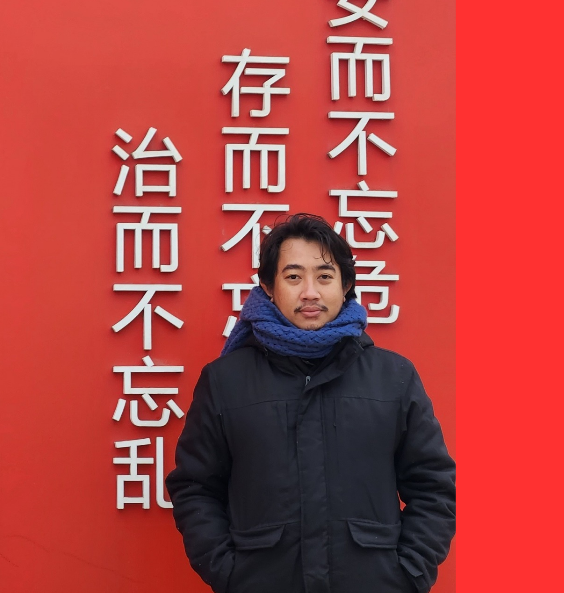
Ahmad Nurcholis, a lecturer in the Faculty of Social and Political Sciences at Sriwijaya University, Indonesia. He earned a Master's degree in International Relations from Shandong University, China, and a Bachelor's degree in Political Science from Syarif Hidayatullah University, Jakarta.
In this article, Aniello Iannone critically evaluates the ten-year trajectory...
The global order is moving beyond rigid bloc politics toward...
In this article, Luo Chen Jun highlights a striking historical...
In this article, Muhamad Ferdy Firmansyah highlights how climate technology...
In his latest article, Aniello Iannone examines the gap between...
This article analyzes Indonesia's ambitious military modernization through its strategic...
DeepRare is being hailed as a major breakthrough in the...
This article analyzes President Prabowo’s decision to skip the June...
This article analyzes the phenomenon of "sibling rivalry" at the...
This article evaluates the normative frameworks offered by China’s four...
This article examines the 2025 Thailand–Cambodia border conflict to evaluate...
This article examines the May 2026 ASEAN Summit in Cebu...
This article examines the May 2026 Beijing summit between Xi...
This article examines how the rise of narcissistic foreign policy—exemplified...
In October 2025, Indonesia's President Prabowo Subianto announced that Portuguese...
This article argues that recent U.S.–Israel military actions against Iran...
This article examines Türkiye’s evolving "Third Way" in Africa, an...
This article critically examines Indonesia’s evolving role from a quiet...
This article provides a firsthand account of how Pakistan emerged...
This article examines how disruptions in the Strait of Hormuz...
This article examines Indonesia’s participation in the Board of Peace...
This article examines what the attempted sale of CK Hutchison's...
This article examines the Kudankulam Nuclear Power Plant as a...
This article examines Nepal’s strategic position within the Indo-Pacific and...




Leave A Comment