
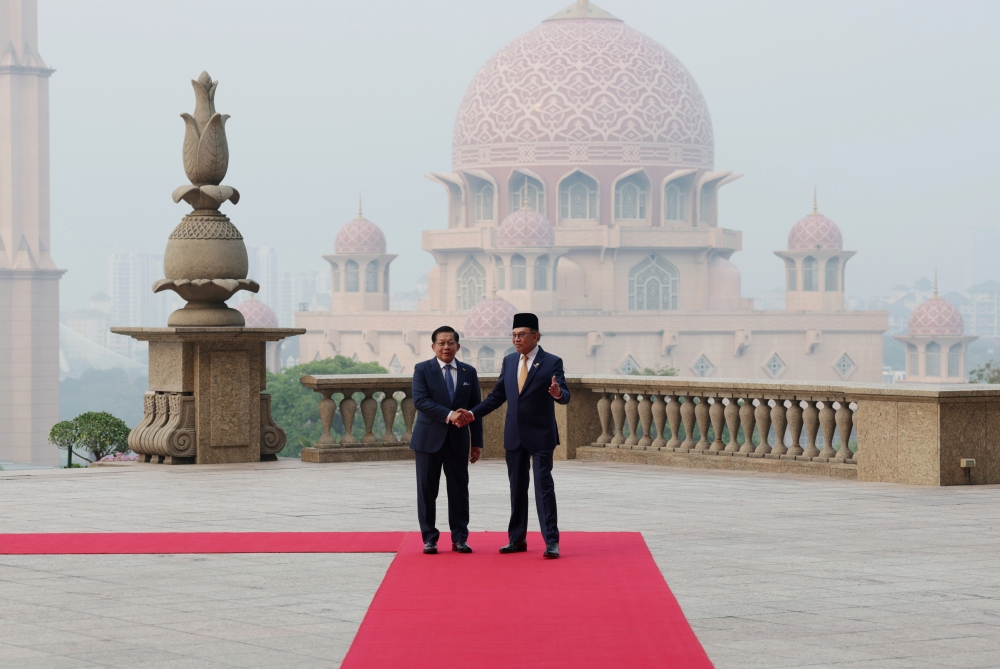
Malaysian Prime Minister Anwar Ibrahim (right) shakes hands with Myanmar’s President Min Aung Hlaing after an official welcoming ceremony at the Perdana Putra Complex in Putrajaya on October 8, 2026, during Hlaing’s two-day visit to Malaysia. Photo: Malay Mail (Bernama)
Malaysia’s repatriation of Myanmar nationals is being debated as a humanitarian question. I read it as two other things as well: a labour policy and a diplomatic trade. Malaysia is a middle-income economy that depends on cheap foreign workers, and it is reorganizing how it uses refugees as part of that workforce. Myanmar’s military-led government wants international recognition, and accepting returnees is one way to earn it. The case also shows something the language of South-South solidarity tends to hide. Relations among countries of the Global South can reproduce the hierarchies, and the tools of border control, that the South has long criticized in its dealings with the North.
On 29 September Malaysia began returning 1,476 Myanmar nationals, the first group of a planned 5,000, aboard two Myanmar navy warships and a hospital ship. Kuala Lumpur calls the operation voluntary, orderly and a matter of security. UNHCR says it has no role in the program and that continuing armed conflict rules out safe and dignified return. More than 160 civil society organizations[GSF1] have warned that returnees face conscription by one armed group or another. Both sides argue about individual consent and conditions at the destination. Two earlier questions stay out of view: how these people came to be available for removal, and what Myanmar’s government gains by taking them back.
A labour reserve the state can drain
Malaysia counted 2.13 million active registered foreign workers in late 2025, concentrated in manufacturing and construction. New quota approvals have been frozen since March 2023, and the government wants foreigners down to 10 percent of the workforce by 2030. The official rationale is upgrading: an economy moving up global value chains should need fewer low-wage workers. Labour-intensive sectors have not adjusted. In July Prime Minister Anwar Ibrahim told agencies to clear restaurant operators’ applications for foreign workers within a month.
Refugee policy sits inside this contradiction. In May, Home Minister Saifuddin Nasution Ismail said the new state-run refugee registration program, the DPP (Dokumen Pendaftaran Pelarian), guarantees no permanent stay. Every case, he said, ends in repatriation, resettlement in a third country or deportation. At the same briefing he described a database to match refugees aged 20 to 40 with vacancies in five sectors, presented as a way to reconcile employers’ demands with the 2030 ceiling. In July the Cabinet directed UNHCR to halt new registrations so that the government could manage refugee data and identity checks without UNHCR records. Malaysia is not party to the 1951 Refugee Convention, the treaty that defines who is a refugee and what states owe them, so no external obligation requires it to grant work or residence. Taking registration away from UNHCR places the power to classify people, and with it the power to allocate their labour, wholly inside the state.
Karl Marx used the term relative surplus population for workers held in reserve: absorbed when employers need them, set aside when they do not. Malaysia’s refugees fit that description closely. They are tolerated on the territory, made available to employers, and their numbers can be expanded or contracted by administrative decision. Their value to employers lies in their legal condition. A worker whose document can be revoked at any moment has little room to change employer, bargain over pay or report abuse, because the realistic alternative is a detention depot or a ship home. Scholars of migration call this condition deportability, the permanent possibility of being removed, and they note that it disciplines far more people than removal itself ever reaches.
Sorting people at the border of citizenship
The registration program and the return program draw on the same population. Of the 10,388 Myanmar nationals held in immigration depots in mid-August, 4,008, mostly Rohingya, were routed into registration and 5,000 into repatriation. Malaysia screened 5,000 names and sent them to Myanmar’s embassy; Naypyidaw accepted 1,476 through a diplomatic note dated 13 August. A government that still rejects the Rohingya identity thus decides, by its own rules of citizenship, who may be sent back. Those it refuses stay in Malaysia, biometrically registered and potentially employable. The line between returnee and worker is drawn jointly by Myanmar’s exclusionary citizenship regime and Malaysia’s demand for labour. Officials say all 1,476 signed documents agreeing to return. That consent has to be read against the options on offer: indefinite detention in Malaysia or return to a country at war since the 2021 coup. The precedent is not reassuring. In February 2021 Malaysia returned 1,086 Myanmar nationals on junta ships despite a court order, and the rights groups challenging the move identified UNHCR-registered people among them. UNHCR had then been barred from the depots since August 2019.
The argument has limits. Nothing public shows how many of the 1,476 had worked in Malaysia or would have qualified for job-matching. My claim rests on the mechanism visible in the public record: one detained population from which the state draws both workers and returnees, with detention as the pressure that moves people toward one track or the other.
Who pays for a life
World-systems analysis, associated with Immanuel Wallerstein, divides the world economy into a core, a periphery and a middle tier called the semi-periphery. Semi-peripheral countries depend on richer economies for capital and technology while drawing cheap labour and resources from poorer ones. Malaysia sits in that middle tier, and Myanmar in the periphery.[GSF2]
Scholars in this tradition have long shown how migrant labour regimes divide the costs of a worker’s life across borders. The receiving economy pays for labour during its productive years. The sending society bears the cost of raising workers before they leave and of absorbing them once they are sick, old, redundant or politically inconvenient. A job-matching window set at ages 20 to 40 states that division with unusual frankness. Repatriation completes it. Malaysia keeps refugee labour available for periods of shortage and returns the remainder, together with the cost of maintaining it, to a peripheral war economy. The relationship runs between two Southern states, yet its structure repeats the core-periphery relation that dependency theorists once described between North and South.
Recognition paid for in people
The returns carry a diplomatic price. Min Aung Hlaing, who led the 2021 coup, was sworn in as president in April after an election from which Aung San Suu Kyi’s party was excluded. In September Anwar said he would invite him for an official visit in return for Myanmar accepting refugees. Malaysia would become the fifth ASEAN member to host him, after Laos, Thailand, Cambodia and Vietnam; outside the region he has already been received in China, India and Russia. Myanmar supplies what Malaysia cannot produce alone, the acceptance of these people as its citizens. In exchange it receives what it cannot give itself, the normal conduct of relations between governments.[GSF3]
Anwar says Naypyidaw accepted two conditions: an end to killing and bombing in Rakhine, and access to medical care for returnees. These are verbal assurances from a party to the war, and no monitoring arrangement outside the two governments can test them. In August Malaysia’s foreign minister himself said UNHCR’s involvement mattered for verifying status and assessing security on return. Two weeks later UNHCR said it had no part in the program.
The bargain will look familiar to anyone who follows migration politics between Europe and Africa. The Italy-Libya memorandum of 2017 and the EU-Tunisia memorandum of 2023 traded money and political standing for control over mobility, entrusting containment to fragile or increasingly authoritarian governments. Southern governments and scholars have rightly criticized these deals as the externalization of Europe’s borders. Malaysia now applies a similar readmission diplomacy to a poorer Southern neighbor, paying in recognition rather than cash. The Global South is a political category with real force, but it does not abolish hierarchy among its members. Domestic politics supplies the remaining pressure. A Change.org petition to remove the Rohingya passed 424,000 signatures in June, a Melaka state election has just been called, and the general election is due by February 2028. Popular hostility toward refugees gives electoral cover to a policy that also serves employers, and the two constituencies never have to be reconciled in public.
Temporariness as a regional regime
Indonesia reaches a similar outcome by the opposite route. It has not ratified the 1951 Convention either, and it manages refugees under a 2016 presidential regulation that, according to Immigration and Corrections Minister Agus Andrianto, makes no provision for asylum seekers to work or study; he called for its revision in November 2024. In December 2023, as villages in Aceh turned away new Rohingya arrivals, President Joko Widodo said assistance would be temporary and would put local communities’ interests first.
Malaysia admits refugees to the labour market on revocable papers. Indonesia keeps the labour market closed and leaves care and processing largely to UNHCR and the International Organization for Migration, funded by external donors. The two models look opposed, yet both hold refugee status in a provisional condition that never matures into residence. In Malaysia that suspension feeds profit directly. In Indonesia it keeps refugees outside paid work and shifts their subsistence onto internationally financed agencies. These are variants of a regional regime of temporariness, and ASEAN is the institutional setting in which that regime reproduces itself.
ASEAN agreed its Five-Point Consensus on Myanmar in Jakarta in April 2021. It has not recognized Myanmar’s election and has kept the country’s leaders out of its summits. On 10 August Malaysia’s foreign minister called the refugee question a collective ASEAN responsibility, said a safety review of the repatriation was still pending, and insisted that Myanmar implement the consensus before any return. I have found no public record of how that review ended. The departure date was announced seventeen days later. Anwar put the contradiction plainly: Malaysia, “following ASEAN”, wants no direct relations with Myanmar, yet it needs someone to negotiate with.
ASEAN’s two founding rules, decision by consensus and non-interference in members’ internal affairs, were designed to keep domestic politics away from collective scrutiny, and they still serve that purpose. When a crisis crosses borders, the same rules return its consequences to each state separately. The result is a series of bilateral settlements, each defensible on its own terms and none examined in a shared forum. I describe this as paralyzed regionalism: a paralysis produced by the way the regional order was built, rather than an occasional failure of political will. The Malaysian repatriation is policy filling the space that paralysis leaves, and each bilateral gesture toward Naypyidaw weakens the collective sanction ASEAN still claims to uphold.
The Home Ministry says it will keep identifying detainees who are eligible and willing to return, with verification due to finish by the end of the year. Two conditions would show whether the program is voluntary in any meaningful sense: UNHCR access to the depots to interview candidates, and a lawful right to stay and work for detainees who refuse return. Without the second, refusal leads back to a cell, and the labour regime that produced these returns will go on producing more.

Aniello Iannone is a Lecturer in International Political Economy at President University, Indonesia. He holds a PhD in International Relations and International Political Economy from Universitas Airlangga. His research examines Southeast Asian political economy, Indonesian domestic politics and foreign policy, ASEAN regionalism, and Taiwan-Indonesia relations. A central focus is transnational labour exploitation, migrant worker governance, and platform labour dynamics. He has developed the concept of "lordly capitalism" to analyse Indonesia's oligarchic political economy, where modernization coexists with personalized domination and quasi-feudal labour relations, and has written on ASEAN's "paralyzed regionalism" for the Lowy Institute. His work combines critical approaches to international political economy with empirically grounded analysis of how structures of power reshape institutions, labour regimes, and regional orders.
Aniello Iannone examines Malaysia's repatriation of Myanmar nationals, revealing how...
In this article, Dr. Angana Guha Roy argues that water...
In "Structural Aseanisation," Aniello Ianone explores Europe's strategic shift in...
In this article, Aniello Iannone critically evaluates the ten-year trajectory...
The global order is moving beyond rigid bloc politics toward...
In this article, Luo Chen Jun highlights a striking historical...
In this article, Muhamad Ferdy Firmansyah highlights how climate technology...
In his latest article, Aniello Iannone examines the gap between...
This article analyzes Indonesia's ambitious military modernization through its strategic...
DeepRare is being hailed as a major breakthrough in the...
This article analyzes President Prabowo’s decision to skip the June...
This article analyzes the phenomenon of "sibling rivalry" at the...
This article evaluates the normative frameworks offered by China’s four...
This article examines the 2025 Thailand–Cambodia border conflict to evaluate...
This article examines the May 2026 ASEAN Summit in Cebu...
This article examines the May 2026 Beijing summit between Xi...
This article examines how the rise of narcissistic foreign policy—exemplified...
In October 2025, Indonesia's President Prabowo Subianto announced that Portuguese...
This article argues that recent U.S.–Israel military actions against Iran...
This article examines Türkiye’s evolving "Third Way" in Africa, an...
This article critically examines Indonesia’s evolving role from a quiet...
This article provides a firsthand account of how Pakistan emerged...
This article examines how disruptions in the Strait of Hormuz...
This article examines Indonesia’s participation in the Board of Peace...




Leave A Comment