
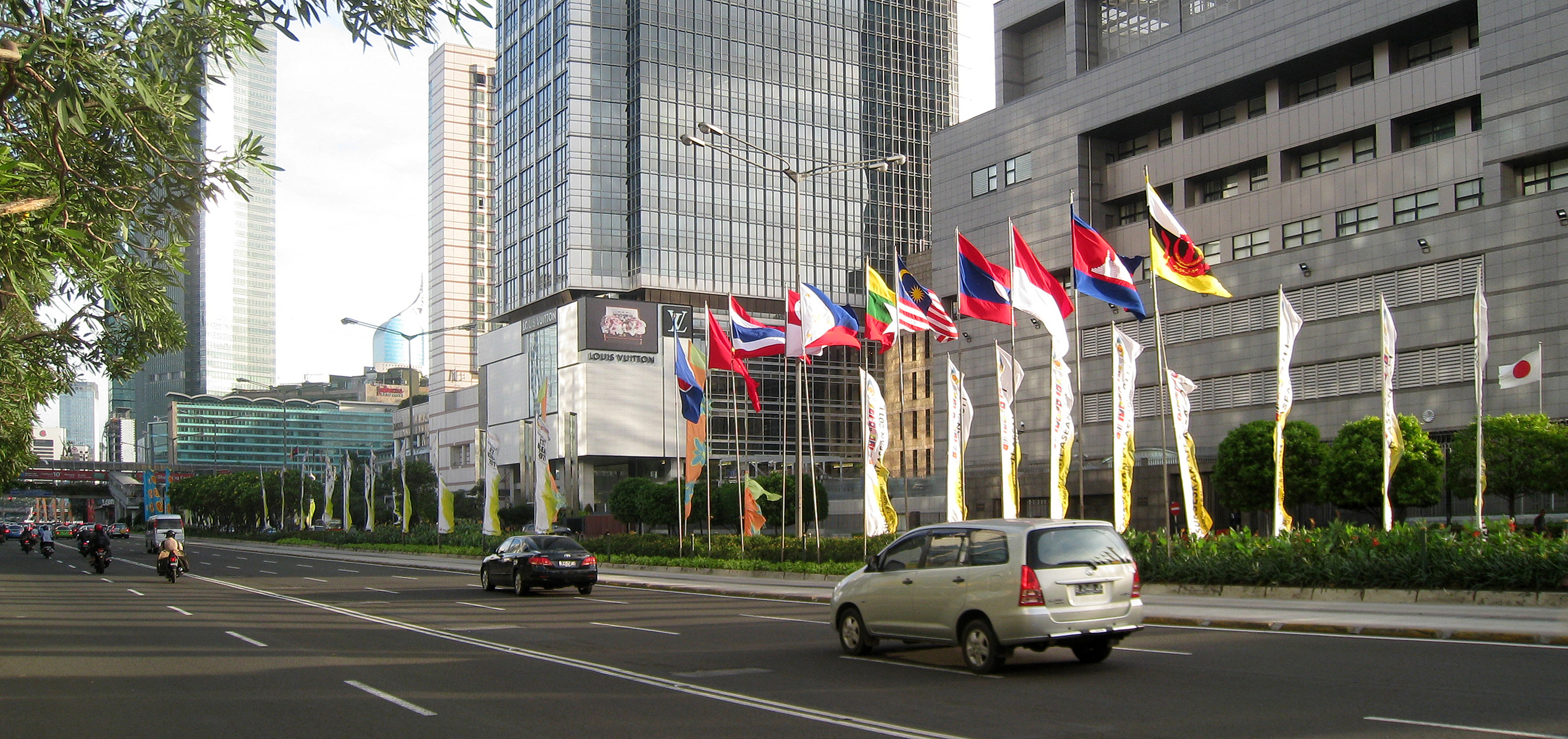
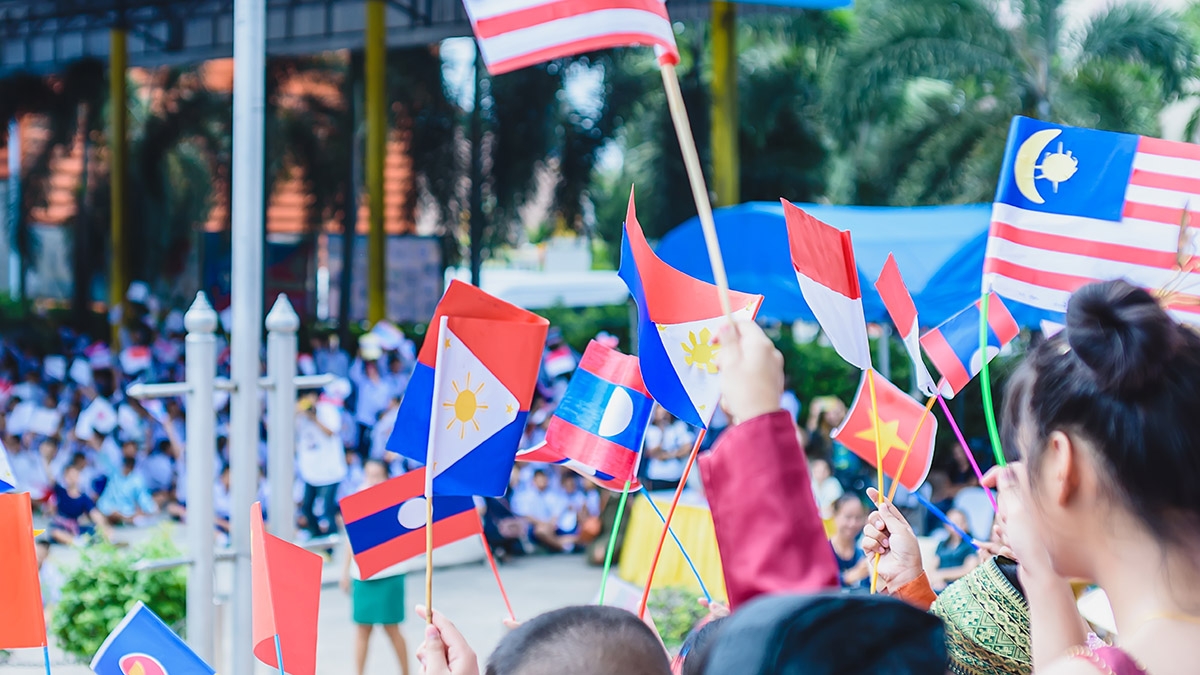
ASEAN member states’ flags in Jakarta, symbolising regional cooperation and the principles of ASEAN centrality. Photo credit: Gunawan Kartapranata / Wikimedia Commons / CC BY-SA 3.0.
Europe’s material position in the South China Sea has changed, and with it the calculation that saying openly what it wants is at last worth the cost. For three decades, the European Union presented itself as something other than a great power: a normative actor spreading law and rights through incentives rather than force, exceptional because it seemed to want nothing beyond the rules it upheld. That story held while the material stakes remained modest. But with maritime security increasingly inseparable from continental prosperity, Europe’s commitments have barely moved while the interests behind them have become harder to disguise. It has stopped in the South China Sea, where around 40 per cent of the EU’s foreign trade passes, and the Commission no longer treats maritime security and continental prosperity as separable. Europe’s commitments have barely moved. Its material position has, and with it the calculation that saying openly what it wants is at last worth the cost.
From normative power to the language of interest
In 2019 the European Commission settled on the formula that has structured its China policy since: partner, competitor, systemic rival, three registers held together because none alone could carry it. A partner-only Beijing would have made market dependence look like naivety; a rival-only Beijing would have made continued trade look like complicity. The register solved a problem of presentation, and let Brussels commit to none of them. No policy document theorizes from nowhere; it read China in whatever combination best served a relationship the Union would not abandon. The appeal to rules had, until then, carried conviction. At the 2016 Shangri-La dialogue, French Defense Minister Jean-Yves Le Drian warned that a law of the sea unenforced off China would soon go unenforced in the Arctic and the Mediterranean. France, the only European state with Pacific bases, had the most to lose if it did, and answered by sending its own ships rather than trusting the norm to hold. Germany and the Netherlands followed, and the 2021 Strategy for Cooperation in the Indo-Pacific formalized what had begun as uncoordinated national hedging. Its three pillars, sustainability, connectivity and maritime security, are the configuration of a historical structure more than a technical program: they name the material stakes, supply an institutional form, and stake a claim to belong where Europe had barely counted a decade before. The reorientation ran ahead of its own vocabulary. When the Union concluded it needed to learn the language of power, it only ratified a shift the material base had already produced. The label that followed, ‘proactive cooperative power’, keeps every word of the older lexicon, democracy, rule of law, human rights, and grafts onto it a register of assertiveness that lexicon could not license alone. The work is translation, not deception, closer to the ideological labor internal to any historic bloc than to marketing: a movement already under way in material interest is rendered into a language the Union’s institutions, and the partners they depend on, can absorb without feeling the ground move.
An asymmetric hybrid
Support for ASEAN-led multilateralism follows, more constraint than conviction. Inclusive structures cost the Union nothing it was not already resigned to spending, since it lacks the military weight an exclusive bloc would demand, and dressing that limit up as a preference lets Brussels avoid choosing between Washington and Beijing while calling the avoidance principle. The split goes deeper, into the form of state this action works through. Trade and development, where the Union holds exclusive competence, run through the Commission; naval deployments and defense dialogues stay with the member states, where authority over force was never handed upward. The hybrid that results leans on the instruments the Union supplies in common and away from the ones, ships and basing rights, that remain national property from an older imperial map. China, the EU’s largest source of imported goods and its second-biggest trading partner behind the United States, plays on this unevenness with care, firm with Paris and indispensable to Berlin, because European capitals seldom put a single position in front of it.
ASEAN is the Union’s first partner in Asia, though the relationship sits less in the trade figures than in the institutional form Brussels works through. The ASEAN way, sovereignty and non-interference raised into a governing principle, sits comfortably alongside a formal commitment to international law, because non-interference has never asked member states to agree on what that law requires of one another, only that they keep the disagreement off the record. For a Union that cannot reconcile its own differences either, the ambiguity reads as a resource before an obstacle. The CRIMARIO program shows how this works at sea. Its information-sharing platform pools maritime data for Indonesia, the Philippines and Vietnam, officially to counter crime and what the program calls ‘grey-zone’ threats. The account is accurate and partial at once: a platform that helps coastal states track vessel movements also helps them track Chinese ones, and it builds the Union technical dependencies with the region’s coastguards that no European navy could win by turning up in person. Capacity building names the mechanism and skips the question of what capacity is built towards, and for whom the resulting picture is made legible. The technology ties with Japan and South Korea run on the same logic: moving off dependence on Beijing has meant moving onto Taiwanese and South Korean fabrication, resilience without autonomy, more partners rather than any real fall in exposure.
The Philippine front and Structural Aseanisation
The Philippine case shows the posture at its most assertive, because the facts there leave little room to hedge. Since 2023 Philippine vessels have been rammed and hit with water cannon by the Chinese coastguard, and incidents that concrete make silence costlier than speech. Manila’s answer, tightening its alliance with Washington while courting European backing, spreads its dependency across more than one patron. The permanent EU-Philippines defense dialogue announced in June 2025 gave that a European counterpart, and left open the one question that matters: what the Union would do if the confrontations moved past coastguards. The bridge to Ukraine says more than the dialogue does. The line that Ukraine today could be East Asia tomorrow, first offered by a Japanese prime minister and since taken up almost verbatim in Brussels, holds that a violation tolerated in one theatre licenses another elsewhere. What it exchanges, under the language of an indivisible order, is solidarity for solidarity: European statements on the South China Sea for Asian alignment on sanctions against Moscow. That is legitimate enough as coalition-building, and still leverage rather than principle, since an order that speaks up in Manila and Kyiv and falls quiet elsewhere turns on whose violations serve the coalition and whose do not.
What is happening is “Aseanisation” in a precise sense. The Union has taken over not just ASEAN’s partners and platforms but its organizational form: inclusion over confrontation, ambiguity chosen not stumbled into, resolution postponed for process. This is not decline in strategic dress. Southeast Asian states took up hedging because their place in the world economy left them nothing else, a rational move for states in that position rather than a virtue freely chosen; the Union has reached the same posture from the other direction, occupying a position closer to the semi-periphery of the present hegemonic order—that is, neither at its dominant core nor entirely outside it, but in a middle position with limited power to shape its rules—heavy enough to count in the contest between Washington and Beijing and too light to set its terms. ASEAN’s long paralysis over Myanmar grew out of institutions built to manage disagreement rather than end it, a record Europe should read as a warning as it goes on borrowing the same tools.
The interest, trade routes and access to supply chains above all, was there from the start, and did the organising work the normative vocabulary later took credit for. What has changed is only the readiness to let it speak in its own voice. Without coordination among member states and a maritime capability none holds alone, the likelier outcome is not that Europe’s commitments are exposed as false. It is that they turn decorative: solid enough to shape how the Union describes itself, thin enough to give way the moment supply chains or market access ask them to. Whether the flexibility Brussels has assembled still earns the name strategic autonomy, or is better read as resilience without autonomy, the next decade in the South China Sea will decide.

Aniello Iannone is a Lecturer in International Political Economy at President University, Indonesia. He holds a PhD in International Relations and International Political Economy from Universitas Airlangga. His research examines Southeast Asian political economy, Indonesian domestic politics and foreign policy, ASEAN regionalism, and Taiwan-Indonesia relations. A central focus is transnational labour exploitation, migrant worker governance, and platform labour dynamics. He has developed the concept of "lordly capitalism" to analyse Indonesia's oligarchic political economy, where modernization coexists with personalized domination and quasi-feudal labour relations, and has written on ASEAN's "paralyzed regionalism" for the Lowy Institute. His work combines critical approaches to international political economy with empirically grounded analysis of how structures of power reshape institutions, labour regimes, and regional orders.
In "Structural Aseanisation," Aniello Ianone explores Europe's strategic shift in...
In this article, Aniello Iannone critically evaluates the ten-year trajectory...
The global order is moving beyond rigid bloc politics toward...
In this article, Luo Chen Jun highlights a striking historical...
In this article, Muhamad Ferdy Firmansyah highlights how climate technology...
In his latest article, Aniello Iannone examines the gap between...
This article analyzes Indonesia's ambitious military modernization through its strategic...
DeepRare is being hailed as a major breakthrough in the...
This article analyzes President Prabowo’s decision to skip the June...
This article analyzes the phenomenon of "sibling rivalry" at the...
This article evaluates the normative frameworks offered by China’s four...
This article examines the 2025 Thailand–Cambodia border conflict to evaluate...
This article examines the May 2026 ASEAN Summit in Cebu...
This article examines the May 2026 Beijing summit between Xi...
This article examines how the rise of narcissistic foreign policy—exemplified...
In October 2025, Indonesia's President Prabowo Subianto announced that Portuguese...
This article argues that recent U.S.–Israel military actions against Iran...
This article examines Türkiye’s evolving "Third Way" in Africa, an...
This article critically examines Indonesia’s evolving role from a quiet...
This article provides a firsthand account of how Pakistan emerged...
This article examines how disruptions in the Strait of Hormuz...
This article examines Indonesia’s participation in the Board of Peace...
This article examines what the attempted sale of CK Hutchison's...
This article examines the Kudankulam Nuclear Power Plant as a...




Leave A Comment