
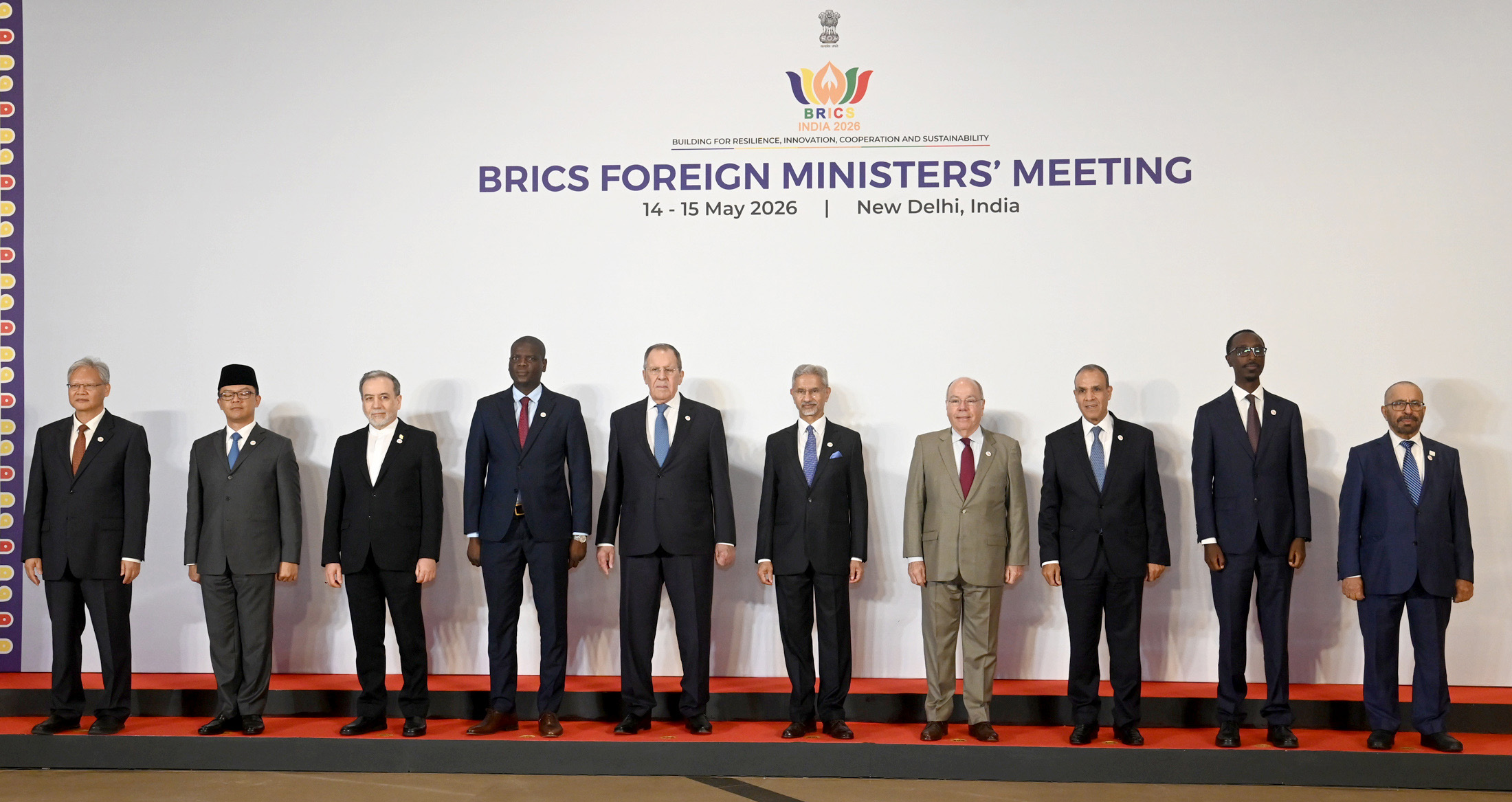
A group photograph of foreign ministers and senior representatives during the BRICS Foreign Ministers’ Meeting at Bharat Mandapam in New Delhi, India, May 14, 2026. Photo: Press Information Bureau, Government of India / Wikimedia Commons.
As the delegates from the expanded BRICS+ coalition depart the mahogany halls of New Delhi following the Foreign Ministers’ Meeting on May 14 2026, the air in the Indian capital carries more than just the heat of early summer; it carries the scent of a permanent shift in the global hierarchy. The "Global South 2.0" is no longer a rhetorical device used by developing nations to vent grievances at the United Nations; it has become a tangible, strategically autonomous, and economically dominant reality that has rendered the rigid bloc politics of the 20th century obsolete.
The communiqués issued today do not merely reflect diplomatic niceties; they signal the formalization of a new world order. We have moved decisively beyond the "Non-Alignment" of the Cold War—which was often defined by what it wasn't—into an era of "Multi-Alignment." This is a hyper-pragmatic landscape where emerging powers leverage their demographic, resource, and technological weight to negotiate with the West and the East on their own terms, refusing to be reduced to pawns in a new Cold War.
The Economic Gravity Shift: By the Numbers
To understand why the old era of Western-led "blocs" is dying, one must look at the hard math of 2026. The center of global economic gravity has completed its migration away from the Atlantic. By the middle of this year, the BRICS+ aggregate—a powerhouse now including Brazil, Russia, India, China, South Africa, Egypt, Ethiopia, Indonesia, Iran, Saudi Arabia, and the United Arab Emirates—commands a staggering 44 percent of global GDP in purchasing power parity (PPP) terms. In contrast, the G7’s share has contracted to roughly 30 percent, reflecting a structural divergence that is no longer a forecast, but a fait accompli.
While the G7 struggles with an aggregate growth rate hovering around a sluggish 1.1 percent, the Global South is accelerating. Sub-Saharan Africa is projected to grow at 4.3 percent this year, maintaining strong momentum despite significant external shocks. Asia, meanwhile, is projected to grow by 4.4 percent, with Southeast Asia expected to expand by 4.5 percent. The figures point to a narrowing growth gap among emerging regions rather than a decisive shift in which region leads. Southeast Asia, led by a resurgent Indonesia, follows closely with a 4.9 percent growth trajectory. This isn't just growth; it is insulation. When 57 percent of developing-country exports are now destined for other developing economies—a South-South trade flow that surged to $6.8 trillion by late 2025—the threat of Western financial exclusion loses its sting.
Digital Sovereignty: Building the Independent Rails
The most profound rebellion of Global South 2.0 is not being fought with weapons, but with code. If the 20th-century order was built on physical sea lanes and oil pipelines controlled by the West, the 2026 order is being constructed on Digital Public Infrastructure (DPI) .
Nations across Africa, Latin America, and Asia are rejecting the private-platform model dominated by Silicon Valley and Shenzhen. Instead, they are adopting "sovereign rails" for identity, payments, and data exchange. India’s "India Stack" has become the primary export of this new era. As of March 2026, India has generated over 144 crore Aadhaar identity numbers and integrated over 58 crore Jan Dhan bank accounts into a seamless digital network . This infrastructure has allowed New Delhi to transfer ₹49.09 lakh crore directly to its citizens, bypassing the bureaucratic leakages that once hobbled developing states .
This model is contagious. Over 80 countries have now engaged with the World Bank’s Global DPI Program to replicate this success . In Brazil, the Pix instant payment system now services 140 million active users, while Malawi has connected 97 percent of its population through digital ID, saving the government millions in service delivery costs . By building these autonomous digital rails, the Global South is capturing "domestic rents" from payments and data that were previously harvested by foreign tech giants, effectively de-linking their internal economies from Western-controlled messaging systems like SWIFT .
The Financial Rebellion: Challenging the "Creditors' Club"
For decades, the "Creditors' Club"—the IMF, the World Bank, and the Paris Club—set the rules for global lending, often imposing austerity measures that were perceived as encroaching on national sovereignty. In 2026, that monopoly has been broken.
On April 15, 2026, a historic shift occurred in Washington DC with the launch of the first-ever UN-hosted Borrowers' Forum . Led by a coalition including Zambia, Egypt, Nepal, the Maldives, and Pakistan, this forum represents the first "debtors' union." It allows developing nations to coordinate their bargaining positions before facing lenders, ending the era of "divide and conquer" debt restructuring .
Furthermore, the "Baku to Belém" (B2B) Roadmap, solidified at COP30, has redefined climate finance. It aims to deliver $1.3 trillion annually to developing nations by 2035, but the real innovation is the Tropical Forest Forever Facility (TFFF) . Championed by Brazil, the TFFF treats standing forests as a capital asset. It aims to mobilize $125 billion to pay tropical nations for preservation—specifically awarding roughly $4 per hectare to countries that keep deforestation below 0.5 percent . With 20 percent of these funds earmarked for Indigenous Peoples and Local Communities, the Global South is finally writing the rules for its own environmental assets .
Reglobalization and the "Connector Economies"
The narrative of "deglobalization" is a myth of the North. In the South, we are witnessing "Reglobalization"—a strategic realignment into a "multi-nodal" network. While direct US-China trade in sensitive sectors shrank by 30 percent last year, global trade actually reached a record $35 trillion in 2025.
The system survives because of "connector economies" like Mexico, Vietnam, and Poland. These nations have become the essential middlemen of the 21st century. Mexico, for instance, imports intermediate components from China to assemble finished products for the US market, allowing trade to flow even as bilateral tensions between superpowers reach a breaking point. These connectors prove that in 2026, prosperity depends not on choosing a side, but on being the bridge between them.
Case Study: Indonesia’s Strategic Balancing Act
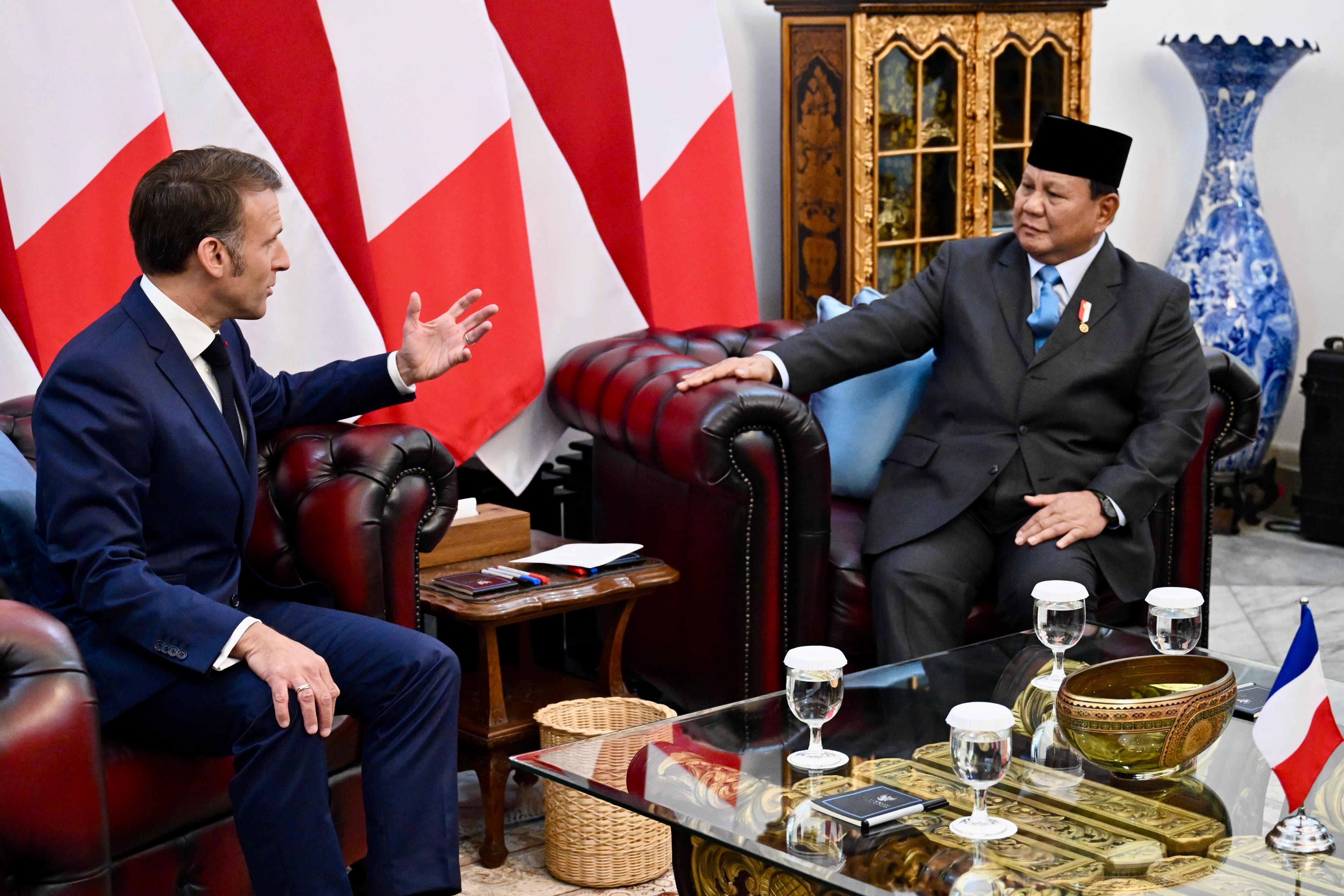
Indonesia serves as the ultimate case study for the irrelevance of bloc politics. As a "middle power" sitting at the heart of the Indo-Pacific, Jakarta has mastered the art of playing both sides. In early 2026, President Prabowo signed a sweeping defense deal and the Agreement on Reciprocal Trade (ART) with the United States, securing market access for labor-intensive exports like textiles and furniture .
Yet, this was not a tilt toward Washington. Simultaneously, Indonesia deepened its integration with China—its largest trading partner and primary infrastructure investor—and officially joined BRICS+ in January 2025 . When the United States recently requested broad military overflight access, Jakarta hesitated, fearing that such access would make Indonesia a target in a regional conflict . Indonesia’s doctrine of "bebas aktif" (free and active) is no longer a lofty ideal; it is a survival strategy in a world where formal alliances are seen as liabilities .
The Industrial Justice of Africa
Africa’s role in Global South 2.0 is defined by its transition from a raw-material provider to an industrial hub. The continent possesses nearly 30 percent of the world’s critical mineral reserves—cobalt, lithium, and rare earth elements—essential for the green energy transition .
Through the African Continental Free Trade Area (AfCFTA), African leaders are now demanding "Industrial Justice". They are no longer content to export raw ore; they are leveraging their BRICS+ membership to demand joint ventures with Chinese and Indian manufacturers for local processing. In South Africa, the New Development Bank (NDB) has already secured over 100 billion rand for energy and logistics infrastructure, focusing on the regional industrialization of value chains.
Conclusion: The Era of Multi-Alignment
The communiqué from New Delhi today does not speak of building a bloc against the West, but of building a world order beyond it. The "New Delhi Consensus" is not a set of ideological rules; it is a pragmatic roadmap for a polycentric century.
Bloc politics is becoming less dominant because it increasingly fails to serve the national interests of many Global South states. In a world where the US remains a military titan, China acts as the world’s workshop, and the Global South provides the demographic and resource engine, the only rational policy is to be "a friend to all and an enemy to none" . As we move toward the 2030s, the nations of the Global South are not choosing between Washington and Beijing. They are choosing themselves.

Nisha Usmani is a student at Jamia Millia Islamia University in New Delhi, India, pursuing her bachelor's in multidisciplinary studies. Her research centres on the intersection of economic policy and international affairs with a strong focus on South and Southeast Asia, particularly how regional political and economic shifts influence global geopolitics.
The global order is moving beyond rigid bloc politics toward...
In this article, Luo Chen Jun highlights a striking historical...
In this article, Muhamad Ferdy Firmansyah highlights how climate technology...
In his latest article, Aniello Iannone examines the gap between...
This article analyzes Indonesia's ambitious military modernization through its strategic...
DeepRare is being hailed as a major breakthrough in the...
This article analyzes President Prabowo’s decision to skip the June...
This article analyzes the phenomenon of "sibling rivalry" at the...
This article evaluates the normative frameworks offered by China’s four...
This article examines the 2025 Thailand–Cambodia border conflict to evaluate...
This article examines the May 2026 ASEAN Summit in Cebu...
This article examines the May 2026 Beijing summit between Xi...
This article examines how the rise of narcissistic foreign policy—exemplified...
In October 2025, Indonesia's President Prabowo Subianto announced that Portuguese...
This article argues that recent U.S.–Israel military actions against Iran...
This article examines Türkiye’s evolving "Third Way" in Africa, an...
This article critically examines Indonesia’s evolving role from a quiet...
This article provides a firsthand account of how Pakistan emerged...
This article examines how disruptions in the Strait of Hormuz...
This article examines Indonesia’s participation in the Board of Peace...
This article examines what the attempted sale of CK Hutchison's...
This article examines the Kudankulam Nuclear Power Plant as a...
This article examines Nepal’s strategic position within the Indo-Pacific and...
This article analyzes Indonesia's participation in the US-led Board of...

Leave A Comment