
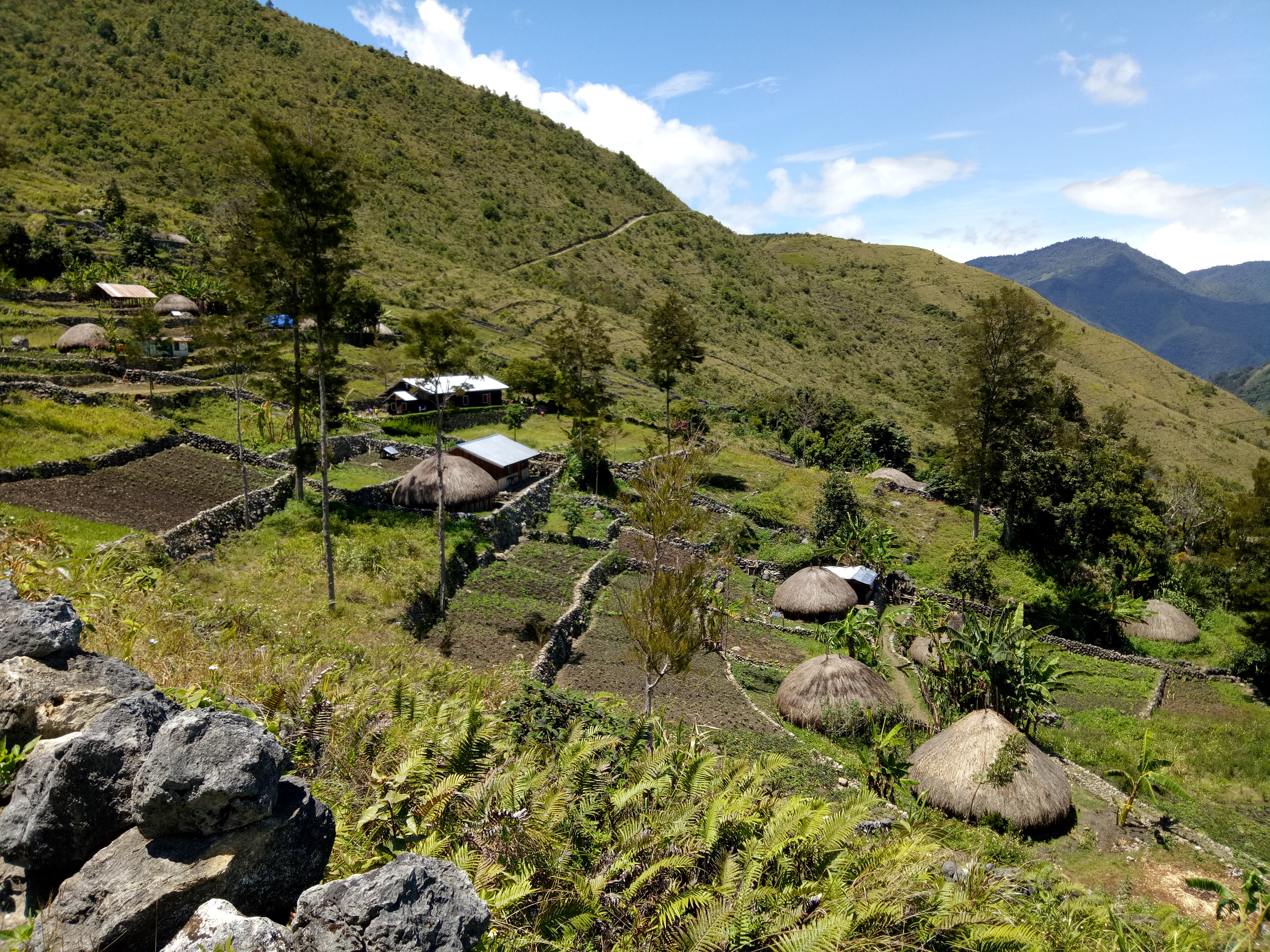
A traditional Papuan village in the Baliem Valley, Highland Papua, Indonesia. The region is home to Indigenous communities whose rights, land, and livelihoods remain central to ongoing discussions on sovereignty, human rights, and state policy in Papua. Source: Lasthib, CC BY-SA 4.0, via Wikimedia Commons.
The 81st United Nations General Assembly (UNGA) 2026 once again brought the issue of Papua to the forefront; more specifically, several Pacific nations, such as the Solomon Islands and Vanuatu, requested that the UN send the High Commissioner for Human Rights to Papua to verify alleged human rights violations. Indonesia’s Permanent Representative to the UN, Nona Gae Luna, promptly exercised her right of reply to respond to the two Pacific nations.
Indonesia rejected these allegations and emphasized that it takes every credible allegation of human rights violations seriously through national institutions and legal mechanisms, including the independent National Commission on Human Rights (Komnas HAM). Furthermore, Indonesia stated that a visit by the UN High Commissioner for Human Rights must be agreed upon between the host country and the Office of the High Commissioner, rather than being dictated by other countries or regional organizations.
In its right of reply, Indonesia noted that any discussion of Papua must take a holistic view of the situation. Nona highlighted the murders of three civil servants, the death of a driver transporting necessities, and the abduction of nine women and children, all linked to armed groups in Papua. The Indonesian government also emphasized that human rights issues should not be used to justify violence or support separatism.
Violence against civilians by armed groups is indeed a serious issue and must be investigated. However, when discussing Papua, taking a holistic view also means examining whether there are alleged violations by security forces against Indigenous Papuans (OAP), the growing number of refugees resulting from the conflict, and restrictions on access for journalists seeking to cover Papua.
Unfortunately, the Indonesian delegation did not mention the mass displacement in Maybrat. It also did not refer to many allegations of security forces’ involvement in the shooting of civilians in Maybrat, which have been monitored by the National Commission on Human Rights (Komnas HAM) and the Regional Representative Council (DPD), nor did it mention the series of civilian deaths in Intan Jaya throughout last July.
The Indonesian delegation also failed to cite Human Rights Watch (2025), which reported an escalation of conflict between Indonesian security forces and Papuan armed groups that threatens the safety of civilians, particularly indigenous communities, and fuels human rights violations, restrictions on civil liberties, and repression of human rights defenders and nonviolent political activists. Furthermore, the national strategic "food estate" project in Merauke, Boven Digoel, and Mappi has drawn criticism for its impact on indigenous peoples' rights and environmental protection.
Pressure from Pacific Nations on Indonesia Regarding the Papua Issue
Indonesia’s defensive response in late September was not the first time Pacific nations had raised the issue of Papua in an international forum. On September 28, 2013, at the 68th UN General Assembly, Vanuatu also addressed the issue of Papua; Vanuatu’s then-Prime Minister, Moana Carcasses Kalosil, raised the matter of Papua within the framework of decolonization and the right to self-determination. A similar pattern emerged in 2016, when a number of Pacific nations expressed concerns about human rights in Papua at the UNGA. The Indonesian delegation at the time accused these Pacific nations of misusing the UN forum and stated that the criticism was politically motivated and supported separatist groups.
Pacific nations continue to apply pressure. In March 2017, seven Pacific nations also called for a UN investigation into alleged human rights violations in Papua, including alleged extrajudicial killings and violence against activists. Indonesia once again rejected all allegations of widespread and ongoing violations.
The debate did not stop at statements and rebuttals between the Pacific nations and Indonesia. In February 2018, President Joko Widodo received the then-UN High Commissioner for Human Rights, Zeid Ra’ad Al Hussein, and the government extended an invitation for his office to visit Papua. However, the Office of the High Commissioner stated that the invitation had not yet been followed up on. For this reason, at the 81st session of the UN General Assembly in late September, Solomon Islands Prime Minister Matthew Wale reiterated his call for the visit to take place. Marshall Islands President Hilda Heine also expressed support for Indonesia facilitating a visit by the UN High Commissioner for Human Rights.
Diplomatic pressure on Indonesia continues through the Melanesian Spearhead Group (MSG). In September 2026, several member states said that Indonesia’s status as an associate member would be reviewed if a visit by the UN High Commissioner was not facilitated promptly to produce a report before the next MSG meeting in 2027.
A review of the historical record of pressure from these Pacific nations reveals a pattern worth examining—when Pacific nations have called for an international investigation into alleged human rights violations in Papua, Indonesia’s response has repeatedly centered on sovereignty, territorial integrity, and alleged support for separatism as the main points of contention. Meanwhile, demands for independent access remain an unresolved issue.
What’s Happening Beyond the Diplomatic Standoff ?
Behind the diplomatic debates lies a reality that cannot be ignored: recurring human rights violations, the seizure of Papuan communities’ customary forests, and the government’s reliance on a securitization approach to frame the conflict in Papua. In “Securitization of a Political Conflict in Southeast Asia: Disengaging the Indigenous Audience in West Papua,” Hipolitus Ringgi Wangge argues that with the securitization approach, where conflict is understood as a security threat, policies tend to be measured by the state’s ability to control armed groups and maintain territorial integrity.
For this reason, in international forums, the securitization approach serves as a strategy to uphold the state’s explanatory framework. When Pacific nations request an investigation or access to the OHCHR, Indonesia can respond by citing armed groups (KKB), separatism, stability, national sovereignty, and national mechanisms. This shifts part of the debate away from alleged actions by state officials toward the state’s legitimacy in maintaining security.
In a BBC News Indonesia interview with Heribertus Jaka Triyana, a professor at the UGM Faculty of Law, he pointed out that not every reference to an armed group automatically constitutes problematic securitization. Armed groups can indeed commit acts of violence against civilians. The analytical question is whether the security framework is being applied proportionally and whether it provides sufficient scope to investigate alleged violations by all parties.
For example, are civilians protected? Can the displacement be brought to an end? Can alleged violations by security forces be independently investigated? And do indigenous communities have meaningful space to voice their demands? One consequence of the securitization approach is that when conflict is framed as a threat to the state, discussion about civilian casualties, security forces’ accountability, displacement, and the political demands of the Papuan people risk being sidelined.
As stated by Indonesia’s permanent representative to the UN, national institutions and legal mechanisms, including Komnas HAM, are capable of addressing alleged human rights violations in Papua. The question is: to what extent is the government willing to grant independent access so that these claims can be verified? Indonesia does not need to choose between sovereignty and human rights. The Pacific nations that have been most vocal on this issue have essentially recognized Indonesia’s sovereignty. All they are asking for is independent verification, which should not threaten territorial integrity but rather help build credibility.
As long as Indonesia continues to prioritize securitization over dialogue, it will remain trapped in a defensive cycle that not only isolates Indonesia on the international stage but also prolongs the suffering of the Papuan people, who should be protected by the state that claims them as its citizens. The defensive diplomacy Indonesia has long pursued, with its emphasis on sovereignty and securitization, is not a sign of strength, but rather a tacit admission that the available arguments are insufficient to convince the world of the true situation in Papua.

Firda Amalia Putri is aResearch Assistant at the University of Amsterdam and Assistant Editor for Studia Islamika. In addition to her academic and professional work, she serves as a board member of Amnesty International Indonesia 2025-Now and has been actively involved in regional and global human rights forums since 2021.
In this article, Firda Amalia Putri examines Indonesia’s defensive diplomacy...
Indonesia’s ambitious defence modernisation is reshaping how Southeast Asia and...
Aniello Iannone examines Malaysia's repatriation of Myanmar nationals, revealing how...
In this article, Dr. Angana Guha Roy argues that water...
In "Structural Aseanisation," Aniello Ianone explores Europe's strategic shift in...
In this article, Aniello Iannone critically evaluates the ten-year trajectory...
The global order is moving beyond rigid bloc politics toward...
In this article, Luo Chen Jun highlights a striking historical...
In this article, Muhamad Ferdy Firmansyah highlights how climate technology...
In his latest article, Aniello Iannone examines the gap between...
This article analyzes Indonesia's ambitious military modernization through its strategic...
DeepRare is being hailed as a major breakthrough in the...
This article analyzes President Prabowo’s decision to skip the June...
This article analyzes the phenomenon of "sibling rivalry" at the...
This article evaluates the normative frameworks offered by China’s four...
This article examines the 2025 Thailand–Cambodia border conflict to evaluate...
This article examines the May 2026 ASEAN Summit in Cebu...
This article examines the May 2026 Beijing summit between Xi...
This article examines how the rise of narcissistic foreign policy—exemplified...
In October 2025, Indonesia's President Prabowo Subianto announced that Portuguese...
This article argues that recent U.S.–Israel military actions against Iran...
This article examines Türkiye’s evolving "Third Way" in Africa, an...
This article critically examines Indonesia’s evolving role from a quiet...
This article provides a firsthand account of how Pakistan emerged...




Leave A Comment