
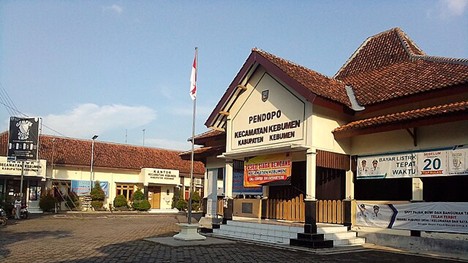
Image Credit: Pendopo Kecamatan Kebumen, Kab. Kebumen by DARMAS SB, licensed under Creative Commons Attribution-Share Alike 4.0, via Wikimedia Commons.
Poverty in Kebumen Regency, Central Java, is a complex problem that is multidimensional. Data from the Central Statistics Agency notes that the poverty rate in this region is still relatively high when compared to the average of Central Java province. This condition indicates that there are structural challenges that have not been fully resolved. The phenomenon of poverty is not enough to be explained through a monetary approach alone but needs to be understood as a problem that includes limited access to education, health, employment, and basic infrastructure. The multidimensional approach through the capability approach emphasizes that poverty is essentially a limitation of individual freedom to live a meaningful life. Therefore, poverty alleviation strategies in Kebumen should include social, economic, cultural, and political aspects and involve active community participation.
The success of reducing poverty in Kebumen is inseparable from coordinated cross-sector collaboration. The local government, through the Poverty Alleviation Coordination Team, integrates various programs that include social assistance, economic empowerment, and infrastructure development. In line with the thinking of Chambers, who emphasized that effective development must depart from the reality of society, a participatory approach has proven to be relevant in Kebumen. At the village level, the involvement of residents in the planning and implementation of the program is a key factor in success, as it ensures that the interventions carried out are in accordance with local needs. One of the main ways to reduce poverty in Kebumen Regency is to build up the infrastructure.
Local governments consistently build and improve the quality of roads, bridges, irrigation, and education and health facilities to open public access to markets, public services, and economic opportunities. We emphasized that infrastructure development plays a role as a catalyst for economic growth, especially in disadvantaged areas, because it is able to reduce transportation costs, increase productivity, and attract investment. Infrastructure development in the digital era extends beyond the physical sector. Internet networks and the expansion of access to information technology are also priorities, considering their potential in opening up digital-based economic opportunities, such as online marketing of micro, small, and medium enterprises (MSMEs) products, as well as expanding access to information for the public.
Understanding the Challenge
Figure 1 explains the poverty data in Kebumen district.
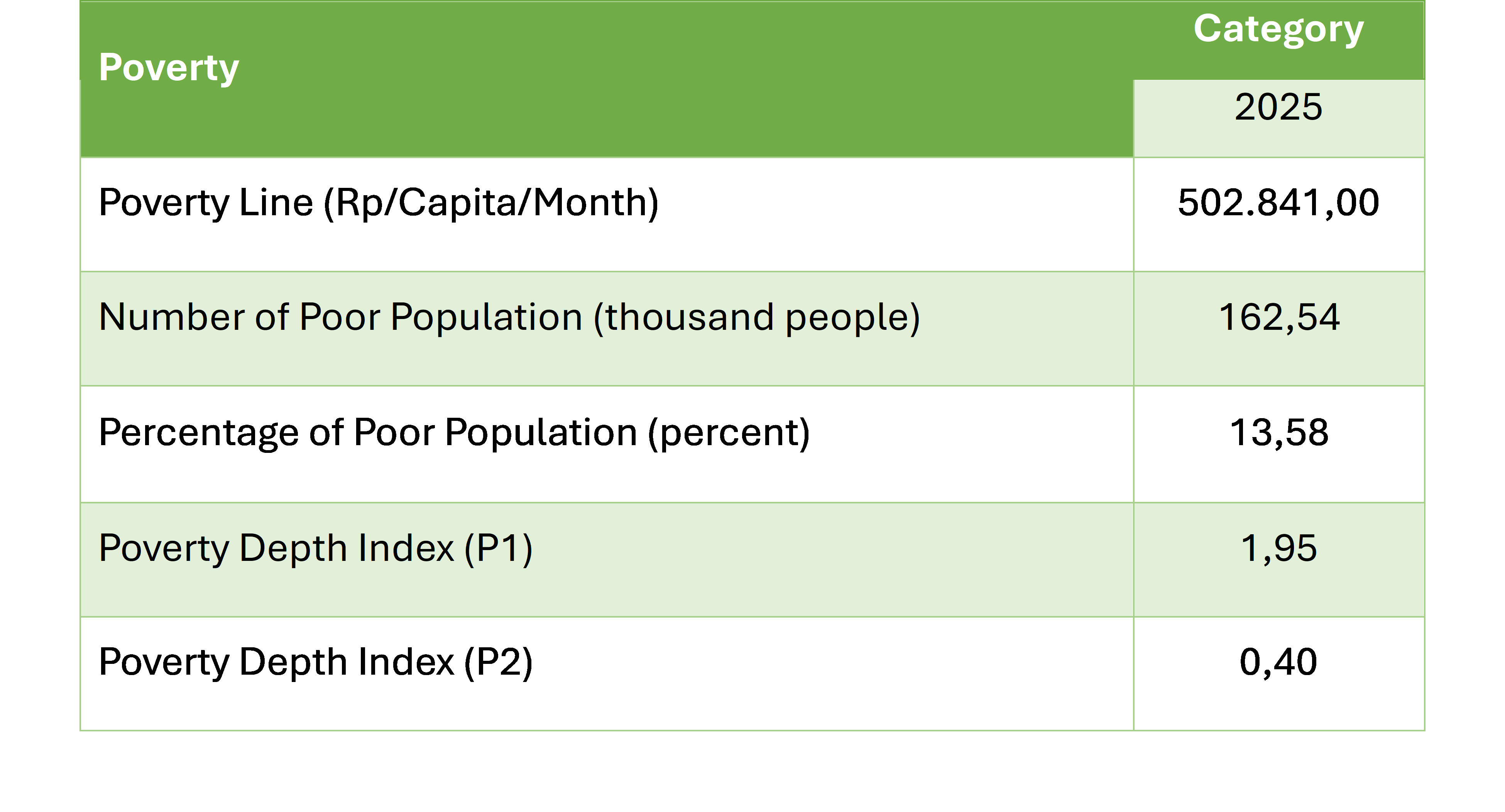
Figure 1. Poverty in Kebumen district
Source: (Badan Pusat Statitsik, 2025)
This article illustrates figure 1 about examining the dynamics of poverty alleviation in Kebumen Regency, the statistical data for 2025 provides a critical quantitative foundation for understanding the challenges and measuring the outcomes of interventions in line with our theme of Collaboration, Empowerment, and Infrastructure. The fundamental measure of welfare, the poverty line, is set at Rp 502,841 per capita per month. This figure represents the minimum expenditure threshold necessary to meet basic food and non-food needs, serving as the benchmark against which the poverty rate is calculated. Currently, the data indicates that approximately 162,540 individuals, or 13.58 percent of the regency's total population, live below this line. While this percentage signifies a notable improvement from previous years, it remains a substantial figure, representing a significant population segment that still requires targeted support to achieve a basic standard of living.
The additional poverty indices give a more detailed picture of the depth and severity of deprivation than the overall poverty rate does. This information is important for creating effective, multidimensional strategies. The Poverty Gap Index (P1) stands at 1.95. This index measures the average shortfall of the poor's consumption from the poverty line. A value of 1.95 means that, on average, the poor in Kebumen need to spend about 1.95 percent more each month than the poverty line to get out of poverty. This relatively low figure suggests that a considerable portion of the poor population is clustered near the poverty line, implying that well-targeted economic empowerment programs and improved access to markets (facilitated by infrastructure) could potentially lift them out of poverty. However, the Poverty Severity Index (P2) is recorded at 0.40. This index gives more weight to the poorest among the poor, reflecting inequality within the poor population. While lower than the P1, this value reminds us that a segment of the community faces deeper, more entrenched poverty that simple income transfers may not fully address, underscoring the need for comprehensive, collaborative approaches that build long-term capabilities, as highlighted by Sen's capability approach.
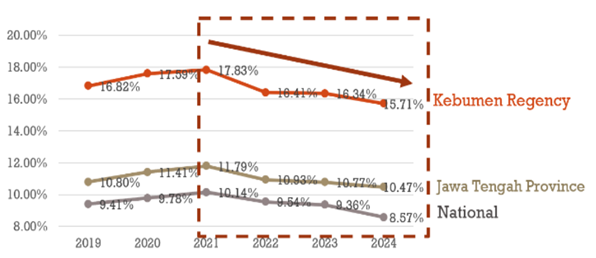
Figure 2: Percentage of Poverty Rate in Kebumen (compared to national and provincial levels) in 2019–2023
Source: (Tamam & Iskandar, 2025)
Why Kebumen Still Struggles
We want to highlight figure 2 about the dynamics of poverty alleviation, understanding time series data which is very crucial to identify patterns, measure policy effectiveness, and position the achievements of a region in a broader context. Data from the Central Statistics Agency (Badan Pusat Statitsik, 2025) regarding the percentage of poor people in Kebumen Regency during the period 2019 to 2024 shows interesting dynamics, especially when compared to trends at the Central Java Province and National levels. At the beginning of the period, in 2019, the poverty rate in Kebumen was recorded at 16.82 percent, which then fluctuated with the highest peak in 2021 reaching 17.83 percent. This increase is strongly suspected to be the impact of the economic contraction due to the COVID-19 pandemic, which nationally has also encouraged the increase in poverty rates. However, since 2022, Kebumen has shown a consistent downward trend, from 16.41 percent, to 16.34 percent in 2023, and a significant decrease to 15.71 percent in 2024. This post-pandemic decline indicates the recovery of economic activity and the effectiveness of social protection and empowerment programs run by local governments.
The position of Kebumen Regency shows significant progress despite still facing structural challenges. When compared to the average of Central Java Province which in 2024 will be at 10.47 percent, Kebumen's poverty rate of 15.71 percent is still higher. This reflects that Kebumen is still in the category of regions with a concentration of poverty above the provincial average. However, an aspect that should be appreciated is the rate of decline in Kebumen which is quite progressive. When the provincial poverty rate fell by 2.2 percentage points from its highest point (11.79% in 2021 to 10.47% in 2024), Kebumen managed to record a decrease of 2.12 percentage points in the same period (17.83% to 15.71%). In 2024, for the first time in that span, the gap between the poverty rate of Kebumen and the province will begin to show signs of narrowing. This indicates that a focused poverty alleviation strategy, which is likely to involve cross-sectoral collaboration, local economic empowerment, and infrastructure development, is beginning to yield tangible results in accelerating poverty alleviation efforts in the region.
Lessons from Neighboring Regencies: Banyumas and Cilacap
Based on data from the Central Statistics Agency (BPS) as of September 2025, the poverty rate in Kebumen Regency was recorded at 13.58 percent with the number of poor people reaching around 162.54 thousand people. Although this figure shows a significant decrease compared to the previous year which was at the level of 15.71 percent, comparatively this achievement is still lagging behind when compared to neighboring districts in the former Banyumas Residency area, such as Banyumas Regency which managed to record a poverty rate of 10.21 percent thanks to the strengthening of the service, trade, and tourism sectors in the Purwokerto area, as well as Cilacap Regency with a relative poverty rate of 11.45 percent more stable thanks to the contribution of the industrial and port sectors in opening jobs.
Kebumen's lagging behind in poverty alleviation efforts can be explained by differences in regional economic structures, where Kebumen still relies on traditional agricultural sectors that are vulnerable to fluctuations in commodity prices and climate change, while Banyumas and Cilacap have successfully diversified their economies into more productive and resilient sectors. This finding is in line with the results of research which emphasizes that areas with an agrarian economic base tend to have a higher poverty rate than areas that have diversified their economies more widely.
Policy Recommendations
The implications of this comparison show that Kebumen needs to accelerate structural transformation by strengthening non-agricultural sectors, such as services, trade, and tourism, where Banyumas can be a model for tourism development and the service sector, while Cilacap provides lessons on how the existence of industries and ports can function as a driving force for the local economy.
Poverty alleviation strategies in Kebumen Regency must be directed at economic diversification, strengthening micro, small, and medium enterprises (MSMEs), and infrastructure development that supports inter-regional connectivity. This approach is in line with the thinking of Sachs (2015) who emphasized that technology-based and environmentally friendly sustainable development can be a long-term solution for regions that still depend on traditional sectors. Kebumen has shown progress by successfully reducing poverty rates consistently, but the gap is still quite wide with Banyumas and Cilacap confirming the need to accelerate policies that are more focused on economic transformation and strengthening community capacity to catch up and achieve more significant poverty reduction targets in the future.

Kaamiliaa Dewi Kaamiliaa Dewi is a postgraduate student in Government Science at Muhammadiyah University of Yogyakarta (UMY), Indonesia. She earned her Bachelor’s degree in Government Science from UMY in February 2025, with a thesis focusing on sustainable village development in Panggungharjo Village, Sewon, Bantul, Yogyakarta. Her academic interests include democratization in political party management, village governance, disaster management related to floods and landslides, and family resilience in the Yogyakarta Special Region. She has completed an internship in the Kutoarjo sub-district, which strengthened her engagement with community development and academic writing. Kaamiliaa has published articles in four journals indexed by Sinta 4, Sinta 3, and Sinta 2, reflecting her active contribution to the field of social and political sciences. https://linktr.ee/Kaamiliaa https://scholar.google.com/citations?hl=id&user=LVVkTukAAAAJ https://www.linkedin.com/in/kaamiliaa-dewi-876a78329?

Tunjung Sulaksono Tunjung Sulaksono completed his doctoral program in political science from the Department of Politics and Government, Gadjah Mada University in 2020. Since 2001, Tunjung Sulaksono has worked as a lecturer in the department of government science, Faculty of Social and Political Sciences, Universitas Muhammadiyah Yogyakarta (UMY). Currently, he is entrusted as the secretary of the master's and doctoral study program in government science UMY. His research interests range from studies on democracy and local politics, electoral politics, party management, and governance. https://orcid.org/0000-0001-6648-9169
In "Lebanon's chronic blackout issue is not just an engineering...
This article asks whether Indonesia is showing early symptoms of...
This article documents the systematic repression of Pan-African activists, journalists,...
This article looks at how Pakistan's 2024 General Elections were...
This article examines the tragic death of a child in...
This article examines poverty alleviation efforts in Kebumen Regency, Central...
This article critically examines Indonesia’s Makan Bergizi Gratis (MBG) programme,...
This article examines the socio-political impact of Pandji Pragiwaksono’s stand-up...
This article examines the persistent "political masculinity" in Indonesia, 41...
This article examines why Islamic political parties in Indonesia remain...
This article examines the global rise of school meal programs,...
This article examines Dhurandhar not merely as a commercial Bollywood...
This article highlight the development of IT that has been...
This article explores how Afghan women are using social commerce...
This article examines how youth-led, digitally networked movements are reshaping...
This article examines proposals to privatize religion not as neutral...
This article traces how a tense India-Pakistan cricket game, complete...
This article explains how the Pakistan-Saudi Arabia Strategic Mutual Defence...
This article examines how Afghan women have transformed the struggle...
This article explores how special autonomy in Aceh and Bangsamoro...
This article examines how Malaysia’s political economy sustains social harmony...
This article critiques the Global Innovation Index (GII) for overlooking...
This article examines how technology has become a highly contested...
This article takes a deep dive into Indonesia’s evolving struggle...












Leave A Comment