
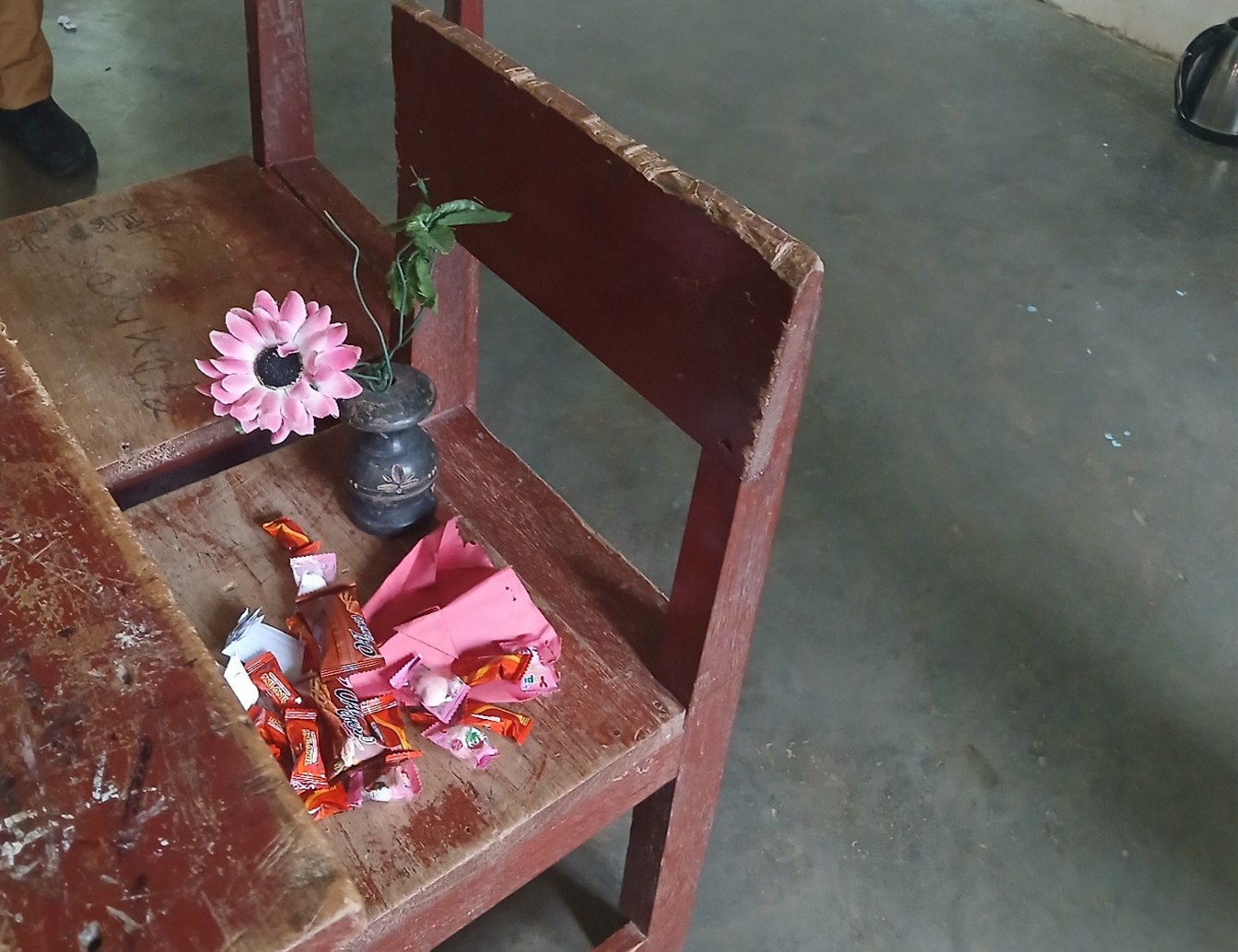
Image credit: The tributes given by friends of the late YBR to his seat included candy, paper airplanes and flowers at SD N Rutojawa, Jerebuu District, Ngada Regency, East Nusa Tenggara, Tuesday (10/02/2026). Photo: Personal Documentation of the author.
Recently, the online public was shocked by a tragedy in Jerebuu, a sub-district in Ngada Regency, East Nusa Tenggara, where a 10 year old boy with the initials YBR ended his life tragically by hanging himself from a clove tree branch near his residence. Who would have thought that the area once known for the cheerful song of the national-famous Tabola Bale, would now reveal a heartbreaking irony and leave a national grief that is suffocating.
Involved in a field review with the relevant authorities at the location where this tragic event occurred, I travelled 1.500 kilometres from Jakarta to Jerebuu, a journey that led me to a much more complex reality, crossing the civilization gap between the capital city of Jakarta and East Nusa Tenggara that disturbs my conscience.
While the Indonesian government is celebrating the triumph of digitalization, Jerebuu stands in silence; where streetlights are largely absent, the main roads that provide access to the city are prone to landslides and are full of potholes, there is no accessible online transportation, and the internet connection is slow. The tragedy in Jerebuu is not an isolated incident, but a stark manifestation of structural neglect in Indonesia’s peripheral regions.
There, it is common to see elementary school children returning home barefoot. Those little feet are still familiar with the muddy paths leading home; a reality these children endure every day for the sake of a future that remains uncertain.
All of this irony boils down to one major question on how we interpret the YBR tragedy. To borrow a phrase from a national pluralist figure, Buya Ahmad Syafii Maarif, the heartbreaking events that befell YBR are a concrete manifestation of “social criticism from a fractured soul.” To understand this rift, we cannot simply summarize it in statistics. It must be read through a humanitarian lens to understand the shattered hopes of children on the fringes of the country who have so far been overlooked.
A Good-Hearted Child Shattered in the Quiet
The widely circulated motive of not being able to buy pens and books for less than ten thousand rupiah only scratches the surface. YBR’s true life story touches a deeper human conscience. YBR endured a challenging journey, yet he never expressed his frustrations to teachers, friends, or family. He was known as a polite and cheerful child, so no one would have imagined that YBR would be so reckless as to end his life.
One of YBR’s teachers at the Rutojawa Elementary School, Mrs. Linda, revealed that YBR is an intelligent, polite, active child, and has a higher social sensitivity than his peers. Mrs. Linda said that there is one of her classmates who is very close to YBR who also comes from a low-income family. When his friend has difficulty understanding some subjects, YBR will proactively help him understand the lesson together.
Because YBR tends to be active and cheerful at school, no one detects that YBR’s mental condition is not good.
Philipus Ngei Botha, Head of the Village Community Empowerment, Women’s Empowerment, and Child Protection Agency (PMDP3A) of Ngada Regency, explained that the tragedy that befell YBR was caused by complex triggering factors, which can be seen in the characteristics of the environment in which the child lives, including economic, educational, and family backgrounds. He emphasized that the motive was not simply a matter of not being able to afford book and pen.
YBR is a child who has lived without father figure since he was born. He grew up and lived with his 80-year-old grandmother in 2x3 meter bamboo hut, sleeping under the light of an oil lamp, isolated amidst the expanse of forest and village plantations.
Meanwhile, his mother worked odd jobs earning a maximum of Rp. 50.000 per day. This income had to be shared with YBR’s two other older siblings: AFM (14 years old) and AN (17 years old), who had dropped out of school.
The stifling economic situation even forced his mother into a loan at a cooperative with a monthly fee of Rp. 130.000, which was difficult to repay. Amidst this pressure, YBR himself was known to sell vegetables to his teachers at school, exchanging cash payments for his unpaid school fees.
This situation more or less illustrates the burden YBR bore alone, at the age of 10.
Flores the Exquisite, Flores the Wounded
At the foot of Mount Inarie, Flores’ majestic natural pyramid, the Jerebuu land is fertile, home to cacao, nutmeg, clove, coffee, durian, and other fruit trees. However, this fertility has not translated into prosperity for the Jerebuu people.
Many families in Jerebuu are mired in extreme poverty, including the mother of YBR, who is forced to borrow from a cooperative for daily needs. Children dropping out of school is commonplace, while educational facilities in the region are largely in dire condition.
At the Rutojawa Public Elementary School, where YBR studies, for example, three classrooms are no longer usable due to landslides and being adjacent to a steep cliff. The ceiling is partially rotten, and some of the school stairs are hollow and vulnerable to breaking, ready to injure students or teachers at any time.
Ironically, this area is not included in the list of 3T; Tertinggal, Terdepan, Terluar (Frontier, Outermost, and Disadvantaged) regions that should receive priority assistance.
The issue becomes even more complex when examining the administrative aspects of the population. According to the Head of the PMDP3A, many children in Jerebuu were born from unregistered marriages, making them vulnerable to not having birth certificates.
Diyah Puspitarini, a commissioner of the Indonesian Child Protection Comission (KPAI), who was also involved in the review, stated that these administrative obstacles could contribute to the increasing school dropout rate in Jerebuu.
Furthermore, amidst these conditions, boys and girls become increasingly vulnerable to the threat of sexual harassment, which is difficult to monitor. The situation can become even more complex when victims of immoral acts have to deal with local customary laws that often do not favor them.
Economic hardship, extreme poverty, limited access to education, and vulnerability to customary law are intertwined factors that have the potential to lead to tragedies like those that befell YBR. According to Statistics Indonesia (BPS) data as of September 2025, East Nusa Tenggara (NTT) ranks seventh in Indonesia as the province with the highest poverty rate, at 17.50%. This figure is below West Papua (19.58%).
This finding is an alarm for the government to no longer delay its presence in creating a safe environment for children and women on the outskirts of the country, especially in Jerebuu.
Analyzing the Structural Violence Behind the Tragedy
Following the YBR tragedy, representatives from the central and regional governments moved quickly to provide assistance and support to the victims’ families and schools. However, going forward, the government is expected to act beyond the role of firefighters, acting only after the fire has broken out; responding only after a live has been lost.
Failure to do so could result in the loss of not only lives but also a further erosion of public trust.
Signs of waning trust are directly felt by school principals in Ngada Regency, who have been grappling with education issues at the grassroots level. In a synergy meeting forum organized by the Deputy Regent and the Head of the Ngada Regency Education Office (10/02), the majority of principals expressed a common complaint: minimal government attention to the shortage of teachers, especially in remote villages in NTT, and policies that are often issued without considering the context and situation of the world of education on the ground, which is very different from the situation on the Island of Java.
The daily pressures they face force most of them to take less-than-ideal paths. Many complained about the difficulty of paying honorary teachers adequately, the difficulty of finding committee chairs due to the extreme poverty rate, and the difficulty of disbursing PIP (Smart Indonesia Program) funds, which cannot be disbursed in one go.
They admitted they were forced by condition to impose levies, agreed upon with the committee, to ensure teaching and extracurricular activities continue, and honorary teachers receive a decent wage.
Looking deeper, this harsh reality only touches the tip of the iceberg. The YBR tragedy exposed a harsh reality: the gaping gap in education in Eastern Indonesia. This gap, seen through the sociological lens of Johan Galtung, is a concrete manifestation of structural violence; a violence that does not directly cause bloodshed, but kills slowly through extreme poverty, geographic isolation, and the neglect of basic, structural rights, a violence that shows up as unequal power and consequently as unequal life chances.
Despite the launch of various central government policies, the challenges of equitable education quality and the welfare of educators remain an unfinished business in Indonesia. The journey to Jerebuu to review this case leaves us with a reflective question: If not for the tragedy of YBR’s death, which shocked the nation, would the reality in the Jerebuu region have captured the attention of the government and our collective conscience?
Ultimately, the tragedy that befell YBR became a turning point that stirred the nation’s conscience. It is time for a collective, cross-sector overhaul of the education system, so that protection and education for the nation’s children can be achieved equitably.
This heartbreaking event serves as a stark warning against continuing systemic neglect, which could trigger a domino effect that undermines the hopes of other children on the nation’s fringes.

Fithri Dzakiyyah Hafizah is a researcher at the MAARIF Institute for Culture and Humanity, focusing on education, the environment, and public civility issues. She also serves as the Education and Social Charity Program Manager at the Yayasan Merah Putih Darma Bakti.
In "Lebanon's chronic blackout issue is not just an engineering...
This article asks whether Indonesia is showing early symptoms of...
This article documents the systematic repression of Pan-African activists, journalists,...
This article looks at how Pakistan's 2024 General Elections were...
This article examines the tragic death of a child in...
This article examines poverty alleviation efforts in Kebumen Regency, Central...
This article critically examines Indonesia’s Makan Bergizi Gratis (MBG) programme,...
This article examines the socio-political impact of Pandji Pragiwaksono’s stand-up...
This article examines the persistent "political masculinity" in Indonesia, 41...
This article examines why Islamic political parties in Indonesia remain...
This article examines the global rise of school meal programs,...
This article examines Dhurandhar not merely as a commercial Bollywood...
This article highlight the development of IT that has been...
This article explores how Afghan women are using social commerce...
This article examines how youth-led, digitally networked movements are reshaping...
This article examines proposals to privatize religion not as neutral...
This article traces how a tense India-Pakistan cricket game, complete...
This article explains how the Pakistan-Saudi Arabia Strategic Mutual Defence...
This article examines how Afghan women have transformed the struggle...
This article explores how special autonomy in Aceh and Bangsamoro...
This article examines how Malaysia’s political economy sustains social harmony...
This article critiques the Global Innovation Index (GII) for overlooking...
This article examines how technology has become a highly contested...
This article takes a deep dive into Indonesia’s evolving struggle...












Leave A Comment