
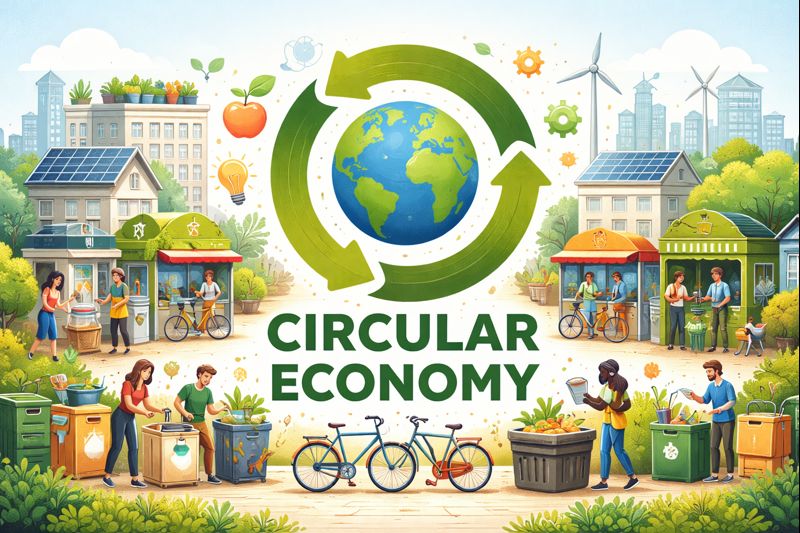
Madiha’s day starts like most students at 7:00 a.m. Her phone alarm buzzes the same phone she depends on for everything, even though it’s clearly not built to survive her degree. She gets ready in a rush, squeezing the last bit of face wash from a tube she’s been pretending isn’t empty all week, until it wheezes out one final bubble and forces her to toss it into the dorm bin with a dramatic sigh. On her way to campus, she grabs a coffee in a disposable cup and a plastic-wrapped snack because, as usual, she’s late for her 8:30 lecture, a class she has never once reached on time, despite daily promises to change. By the time she sits down, the bin beside her already holds her cup, wrapper, and a receipt she never needed. Without doing anything unusual, Madiha has created more waste before mid-morning than her grandparents might have in an entire day. Across the world, countries that have embraced circular economy principles are proving that circularity is not just an economic framework, it is a cultural shift. While policies and roadmaps play their part, the most meaningful change happens when societies weave circular habits into daily life. Circularity becomes behavioral. It becomes social norm and lifestyle.

Blue City Rotterdam’s Tropical Waterpark-turned Circular Lifestyle Hub
On the banks of the Maas River in Rotterdam sits a 12,000-square-metre building that once hosted a lively indoor waterpark. Today, that same space pulses with a very different kind of life: more than 40 start-ups, artisans, and bio-enterprises work side-by-side under the banner of circular economy. Known as BlueCity, this abandoned “Tropicana” swimming-pool complex has been transformed into a circular-economy living lab, where recycled concrete walls become office partitions, coffee-grounds feed mushroom farms, and plastic waste is shredded into raw material for 3D-printed products. Rather than discarding, everything gets reused, repaired, or repurposed inside the building itself. The ethos is shared: waste is not waste, but resources old buildings are not discarded, but reborn. Blue City demonstrates that circular economy is not just about bins or recycling it can be a way of urban life, a culture of reuse, and an ecosystem of innovation.
 BlueCity Rotterdam’s Tropical Waterpark
Kamikatsu, Japan a village that made circular living ordinary
In Kamikatsu a small mountain town circular economy isn’t policy jargon, it’s everyday life. Since the town adopted a “zero-waste” commitment, residents sort their trash into dozens of categories and bring it to a communal center rather than throwing it away. The town’s official recovery facility, the Kamikatsu Zero‑waste Center, manages waste with such care that around 80% of all garbage is recycled or repurposed, compared to roughly 20% in much of Japan. For Kamikatsu residents, it’s a shift in mindset: reuse, repair, and share are part of daily routines not an afterthought. Broken tools are fixed instead of discarded, plastic containers are cleaned and reused, and items unwanted by one household often find new life with another. The zero-waste lifestyle has become normal an embedded community value, not just an environmental project
 Kamikatsu village, Japan
San Francisco, USA Virtual Warehouse Program for City Owned Materials
While it’s common to have separate bins, San Francisco has gone further. Through its “Zero Waste Program,” the city doesn’t only collect waste it actively reuses surplus city-owned material (furniture, equipment, supplies) by donating them to non-profits, schools, or other public institutions rather than disposing them. This means that public-sector “waste” becomes a community resource turning government discard into opportunity, cutting demand for new production, and embedding reuse as a public-service norm. For residents, this creates an everyday culture in which second-hand, reused items are normalized not just for households, but for community and institutional use a shift from disposal to circular resource-sharing. This signals that circularity can be embedded in national systems rather than left to voluntary activism.
 San Francisco Warehouse
Ecocitex is reinventing fast fashion in Chile by repurposing used clothing.
In Chile, many garments discarded as “worn out” or “unsellable” end up in landfill. But one company is defying this throwaway culture, and that is Ecocitex. Ecocitex is a company founded by a team of inventive individuals who recover used and worn-out clothes and turn them into shreds and then recycle them into re-used yarn that can be utilized to create other clothes or other textile products. In so doing, Ecocitex will break the cycle of fast fashion waste. It encourages consumers to rethink their view of clothes as something that can be discarded, but as a component of an extended cycle of life. The rubbish has been turned into raw material; the unwanted has turned into new. Its round economy is not actually austerity but rather resourcefulness and inventiveness in that, sustainable fashion living in a consumer oriented society is not entirely impossible.
 Ecocitex, Chile
Isatou Ceesay the Recycling Queen of Gambia
As one small village in The Gambia, what started as a challenge of plastic pollution by a community evolved into an inspiring narrative of agency and strength. When Isatou Ceesay noticed plastic bags clogging her village and choking the red earth, harming living creatures, she just could not accept the fact that it was the way things are. In 1997, she established the Njau Recycling and Income Generation Group (NRIGG) with a few of her friends where they would collect plastic waste and handcraft it into reusable bags, purses among other things. What began as a non-event recycling project ended up becoming a social enterprise of significance: women made money, villagers realized plastic as an asset and garbage used to be a source of income and social empowerment. It demonstrates that despite the absence of formal waste-management infrastructure, local creativity, solidarity and entrepreneurship can create circular lifestyles.

Isatou Ceesay aka Queen of recycling , Gambia
These cases illustrate that circular economy only becomes meaningful when societies embed it into everyday life in how people consume, dispose, repair, reuse, and value materials. Circularity then shifts from a policy ideal to a lived lifestyle.
Everyday Life How Circular Economy Becomes Lifestyle?
Toronto Tool Library (Canada) Borrow Instead of Buying
In Toronto, a non-profit called Toronto Tool Library lets people borrow tools like books drills, saws, gardening gear, even 3D printers and laser cutters rather than buying them for one-time or infrequent use. The tools are checked out by members through an online system and are used at the length and breadth of the need without necessarily having to own the tools individually since they are returned after use. This habit is not only convenient and economical in the long run, but it also decreases the total demand of new products, decreases resource mining, and decreases energy waste precisely what a lifestyle of a circular economy is supposed to achieve. It questions the culture of owning things through purchasing. People lend and separate the normalization of access rather than ownership of tools, which are not often used in closets. Circular-economy behavior is being incorporated into everyday life, work, and community around the world, not as policy or strategy, but as lived reality. Fundamentally, a circular economy is not an industrial recycling facility, a hi-tech solution or a government national policy; rather, it is equally the lifestyle, consumption, disposal, and reuse patterns of everyday people. Circularity should be real: systems must relate to everyday life: shopping, discarding, repairing, sharing and disposing. Once households start to think about waste and consumption as a cycle rather than as a use-and-dispose line, the effect has a compound effect throughout communities, cities and eventually through nations. According to scholars, this sort of micro level of behavioral and social change is needed to have meaningful circular transitions.
 Toronto Tool Library (Canada)
Citizen Level: Smart, Practical Solutions to Live a Circular Lifestyle
And in its core, the circular economy is not a far-off policy or an elaborate model, but all around our kitchens, our shopping bags, our wardrobes and even how we handle a broken object. Big systems change is significant, but the actual transition is made in the background, in the daily decisions people make without much pageantry. When people move towards different consumption and disposal behavior, they contribute to the creation of the culture that will ensure the survival of circularity.
1. Buying Less and Choosing Better
It is common knowledge among most people to purchase something and forget about it in the following week. Circular living makes one ask before buying a product a different question: Do I really need this? Reducing, and better production of things, either a well-built water bottle, refillable soap bottle, or household goods that last longer eliminate waste at the beginning. It also reduces the environmental cost that no one gets to see behind each new product, the extraction, manufacturing, packaging and transport. This is not a matter of being right or being low in cost, but it is a matter of using one’s brains. A few minutes of delay in making a purchase are likely to minimize clutter, economy and decreasing our footprint without feeling deprived.
2. Reusing and Repairing
It is common knowledge among most people to purchase something and forget about it in the following week. Circular living makes one ask before buying a product a different question: Do I really need this? Reducing, and better production of things, either a well-built water bottle, refillable soap bottle, or household goods that last longer eliminate waste at the beginning. It also reduces the environmental cost that no one gets to see behind each new product, the extraction, manufacturing, packaging and transport. This is not a matter of being right or being low in cost, but it is a matter of using one’s brains. A few minutes of delay in making a purchase are likely to minimize clutter, economy and decreasing our footprint without feeling deprived.
3. Composting: Returning Food to the Earth
Food scraps that are found in every kitchen include banana peels; tea leaves as well as vegetable stems. Most households are composting them either at small bins on balconies or at community compost centers, rather than throwing them in a bag, which finds its way to a landfill. Over time, scraps turn back into rich soil a full circle from food to earth and back again. It’s simple, natural, and surprisingly satisfying. And for those who love plants or small gardens, homemade compost is a gift.
4. Sharing Instead of Owning Everything
Most people own things, they rarely use a drill that comes out once a year, camping gear used only on holidays, a blender that gathers dust. Instead of each household buying and storing everything, communities and neighborhoods are increasingly moving toward sharing or borrowing. This can look like a “library of things,” a neighborhood WhatsApp group for tool-sharing, or even casual loaning between friends. Not everyone needs to own everything. Sharing reduces consumption, saves space, saves money, and strengthens community ties all while keeping resources in circulation longer.
A Circular Future Starts with Us
Circularity isn’t some far-off ideal. It’s already taking shape in our homes and communities, asking us to see our belongings not as disposable but as valuable resources. A future defined by circular living begins with small, steady habits one refill, one repair, one shared tool at a time, each one a ripple that, together, becomes a wave. For years, the numbers have warned us where we’re headed. The world now produces about 2.1 billion tons of municipal waste each year, a figure the UNEP says could reach 3.8 billion tons by 2050 if we continue consuming and discarding at today’s pace. The real cost isn’t only in the trash itself but in the pollution, health risks, and climate impacts that quietly accumulate around it. Yet within this crisis sits a possibility. From villagers sorting waste by hand to designers repurposing old clothes and families composting kitchen scraps, people across continents are already showing that circularity isn’t just a policy idea. It’s a way of life one that grows from everyday choices rather than grand declarations. When people choose durability over disposability, repair what breaks, sharing what they rarely use, or simply keeping an item a little longer they quietly join a movement that’s far more powerful than it looks. In recent research even small shifts matter research shows that extending the life of clothing by just nine months can reduce its carbon, water, and waste footprint by 20–30%. Now imagine those choices multiplied across millions of households reusing jars, composting scraps, borrowing tools, fixing instead of tossing. These habits don’t just reduce waste; they reshape demand, influence how products are made, and ease the strain on the planet.

Muhammad Atif Zia is pursuing a Master of Arts in Economics at Universitas Islam Internasional Indonesia (UIII), specializing in Circular Economy, behavioral economics, and sustainability transitions. With experience in the pharmaceutical and banking industries, he examines how everyday behavior influences economic and environmental systems in emerging economies.
This article examines how the systemic failure of urban waste...
Indonesia is spending Rp 75.8 trillion (around US$4.7 billion) building...
This article analyzes climate vulnerability across Economic Community of West...
This article argues that addressing climate change in the Global...
This article examines Indonesia’s transition from reactive emergency disaster spending...
This article examines the DRC–Rwanda peace accord through the lens...
This article offers a comparative reflection on how Islam has...
This article examines how youth-led, digitally networked movements are reshaping...
This article examines why forest-based approaches remain critical for addressing...
This article exposes the injustice of Afghanistan’s exclusion from COP30...
This article highlights the significant emotional and mental health burden...
This article defines Code Green as a model of public...
This article analyzes how China’s ambitious green transition serves not...
This article traces how the 2025 UN General Assembly turned...
This article looks at how Indonesia’s provinces with extensive biodiversity...
This article examines how climate change and privatization intersect to...
This article analyzes how Trump’s second time withdrawal from the...
This article critically analyses Pakistan’s worst floods ranging from the...
This article examines the climate vulnerabilities of Pari Island in...
This article traces how Pari Island in Jakarta’s Thousand Islands...
This article explores how ecotourism in Indonesia’s Thousand Islands generates...
This article compares how U.S. Presidents Joe Biden and Donald...
This article explores the devastating impact of human activities such...
This article critically examines the European Union’s Carbon Border Adjustment...

















Leave A Comment