
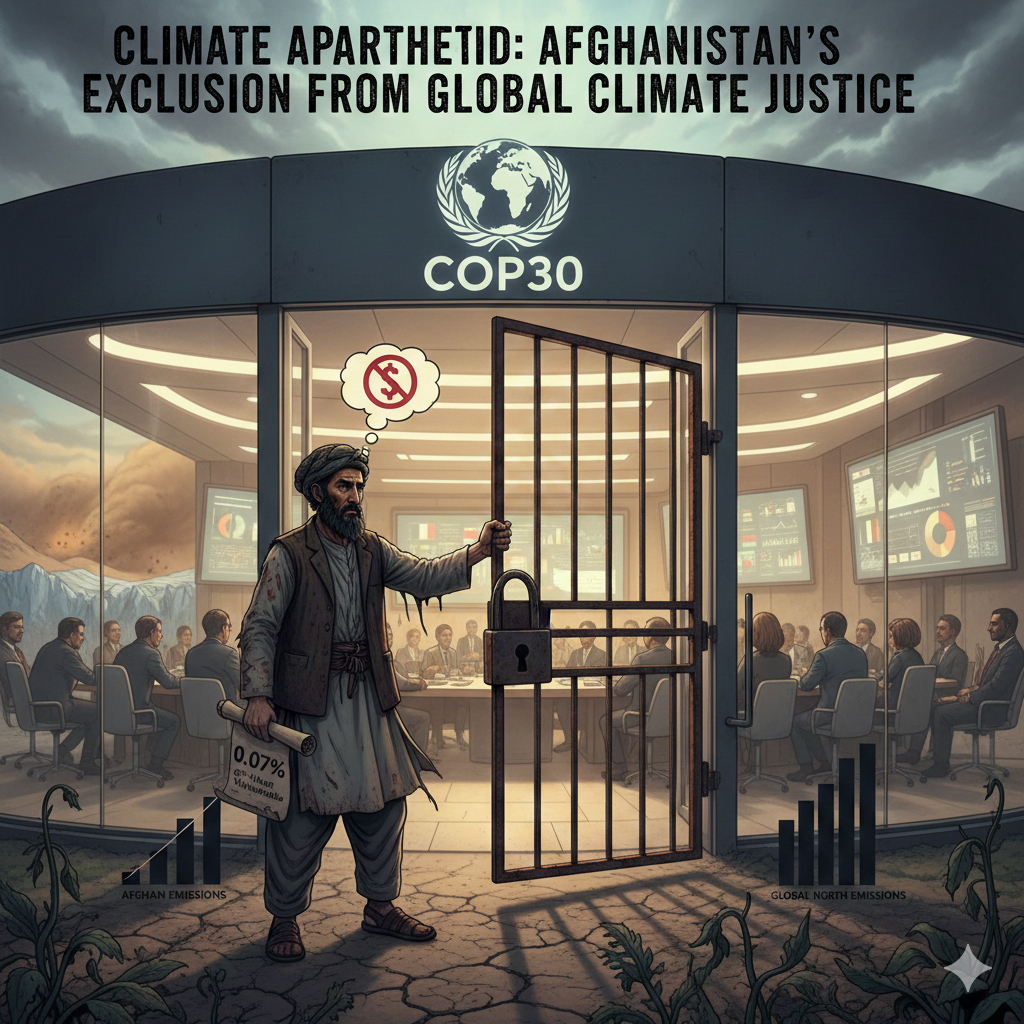
The case of Afghanistan illustrates a profound injustice in global climate governance: despite contributing a negligible 0.07% of global emissions, the country is ranked among the ten most vulnerable worldwide, yet remains one of the least-prepared to adapt. This stark vulnerability shows that Afghanistan’s absence from the recent Conference of the Parties (COP30) in Belém, Brazil, is both regrettable and concerning. While 193 nations convened for negotiations, Afghanistan was denied a seat, a decision that directly contradicts the declared international principles of "No one should be left behind," "every voice matters," and "collective action," thereby marginalizing a nation facing severe, climate-induced existential risks.
After the Taliban took over Afghanistan in 2021, the nation has been systematically excluded from any meaningful participation in international climate negotiations. Afghanistan did not attend COP28 in the United Arab Emirates. Although Azerbaijan invited a Taliban delegation to COP29, it did so only as a guest of the host country, not as an official participant, but merely as an observer allowed to attend side events and hold informal meetings. However, even this limited engagement was not sustained. For COP30 in Brazil, Afghanistan was not invited at all, despite the National Environmental Protection Agency having already expressed its willingness to participate and prepared both a delegation and a roadmap.
The rationale behind this exclusion by the United Nations Framework Convention on Climate Change (UNFCCC) is obvious, not even a single nation, other than Russia, does so as recognizing the Taliban as the legitimate government in Afghanistan, as they are gross violators of human rights, especially due to the systematic oppression of women and girls. The Bureau of the COP of the UN Framework Convention on Climate Change has since 2021 not discussed the issue of whether or not Afghanistan should participate, effectively putting the country out of the negotiations. This produces a tragic irony the Afghan people are being locked out of climate talks, ironically as a result of policies that are inculcated by a regime that they had no say in, but rather the Afghan people bear the brunt of climate change and their marginalization.
This is an unjust situation that cannot be overestimated. Afghanistan has an average of 0.07 percent of the total global greenhouse gas emissions, which is one of the lowest carbon per capita footprints in the world. In perspective, Afghanistan contributes an average 0.14 tonnes of CO2 per capita into the climate crisis every year, but despite this insignificant contribution to the climate crisis, Afghanistan is classified as the sixth to eighth most vulnerable nation on Earth to the effects of climate change.
Implication for Policy Making and Governance
The impact of exclusion of Afghanistan in COP meetings is devastating to the capacity of Afghanistan country to develop and act on the effective climate policy. With no seat at the negotiating table, Afghanistan will not be able to formalize its updated Nationally Determined Contributions (NDCs) the document of declaring plans, vulnerabilities and financial requirements on climate of a country under the Paris Agreement. These updates had been prepared by the country prior to the Taliban takeover, but due to the international non-recognition, these updates have not been formally submitted.
Such omission establishes a policy gap. Although the National Environmental Protection Agency (NEPA) under the Taliban care has voiced the issue of climate change and has tried to get involved in international processes, the lack of officially joining it in any form implies that Afghanistan has no representation in global climate structures, it is not able to receive technical advice of international climate organizations, and it is not able to coordinate national policies with changes in the rest of the world. The outcome is that Afghanistan suffers in climate governance in solitude without knowledge sharing, best practices, and coordinated strategies that can be available to other vulnerable countries through the participation in COP.
Barrier to Climate Finance
The reduction of Afghanistan to almost total dependence on the international climate finance mechanisms is, perhaps, the most harmful impact of exclusion. Prior to 2021, three large UN climate funds, such as the Global Environment Facility (GEF), the Green Climate Fund (GCF) and the Adaptation Fund, were able to assist Afghanistan. There were a number of water resource management and disaster risk reduction projects worth millions of dollars that were awaiting approval. These projects were halted immediately by the Taliban take over.
In 2015, the government of Afghanistan projected that 2020-2030 climate mitigation and adaptation in Afghanistan will require about 17billion dollars- about 1.7 Billion a year. Considering that the economic damages already experienced due to climate shocks stand up to 3 billion dollars annually, it is financially not viable to mitigate climate change in Afghanistan without the aid of the international community. However, the nation is virtually locked out of even the financial processes that are meant to assist nations in distress to cope.
The UN agencies are trying to bypass the established authorities by proposing projects where they are the requesting agency and the implementing partner, which, of course, is the Taliban government. Nonetheless, this strategy is as well small-scale and poses coordination issues. Climate finance then takes place through fragmented humanitarian initiatives and not systematic development programmes, because there is no recognized government to relate to.
Impact on International Relations
The fact that Afghanistan has not been incorporated in COP reflects and confirms its overall isolation to the rest of the world. Taliban government that can only be recognized by Russia as of mid-2025 has been desperately trying to get international legitimacy. Climate diplomacy is one of the few spheres in which the Taliban tried to start a constructive interaction with the international community, claiming that climate change is a global problem and cannot be discussed in terms of political differences.
Scholars and practitioners believe that there should be de-politicization of climate engagement whereby the environmental agencies can participate on technical levels without giving political credence to the Taliban government. The example of COP29 when Afghanistan came as a guest of the host country and not a party is one of the possible models. Nevertheless, this strategy is questionable and it was not repeated with COP30.
The exclusion also undermines the moral authority of the international climate regime. The principle of "common but differentiated responsibilities" recognizes that developed countries, which caused most historical emissions, have special obligations to help vulnerable developing countries adapt. When the sixth most vulnerable country in the world cannot access climate finance because of a regime it did not choose, it reveals the limits of climate justice in practice. As one UN official noted, "If one of the countries most affected by climate change in the world cannot access international climate funds, it indicates that something is amiss".
Depoliticizing Climate Governance
Climate change is a global issue that requires collective action. All nations, regardless of their political status deserve equal treatment and the right to raise their voices.
Nevertheless, COP has become politicized to an extent that it goes against its principles of inclusiveness and international cooperation. The fact that Afghanistan is not a COP30 did not just happen as an unfortunate bureaucratic backlash, but a symptom of the international community being unable to seperate climate justice from political recognition. A country that contributes almost nothing to global emissions yet faces some of the most severe climate impacts is being denied the right to participate in discussions that directly concern its survival.
Finally, Afghanistan has millions of citizens, who are entitled to speak, to express their concerns, and to negotiate for their future in global climate forums.

Sayed Anwar Wisa is an Afghan public policy practitioner currently pursuing a Master of Public Policy with a specialization in Climate Change at the Indonesian International Islamic University (UIII). Trained originally as a civil engineer, his growing commitment to environmental issues and the profound impacts of climate change on Afghanistan led him to shift his academic and professional focus toward climate policy. He has contributed to freshwater and community conservation efforts through a project with the National Geographic Society (NGS) and The Nature Conservancy (TNC), where he explored Kabul’s water challenges through storytelling. He is driven by the conviction that the climate crisis can still be confronted through collective action, strong advocacy, and decisive, sustained commitment.
This article examines how the systemic failure of urban waste...
Indonesia is spending Rp 75.8 trillion (around US$4.7 billion) building...
This article analyzes climate vulnerability across Economic Community of West...
This article argues that addressing climate change in the Global...
This article examines Indonesia’s transition from reactive emergency disaster spending...
This article examines the DRC–Rwanda peace accord through the lens...
This article offers a comparative reflection on how Islam has...
This article examines how youth-led, digitally networked movements are reshaping...
This article examines why forest-based approaches remain critical for addressing...
This article exposes the injustice of Afghanistan’s exclusion from COP30...
This article highlights the significant emotional and mental health burden...
This article defines Code Green as a model of public...
This article analyzes how China’s ambitious green transition serves not...
This article traces how the 2025 UN General Assembly turned...
This article looks at how Indonesia’s provinces with extensive biodiversity...
This article examines how climate change and privatization intersect to...
This article analyzes how Trump’s second time withdrawal from the...
This article critically analyses Pakistan’s worst floods ranging from the...
This article examines the climate vulnerabilities of Pari Island in...
This article traces how Pari Island in Jakarta’s Thousand Islands...
This article explores how ecotourism in Indonesia’s Thousand Islands generates...
This article compares how U.S. Presidents Joe Biden and Donald...
This article explores the devastating impact of human activities such...
This article critically examines the European Union’s Carbon Border Adjustment...








Leave A Comment