
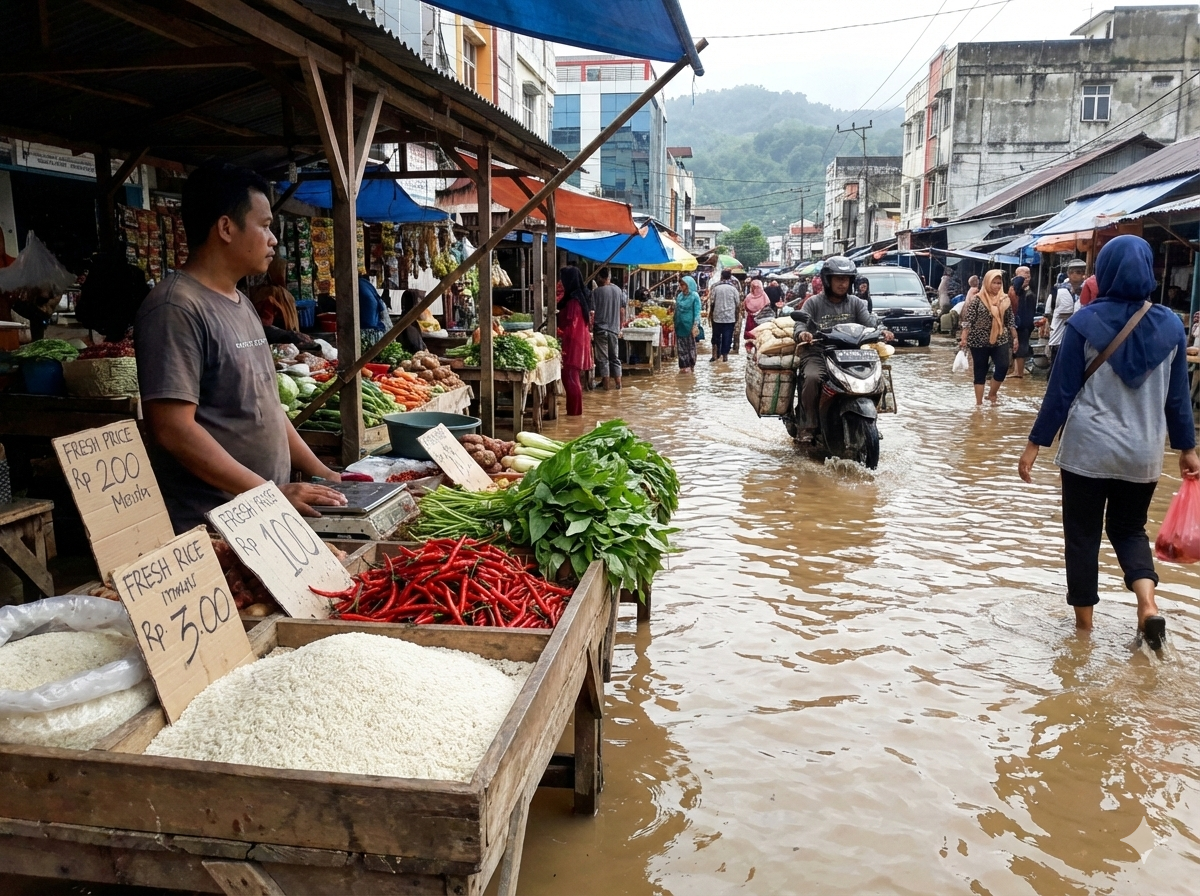
Padang serves as a coastal urban center which also operates as an agricultural center for West Sumatra. The city has experienced multiple climate and development challenges which result from different pressures that combine together. The city has experienced multiple climate-related issues through the past few years which include heavy rainfall and river discharge and severe weather events that create repeated major floods which destroy agricultural fields and disrupt market operations and push food costs higher for both city and rural residents. The agricultural cycle that produces floods which then destroy crops before causing price increases creates a dual problem for food production and social economics which exposes food system weaknesses and leads to greater social inequality in Padang.
Floods are at the core of the food supply crisis as they hit the fields, seedlings, irrigation facilities, and local distribution routes that form the physical base of food supply. Studies based on experience of rice farming in Padang reveal that flooding causes immediate crop loss, soil nutrient depletion, and delays in planting windows that lead to lower annual yields. For instance, a regional study on rice farming in Padang, which is based on modeling scenarios, came to the conclusion that flood events lead to drastic production losses and the need for risk management strategies to be put in place specifically for paddy areas in order to both protect them and keep supply going.
Markets react immediately when local production experiences a significant decline. Traders and market intermediaries who encounter reduced local stock levels expand their procurement activities to reach distant districts and islands. The replacement of goods leads to elevated procurement expenses because of extended transportation routes and damaged transport infrastructure which includes roads and bridges destroyed by floods and intensifies the supply chain disruption. The National Statistics Offices of Indonesia have identified weather-related damage and infrastructure failures as the main causes behind recent price increases in rice and staple foods because supply shortages and transportation obstacles lead to regional price spikes.
Padang’s food basket which includes rice and chili and leafy vegetables and fish faces major risks because these products spoil quickly and their production remains limited to specific areas. The destruction of wet paddy fields together with the flooding of vegetable gardens and fish pond contamination leads to instant shortages of fresh agricultural products. The West Sumatra province had to focus its resources on emergency recovery operations and agricultural production restoration because major flooding destroyed thousands of hectares of farmland. The market experienced immediate price surges for essential fresh products and basic staples which directly resulted in these losses.
Price spikes are not merely a temporary inconvenience; they translate quickly into food insecurity for low-income households. Households with low income dedicate more of their budget to food expenses which leads them to switch from healthy food choices to inexpensive calorie-rich but nutritionally poor options that harm both child nutrition and community health. The research conducted at the household level in Indonesia reveals that repeated flooding events destroy household food security for several years because families must use their savings and sell their assets and borrow money to survive. These coping strategies reduce resilience to subsequent shocks and can lock families into longer-term vulnerability.
Padang's vulnerability is deepened due to two structural factors. Firstly, the city is heavily reliant on localized production and has a very limited storage capacity. In situations where there is a lack of post-harvest storage and buffer stocks, even a minor production shortfall can lead to a rapid shortage of the market. Secondly, there is a scarcity of formal risk-transfer mechanisms, such as reasonably priced crop insurance or social safety nets, that can help smallholder farmers and poor urban consumers; thus, these groups are still fully exposed to price volatility. Research on rice price determinants across Indonesia points out that, production shocks, weather variability, and damage to infrastructure are, in most cases, the main causes of price fluctuations, particularly when market integration is not complete.
Mitigating post-flood price spikes in Padang requires a combination of strategies that are based on both temporary relief and lasting resilience. Short-term measures which were effective in other regions of Indonesia include, inter alia, first rapid assessments to direct the delivery of emergency foods where there is absence of supply and malfunction of markets, temporary price controls or food subsidies targeted at the most vulnerable groups and the repair of the most essential transport routes to facilitate market access again. The medium- and long-term measures are mainly about production with an emphasis on the agricultural sector: besides restoring and modernizing the drainage systems, the rehabilitation of flood-damaged rice terraces and fish pond, the use of climate-resilient crop varieties and the planting at different times for crops to reduce the risk of failure in the entire region, are some of the measures. Provincial rehabilitation programs in West Sumatra, which are designed to restore tens of thousands of hectares of land that have been damaged, demonstrate the scale of the intervention that is necessary to stabilize supply.
What is equally necessary are market-oriented solutions to the problem: these include investment in rural storage and cold-chain logistics, making market information systems more efficient so that both traders and consumers can react quickly, and promoting regional trade linkages which lower the risk of a single production zone while at the same time ensuring that local farmers continue to receive incomes. Innovations in policies like subsidized micro-insurance for smallholders, cropforgiveness programs, and improved social protection systems can help households to have fewer impacts from price shocks. The research that deals with the socio-economic consequences of flooding points out that if there are no measures to protect the poor directly, then price spikes will result in welfare losses and nutritional deficits that will last for a long time.
At last, any feasible plan in Padang should definitely be based on the perspectives of the people living there. Farmers, fishers, market vendors, and women who manage households are the ones who directly experience and react to floods; therefore, their practical knowledge provides the most reliable ways of implementing culturally safe measures. For instance, from communal seed banks to small-scale raised beds and local early-warning networks which are usually neglected by formal documents. A humanized intervention understands that resilience is not just a technical aspect but a social one as well: hence, building trust, strengthening local institutions, and granting easy access to timely cash assistance and information lessens the period between the occurrence of a shock and recovery.
In conclusion, the destruction of crops by flood events in Padang operates as a contributing or proximate cause of the swift increase of food prices, which immediately affects the poor. The mitigation of the ripple effects of the problem of destroyed fields, hence the rising food price, demands concerted strategies and the implementation of approaches for the recovery of the affected sectors, stabilization of markets, and adaptation strategies informed by the region.

Bala Muhammad is a postgraduate student in Mathematics with a strong foundation in Computer Science at Universitas Andalas. His academic and research work focus on machine learning, data science, computer vision, optimization, and mathematical modeling. He is particularly interested in applying analytical and intelligent computational methods to real-world problems across science and engineering.
This article examines how the systemic failure of urban waste...
Indonesia is spending Rp 75.8 trillion (around US$4.7 billion) building...
This article analyzes climate vulnerability across Economic Community of West...
This article argues that addressing climate change in the Global...
This article examines Indonesia’s transition from reactive emergency disaster spending...
This article examines the DRC–Rwanda peace accord through the lens...
This article offers a comparative reflection on how Islam has...
This article examines how youth-led, digitally networked movements are reshaping...
This article examines why forest-based approaches remain critical for addressing...
This article exposes the injustice of Afghanistan’s exclusion from COP30...
This article highlights the significant emotional and mental health burden...
This article defines Code Green as a model of public...
This article analyzes how China’s ambitious green transition serves not...
This article traces how the 2025 UN General Assembly turned...
This article looks at how Indonesia’s provinces with extensive biodiversity...
This article examines how climate change and privatization intersect to...
This article analyzes how Trump’s second time withdrawal from the...
This article critically analyses Pakistan’s worst floods ranging from the...
This article examines the climate vulnerabilities of Pari Island in...
This article traces how Pari Island in Jakarta’s Thousand Islands...
This article explores how ecotourism in Indonesia’s Thousand Islands generates...
This article compares how U.S. Presidents Joe Biden and Donald...
This article explores the devastating impact of human activities such...
This article critically examines the European Union’s Carbon Border Adjustment...












Leave A Comment