
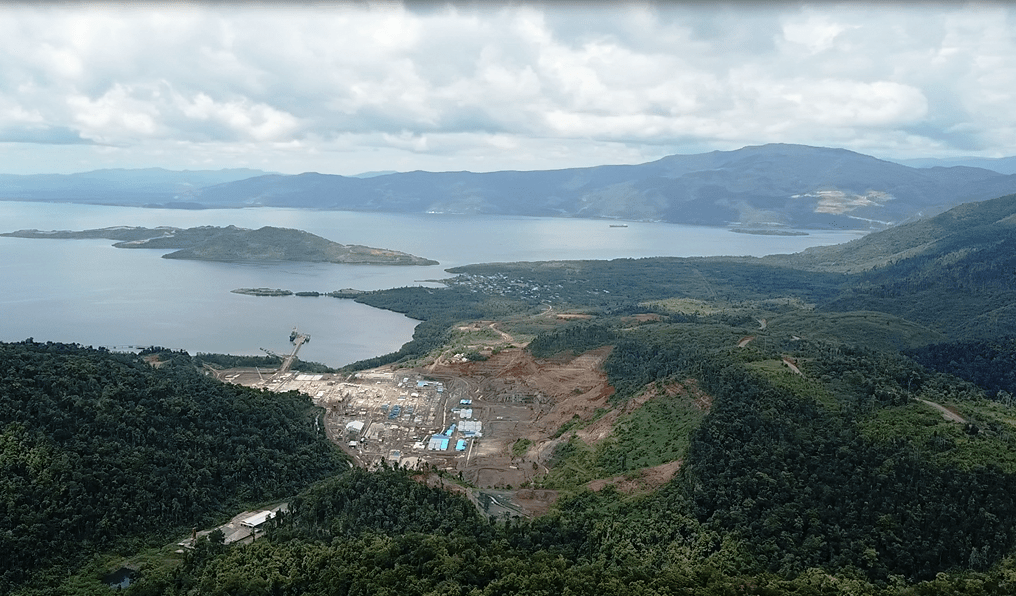
A mining concession area in the middle of the forest on Halmahera Island, North Maluku. (Photo: Budi Nurgianto/Ekuatorial).
With 62 million metric tons, or equal to 44 percent of global nickel reserves, Indonesia is the capital of global nickel production. Nickel downstreaming policy or officially promoted as hilirisasi nikel (which no longer allows raw nickel export)has made the country the center of the global clean energy transition.
Since this policy was enacted in 2020, the Non-Tax State Revenue (PNBP) from the mineral and coal sector has increased significantly. As of mid-May 2026, PNBP had already reached Rp55 trillion, surpassing the Rp34.6 trillion of the entire 2020’s PNBP. If the 2026 target PNBP of Rp133.93 trillion can be achieved, this number will be almost four times the level recorded before downstreaming began.
Nickel-producing provinces have also recorded high economic growth. Observing the economic growth of a nickel-producing region such as North Maluku, for instance, the figure has risen from 7.92% in 2018 to 34% in 2025 and 19.6% in the first quarter of 2026. Under Jokowi, and now Prabowo, these dramatic developments are often glorified to justify downstreaming as one of Indonesia's most successful industrial policies in recent years.
Yet, even when mining brings large economic benefits to the country, social conflicts and environmental problems continue to occur in many mining areas. Why? We argue that the issue is related to a more difficult question. This is about who dominates the decision-making process and how those benefits are defined, calculated, and eventually distributed in fair and just ways.
This issue is therefore not as trivial as the fact that government agencies and corporations often invite the locals to participate in so-called collaborative forums. Much more fundamental, how benefits are distributed is closely linked to how participation in meetings on CBS is organized in a way that prevents power distribution to the locals.
At this point, there is urgency to shift value creation questions through downstreaming to the political ones, of who is able to shape decisions on how those benefits are distributed?
Participation without influence
Community participation in mining has been regulated in various regulations including Law No. 4 of 2009, Law No. 3 of 2020, Law No. 2 of 2025, Government Regulation No. 96 of 2021, Government Regulation No. 39 of 2025, and Ministerial Decree No. 1824K/30/MEM/2018; hence, the problem is not the lack of participation forums.
But a closer reading shows that communities largely remain at a consultative level. In those regulations, communities are expected “to be consulted”, “involved”, or “asked for their views.” They are not yet positioned as actors with the authority to make or influence key decisions.
In other words, participation exists, but influence remains limited. Communities may be present in meetings, but their presence does not necessarily alter the final decision.
The first constraint starts with the way mining-related problems are understood, discussed, and addressed. Official problem representation in the nickel industry tends to have biases in favor of the mobilization of less contentious issues (such as CSR programs or compensation schemes) and conflicts, and the suppression of others. The suppressed “others”, unfortunately, often directly affect the fate of the locals.
Who benefits most from mining activities? Who decides what kind of development should be prioritized? And whose interests are considered when benefits are shared? These issues and conflicts are expelled from being disputed far before the discussion even starts.
As a result, benefit sharing is often treated as an administrative or technical matter, such as benefit sharing formulas, rather than a political question about power and distribution.
The issue becomes even more complicated because participation has never taken place on equal terms from the beginning. The state and corporations possess greater resources, stronger access to bureaucracy, along with technical expertise that are beyond the reach of local communities.
Under such conditions, as political economist Garry Rodan (2018) argued, participation can easily function as a mechanism for confining conflict rather than sharing power. Communities may be invited into consultation processes. But this does not necessarily mean they have meaningful influence over decisions.
After the 2020 revision of the Mining Law, the situation has been worsening. One change was the removal of sanctions for abuse of authority that used to be stated under Article 165 of Law No. 4 of 2009.
Since then, it is more visible that those who are closer to political and bureaucratic circles tend to have more room in accessing decisions and also in shaping how things are eventually decided, while communities in mining areas remain in a weaker position.
Participation forums, therefore, risk becoming a source of procedural legitimacy for decisions that are largely shaped before consultations take place.
Re-politicizing participation
What are the options?
The absence of such recognition since the beginning has closed off the emergence of alternatives in the way nickel mining is governed, including the distribution of CBS in a just way. In such contexts, what is needed first is not to create more forums. Instead, it requires the shift in participation paradigm which previously prescribes harmony and enact depoliticization to the institutionalization of participation which recognizes and facilitates conflicts as part of politics in a democracy.
Second, participation should go beyond consultation to negotiation. Contentious issues and conflicts should be mediated by credible and independent mediators. Policy brokers (experts in collaboration whose work is oriented toward finding negotiated terms) can facilitate negotiations over land, environmental impacts, or the direction of local development.
Third, participation should have maintenance mechanisms to ensure that rules, implementations, and accountability are guaranteed so that these multi-stakeholder platforms can become “the only game” adhered to by government agencies, corporations, civil society organizations, and local communities.
Ultimately, fourth, without undermining the importance of generating economic growth, ensuring that communities in producing regions have a real influence over decisions that affect their daily life and local development priorities is equally pivotal.
Without that, downstreaming risks producing a model of development where economic growth may continue, but local communities remain largely excluded from decisions that shape their future, and the future of their environment.

Ashari Cahyo Edi earned an MA and is currently a PhD candidate in Political Science at the University at Albany, State University of New York (SUNY), funded by the Fulbright Scholarship. He also holds an MPA from the Joseph R. Biden Jr. School of Public Policy and Administration, University of Delaware, funded by a USAID-PRESTASI Scholarship. He further participated in a Spring School on Democracy in the Global South at University of Oslo, Norway. He is a full-time faculty member in the Department of Politics and Government at Universitas Gadjah Mada and serves as a research fellow at INFID. His research interests include policy process politics, NGOs and advocacy, village governance, and the politics of corporate social responsibility.

Dhivana Anarchia Ria Lay is a research assistant at the PolGov Research Center, Faculty of Social and Political Sciences, Universitas Gadjah Mada.
In this article, Affabile Rifawan examines the shifting landscape of...
This article examines how Indonesia’s nickel downstreaming policy has driven...
This article examines the "permission economy" in Pakistan, an informal...
This article examines how the illicit smuggling of critical minerals...
This article argues that poverty and uneven development in the...
This article explores how the Global South is reevaluating its...
This article examines the challenging path for Indonesia to meet...
This article analyzes Nigeria’s attempt to convert carbon credits into...
This article examines how Indonesia’s MBG program, while reaching more...
This article critically analyzes the 17th BRICS Summit communique, highlighting...
This article explores what Indonesia’s upcoming Digital Rupiah can learn...
This article explores how Indonesia can transform its steady economic...
This article discusses how global ESG standards, mainly created within...
This article explores Indonesia’s resilient people-based economy, driven by 65...
This article examines Indonesia’s 2025 economic turmoil, marked by a...
This piece explores how Pakistan can harness its rich cultural...
This incisive piece unpacks the deeper logic behind Trump’s so-called...
This article introduces Sustainable Prosperity Investing (SPI) as a hybrid...
This article examines how globalization challenges the authority of Islamic...
This article examines Danantara, Indonesia’s recently launched sovereign wealth fund...
This article explores how digital payment systems are reshaping financial...
This article explores the expansion of Islamic banking beyond Muslim-majority...
This article examines the impact of Trump’s aid cuts on...
Nestled within the Singapore-Johor-Riau Growth Triangle, Bintan Island has quietly...




Leave A Comment