
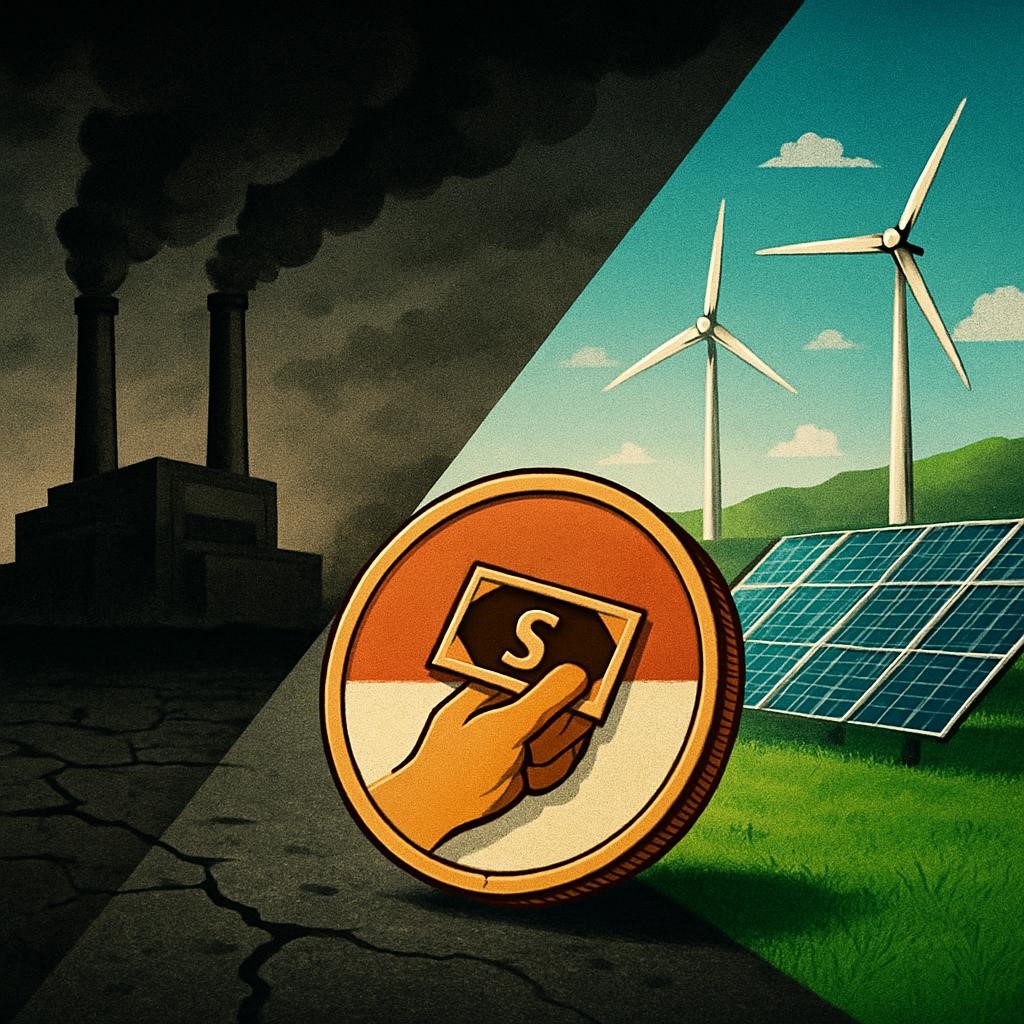
Indonesia is a major producer and consumer of coal worldwide, and coal energy plays a crucial role in the country's energy structure. About 60 percent of the electricity produced in Indonesia is from coal, which highlights the importance of the sector in supplying energy and presents serious climate and health issues (Paiboonsin et al., 2023). Indonesia has committed to net-zero emissions by 2060, has submitted its Nationally Determined Contributions (NDCs) that are consistent with the Paris Agreement, and this reduces the need to decarbonize its energy mix as it seeks economic growth (Santosa et al., 2023). The primary question that will guide this article is whether Indonesia can achieve a coal-free status quickly enough to meet these goals, given the high costs of the transition, and the crucial question: who will finance this transition? It is noted that financing is one of the key challenges that will have a significant impact on the design of policies, technology directions, and the issues of equity (Syabriyana, 2024).
Why Indonesia Must Phase Out Coal: Climate, Health, and Economic Pressures
Indonesia has the binding climate commitments in the form of the Paris Agreement, wherein parties are obligated to seek domestic mitigation efforts and ambition enhancement regularly to reduce warming to levels well below 2°C and aim at 1.5°C (Elzen et al., 2023). The power sector, which is majorly coal-based, contributes to the increasing greenhouse gas emissions as the demand rises and generation is still carbon-intensive (Hersaputri et al., 2024). The cost of coal burning to public health is immense due to low air quality, the heightened concentration of particulate matter and other pollutants, which compromise respiratory and cardiovascular health (Syuhada et al., 2023). The worldwide energy change is simultaneously leaning towards less expensive and more competitive renewables due to technology gains, a decreased Levelized Cost of Energy, and policy backing, which further strains its reliance on coal (Vrontisi et al., 2018). All these dynamics are a good empirical and normative argument for a faster phase-out of coal as a necessary step towards climate targets, public health, and economic competitiveness, but it acknowledges that there will be a funding issue that will be discussed later (Elzen et al., 2023).
The process of decommissioning coal requires multidimensional expenses that go beyond the plant decommissioning price tag. Stranded assets are those that investors suffer because coal plants have ended their productive life sooner than it was expected under the low-carbon policies, and they have assets that cannot generate expected returns (Ordóñez et al., 2021). Early retirements would be unrecovered capital spending and debt service payments, and lower asset valuation to financial feasibility and creditworthiness of the PLN (the state utility) and the private owners (Ordóñez et al., 2021). One of the key aspects is payment: investors have to be rewarded when closing or restructuring under current power purchase agreements and concession possibilities and lays fiscal and regulatory burdens on the state and on ratepayers (Roelfsema et al., 2020). Integrating the grid is very expensive: to substitute coal with renewables, the grid needs substantial upgrades, increased interconnection capacity, and investment in energy storage to deal with intermittency, voltage regulation, and reliability, which can increase the cost of the system in the short run (Chen and Mauzerall 2021).
Costs of social and economic transition are also important. The regions that mine coal, like Kalimantan and Sumatra, lose jobs, experience economic declines in the region, and their societies do not feel secure without specific policies. Therefore, there must be a Just Transition model, re-training, regional diversification, social protection, and active labor policies that will help allocate costs fairly and keep social unity, and allow a quick, believable transition off coal (Ordóñez et al., 2021).
Who Pays? Financing Challenges for the State, PLN, Donors, and the Private Sector
International Financing: The Role and Limits of the JETP
The Just Energy Transition Partnership (JETP) is a group initiative intended to seek international financing to support the energy transition in Indonesia, with an envelope target of approximately USD 20 billion to decarbonize the power sector at a faster rate (Wardhana et al., 2024). The funding structure includes grants, concessional loans, commercial loans, and private funding, which means that not all funds are provided on favorable terms; some of the instruments have a cost corresponding to the market rate, or prospects of returns that might change the affordability and risk profile of the entire package. The JETP is a massive inflow of capital and policy, yet has a comparatively limited total cost impact on the coal phase-out in Indonesia, thus a major financing gap that should be filled by domestic and international finances, as well as the involvement of the private sector (Auger et al., 2021).
Besides, the timing and sequencing of investments may be influenced by conditionalities and policy requirements related to disbursements, which may require policy changes before project approval and could limit fast deployment. Even though such international support is essential and reflects the political commitment, its small size and terms of mixed financing suggest that the JETP is not a one-size-fits-all tool but a complement to the problem of full transition that Indonesia needs, and the support should be considered a partial measure (Auger et al., 2021).
The Role of the Indonesian Government
The Indonesian government is a central possible payer in any coal phase-out as it is both the owner of the main energy institutions, the regulator, and the final guarantor of public finances. The state, as the main fiscal player, could finance some of the transition by redistributed subsidies, implementing fiscal austerity, issuing debts, and leave the gap using international finance and private capital. Budgetary limits, however, and competing priorities, such as infrastructure development, health, education, and continued subsidies, restrain the amount of energy transition that can be made within the annual budget, though policy sequencing and policy reform are necessary, as opposed to what can be made within budget capacity. The fiscal space of Indonesia is also limited because it has high levels of social debt and high levels of fossil-fuel subsidies, and other current commitments based on social protection and development projects, which lower the margin of the high, front-loaded transition costs. Paying PLN (Perusahaan Listrik Negara) and individual investors to prematurely retire their coal resources may incur significant near-term liabilities, which may increase the contingent liabilities and influence the credit metrics in case it is funded domestically. Although the government has the key role to play in transition, it should not be expected to entirely fund its efforts; blended finance, international assistance, and capital will be vital in preventing the incurring of unsustainable fiscal liabilities.
PLN’s Financial Constraints and Structural Barriers
Financial ability of PFN is limited by the continued high level of operating expenses, high debt service, and high asset base of coal. The balance sheet of the utility has minimal fiscal room to cover massive and sudden losses of premature coal retirements, casting doubt on its solvency and creditworthiness in the absence of outside rescue (Cui et al., 2019). Power Purchase Agreements (PPA) with coal plant operators are not very effective in locking in Indonesia to coal generation over long periods, which makes the sequencing of transition more complex and the risks associated with stranded assets more significant if the Indonesian policy goals change abruptly towards decarbonization (Cui et al., 2019). Without significant external subsidies or risk-sharing instruments, PLN will not be able to pay the financial losses of early retirements of coal assets without disrupting the electricity tariffs and reliability requirements (Edwards et al., 2022). It highlights the necessity of blended financing solutions that allocate transition costs among both domestic budgets and global finance as well as the involvement of the private sector, in order to ensure the financial stability of PLN and allow the country to have a plausible phase-out path.
International Donors and Climate Funds
The international donors and climate funds, such as development banks and the Green Climate Fund (GCF), are essential in offering grants and concessional funding to the de-risking investments of transition (Steckel et al., 2016). Nevertheless, existing pledges by donors are not enough to finance the entire process of coal phase-out in Indonesia, which means that a funding gap will persist and will have to be closed either locally or by private means (Lopes and Albuquerque 2023). Donor funding may also come with conditionalities, governance rules, and policy conditions that may impact the timing, extent, and order of funded projects, which may slow the deployment in case domestic readiness is lagging (Steckel et al., 2016).). Although international assistance promotes more credibility and reduces the average cost of the project, it is unable to completely replace the size of financing needed to implement a complete transition.
Private Sector Participation and Investment Challenges
The given owners of the private coal plants will not willingly agree to an early closure without any pay to stay in terms of remaining contractual terms, such as PPAs, and stranded asset risks, which places a significant near-term liability that is not supported by proper risk-sharing or guarantees (Edwards et al., 2022). However, capital flows are moving towards coalto-renewable energy more rapidly as a result of ESG pressures and investor requirements and the reduction in technology costs, which marks a gradual shift even in high-coal systems. The involvement of the private sector will be facilitated in case they have predeveloped risk-sharing mechanisms (compensation, guarantees, or performance-based subsidies) to ensure their incentives are consistent with socially optimal decarbonization schedules. In this regard, the role that can be played by private finance can have a positive influence, but within a well-defined framework that reduces the counterparty risk and predictable policy environments (Lopes and Albuquerque 2023)
Indonesia is successfully being locked out of coal generation through long-term PPAs with coal plant operators, making it exceptionally difficult to exit earlier and risky to transfer risks to any phase-out process (Zahari and McLellan 2023). This contractual inflexibility exposes any strandedasset risk and a higher order of financial complexity of disaggregating or shutting down early a plant, especially in cases where PPAs contain minimum generation, capacity payments, or tariff protection (Zahari and McLellan 2023).
The perception of financial risks regarding renewable energy projects is also a hindrance to the timely decarbonization. The issues of revenue predictability in a developing market, counterparty credit risk in the changing tariffs, and reliability in the technology in the face of grid constraints and intermittence all concern investors more than the required returns, which may increase the rate of delay during the implementation (Zahari and McLellan 2023).
This uncertainty is further enhanced by the absence of proper regulatory systems that will govern the early retirement of coal plants. Uncertainty regarding approval procedures, compensation strategies, and timing of transition may slow the financing of projects, and may make the terms of financing policy risky (Zahari and McLellan 2023). Social and political backlash in coal-reliant areas, where people live based on mining and coal-related sectors, also act as obstacles to speedy phasing out, and possible social disturbance and political backlash that can be converted into policy repeals or delays (Zahari and McLellan 2023)The costs of the projects and the lack of appetite to invest in a high-risk transition climate due to high interest rates on financing clean energy highlight the risks of sharing risks and predictable policy signals to attract capital. On the whole, despite the presence of funding sources, such structural, regulatory, social, and financial obstacles make the coal phase-out in Indonesia a multi-layered problem.
Pathways Forward: Policy and Financing Solutions for a Just Coal Transition
Indonesia can use a combination of the policy lever and financing instruments to hasten a fair phase-out of coal. A strong carbon market or taxes can be used as carbon pricing to raise funds to support renewables, grid upgrades, and retraining programs. Blended finance, a mix of public funds and private investment, can help de-risk projects and help to attract private finance to projects in early retirements, grid expansion, and storage (Vanatta et al., 2022). The models of Energy Transition Mechanisms (ETM), which are applied to early coal retirement pilots by development banks, may offer organized buyouts or compensation during the process of shifting to renewables (Hurlbert et al., 2020). Reform subsidies gradually (shifting the subsidies on fossil fuels to clean energy) can enhance the affordability and market indicators. Transition bonds or green bonds provide specific capital to the transition, and retraining assists coal workers and community diversification, which will allow a socially equitable transition to the low-carbon economy. The coal phase-out can be technically viable and sustainable financially and through a well-rounded policy mix that will be anchored on credible finance and an inclusive transition planning.
The transition away from coal is essential to Indonesia's climate goals but entails significant financial costs. No one actor-government, donors, or the private sector-can bear this burden alone. A shared-cost model-public support, international finance, and private capital-is needed to close the funding gap. Early investment in the transition can avoid higher future costs-economic, environmental, and social-through reduced stranded assets, health impacts, and grid retrofits. Coordinated action now builds credibility, lowers long-run risks, and accelerates a credible and just decarbonization path for Indonesia.

Muhammad Ayoub is a Master’s candidate in Sustainable Finance at UIII, where he specializes in the critical intersection of energy transition, ESG integration, and broader sustainable development challenges. His academic work is driven by a passion for exploring how financial innovation can be leveraged to mobilize capital effectively, ultimately supporting a more environmentally and socially conscious future.
In this article, Affabile Rifawan examines the shifting landscape of...
This article examines how Indonesia’s nickel downstreaming policy has driven...
This article examines the "permission economy" in Pakistan, an informal...
This article examines how the illicit smuggling of critical minerals...
This article argues that poverty and uneven development in the...
This article explores how the Global South is reevaluating its...
This article examines the challenging path for Indonesia to meet...
This article analyzes Nigeria’s attempt to convert carbon credits into...
This article examines how Indonesia’s MBG program, while reaching more...
This article critically analyzes the 17th BRICS Summit communique, highlighting...
This article explores what Indonesia’s upcoming Digital Rupiah can learn...
This article explores how Indonesia can transform its steady economic...
This article discusses how global ESG standards, mainly created within...
This article explores Indonesia’s resilient people-based economy, driven by 65...
This article examines Indonesia’s 2025 economic turmoil, marked by a...
This piece explores how Pakistan can harness its rich cultural...
This incisive piece unpacks the deeper logic behind Trump’s so-called...
This article introduces Sustainable Prosperity Investing (SPI) as a hybrid...
This article examines how globalization challenges the authority of Islamic...
This article examines Danantara, Indonesia’s recently launched sovereign wealth fund...
This article explores how digital payment systems are reshaping financial...
This article explores the expansion of Islamic banking beyond Muslim-majority...
This article examines the impact of Trump’s aid cuts on...
Nestled within the Singapore-Johor-Riau Growth Triangle, Bintan Island has quietly...





Leave A Comment