
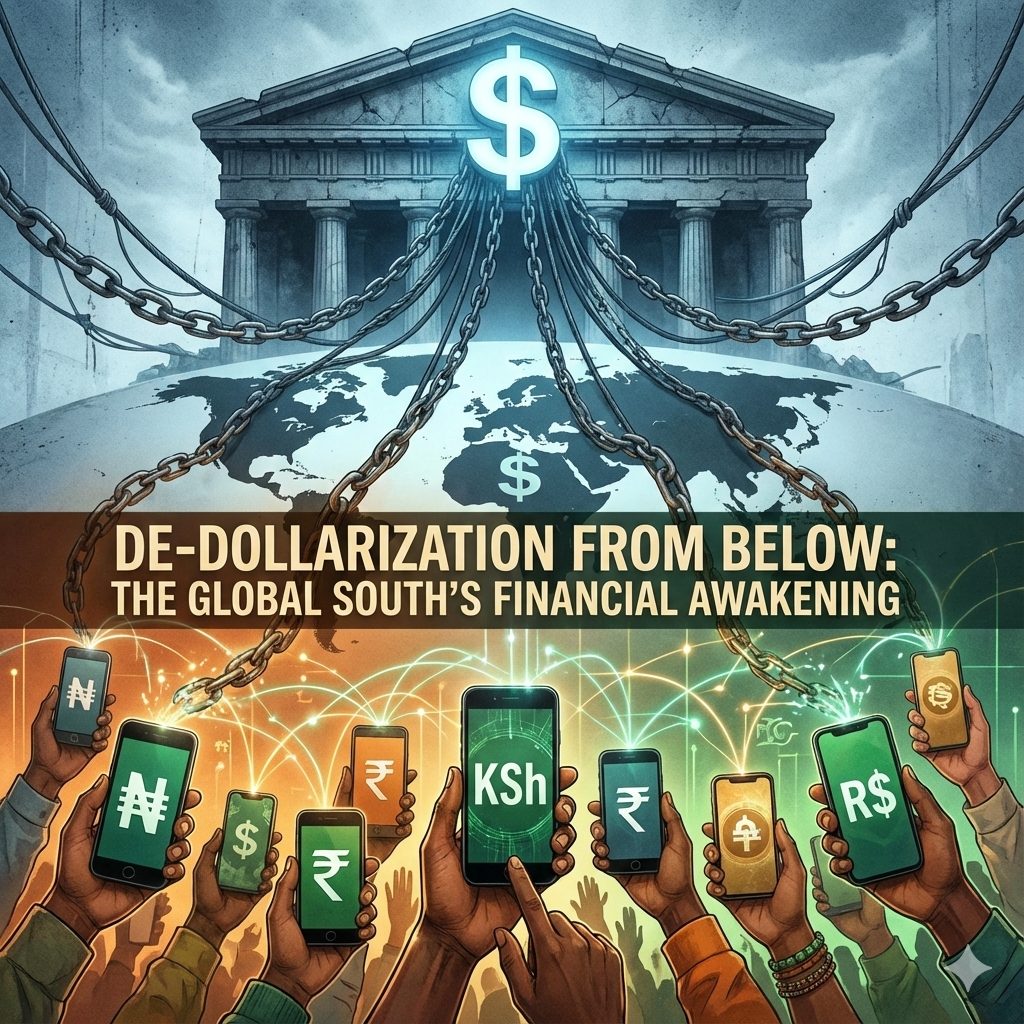
For more than seven decades, the U.S. dollar has held an unquestioned reign over the world of finance, from oil contracts to debt payments to the accounting of reserve balances. The dominance once considered the Global South increasingly sees an anchor of stability as a constraint-a silent lever of dependency that curbs economic sovereignty. From BRICS summits to experiments with digital currency by African and Asian central banks, a new movement is taking shape, de-dollarization from below. It is not an economic adjustment but a political awakening-a reclamation of autonomy from the financial order built in 1944 at Bretton Woods. As Bhattarai & Adhikari (2025) Note, this shift represents “a tug-of-war” between a West-dominated financial system and an emerging multipolar currency world. The question is no longer whether the dollar’s hegemony is absolute; it is how long the Global South will tolerate it.
A World Built on the Dollar
The U.S. dollar became the global reserve currency via the 1944 Bretton Woods system postwar compromise that gave the United States control of the world's financial plumbing. Even after the end of the gold standard in 1971, the dollar retained its supremacy. It now accounts for nearly 60% of global foreign exchange reserves and 88% of cross-border transactions(Khanijou, 2024). When the system finally collapsed in 1971, the dollar nonetheless retained its status as the world's reserve currency. Today, about 58 percent of worldwide foreign exchange reserves and over 80 percent of international trade invoices are dollar-denominated. For countries in the Global South, this dependence has been both a lifeline and a leash. It facilitates trade and access to capital markets, but exposes economies to US monetary policy, sanctions, and capital flight risks. When the U.S. Federal Reserve hikes interest rates, currencies in the Global South plummet, unleashing inflation and debt crises. In the 2022–23 surge of dollar appreciation alone, dozens of Global South currencies-from Ghana's cedi to Pakistan's rupee-lost up to half their value. The outcome was a fiscal squeeze, soaring import costs, and social unrest. As Komolov (2023) argues, the dollar’s dominance perpetuates a “core-periphery” structure, allowing wealth to flow from developing nations to advanced economies through unequal financial exchange.
From Fintech to Freedom: Grassroots De-Dollarization in the Global South
It is normally presented as a geopolitical project taken up by the central banks, led by regional blocs like BRICS. That said, less noticed but arguably more transformative is the bottom-up process of de-dollarization that citizens, micro-entrepreneurs, and local fintech ecosystems are pushing through the Global South. This concept of "bottom-up de-dollarization" challenges the assumption of monetary autonomy emanating necessarily from state-level policy. In Kenya, Nigeria, Bangladesh, or India, digital payment platforms or mobile money systems have started localizing economic trust, where millions now conduct financial transactions using domestic or regional currencies and not in U.S. dollars.
According to the World Bank (2024), further, the rapid diffusion of mobile payment technologies has reduced remittance costs drastically and reshaped cross-border liquidity patterns, thereby allowing households and businesses to bypass dollar-clearing intermediaries. Similarly, there is a report by the GSMA, titled Mobile Economy Report 2023. It is important to note that in sub-Saharan Africa alone, more than $830 billion was processed in mobile money transactions in 2022, a number that surpasses the GDP of many regional economies. Fintech systems like M-Pesa in Kenya, bKash in Bangladesh, and Paytm in India demonstrate how technologies promoting financial inclusion are significantly fostering currency diversification at the same time. Anchoring value exchange in local units of account reduces the structural dependence on the US dollar for everyday economic activities. This is not just a technological shift, but one of redistributive financial agency. Every mobile transfer settled in shillings, rupees, or naira strikes a dent in the psychological and practical monopoly of the dollar in everyday life. The implication of this development for theory is an important one: monetary sovereignty can arise from below, even without explicit policy de-dollarization. As locally trusted systems multiply, they begin to rewire transactional infrastructure in a bottom-up fashion toward domestic currencies, reinforcing public confidence in national monetary frameworks. Thus, grassroots fintech innovation powered by need, digital literacy, and social trust represents a new front in financial independence for the Global South, redefining what it means to de-dollarize in a digitized, post-Bretton Woods world.
Micro-De-Dollarization and Monetary Trust
For much of the modern era, the U.S. dollar has served as more than just a medium of exchange-it has functioned as a psychological anchor for the global economy. In many parts of the Global South, people came to associate the dollar with security, stability, and legitimacy, while viewing local currencies as fragile and unpredictable. From street vendors in Nairobi to remittance workers in Dhaka, holding dollars became synonymous with economic protection. Yet this dependency was not merely financial-it was emotional, embedded in collective memory and habit. Today, however, that inherited faith is beginning to break up in silent yet important ways. More citizens from Africa and Asia are using digital platforms to conduct transactions, save, and invest in their own currencies, bypassing dollar-based systems. This evolution, happening largely unnoticed in official economic discourse, translates to a change in the very way people trust money. It represents what can be called micro-de-dollarization, a process where financial independence gets rebuilt from the ground up through everyday behaviour, not by top-down policy.
Consider the digital payment revolution sweeping parts of the Global South: with rapid penetration, platforms such as M-Pesa in Kenya, bKash in Bangladesh, and Paytm in India have become an integral element of their respective local economies. They turn small businesses, households, and informal workers into empowered agents who can arrange for real-time and secure money transfers in their own national currencies.
According to the World Bank in 2024, reports, the cost of remittances worldwide has fallen to its lowest level in ten years, and largely due to fintech channels avoiding dollar-clearing intermediaries. Such systems, by allowing for direct transactions to be denominated in local currency, do more than lower transfer costs: they rebuild domestic confidence in national currencies-the psychological foundation of financial sovereignty. Meanwhile, mobile money has created new forms of social trust in digital finance. In fact, research proves that communities increasingly have come to treat mobile balances in the local unit as a secure store of value-an implicit vote of confidence in their monetary systems. For instance, one regulatory study of digital financial services in Zimbabwe and South Africa found that fintech adoption expanded access to credit and savings for millions of citizens outside traditional banking structures (Chitimira & Torerai, 2023). In effect, financial trust is being re-nationalized one mobile transaction at a time. But this transformation also hides a tension. The rapid expansion of unregulated digital platforms has introduced new vulnerabilities around data risks, predatory lending, and unequal access to digital infrastructure. Without strong domestic regulation, fintech threatens to replace one type of dependency with another, shifting power from Western banks to private technology firms.
As Chitimira & Torerai (2023) say, warn, innovative sustainable digital transformation needs to be underpinned by effective consumer protection and open governance. The deeper point is that monetary sovereignty can't be legislated into existence by fiat; it has to be lived through trust. When people trust their domestic financial systems-when a digital balance in rupees or shillings feels as safe as a dollar note-true dollarization starts to take hold. Every local transaction that settles in a home currency loosens the dollar's symbolic stranglehold, not in an adversarial way, but through quiet normalization. The result is a reimagined monetary order not premised on dominance but distributed confidence. In this vein, micro-de-dollarization represents a social revolution as much as an economic one: the democratization of financial autonomy whereby active citizens reshape global currency relations from below. This bottom-up perspective dissolves the age-old assumption that reforming the world's monetary system can be willed only by powerful states or central banks. Instead, the foundations for a more plural and fair financial future are already being laid transaction by transaction, trust by trust, across markets, mobile screens, and daily lives in the Global South.
Local Digital Economies as Sovereign Spaces
The growing emergence of local digital economies across the Global South redefines what it means to have financial sovereignty in the twenty-first century. For decades, economic dependence on the US dollar was symbolic not only of monetary subordination but also of a structural inequality in global trade and finance. However, the constitution of digitally mediated local economies through mobile payments, regional settlement systems, and other forms of digital banking innovations has started creating new forms of sovereign economic space. These represent more than virtual markets; they are political zones in which local currencies, digital infrastructures, and user communities come together to reclaim control over value creation and exchange. In areas where conventional banking setups have not been able to reach large sections of their populations, digital platforms have become de facto state-like financial architectures. They provide immediate avenues for transacting, saving, and investing without having to go through international dollar intermediaries. For instance, thanks to the Pan-African Payment and Settlement System, African enterprises are now able to settle intracontinental trade in their own national currencies, avoiding exposure to exchange volatility and dollar liquidity squeezes.
On the other hand, the economies of South and Southeast Asia are trying to work out regional settlement frameworks that would connect local currencies without passing through any correspondent banking channels (Bhattarai & Adhikari, 2025). Neither the author nor anyone else acting on behalf of the author may process, reproduce, distribute, or archive this work. These systems are more than financial instruments; they are statements of economic self-determination. In fragile or post-conflict countries, such as Somalia, the institutional vacuum left by weak central banks has been filled by digital financial ecosystems, enabling citizens to sustain commerce and savings through mobile money networks. As Chonka et al. (2025) argue that in such contexts, mobile money functions as a proxy for state authority, rebuilding trust and transactional legitimacy from below. In this sense, digital economies are not only economic tools but sovereign spaces where governance, trust, and identity are digitally reconstituted.
Yet these digital local spaces are not free from contradictions. They exist within the global infrastructures of the internet, still dominated by companies from the West, thereby placing the Global South in a more subtle state of technological dependence. Payment processors, cloud services, and data servers remain under the control of multinational firms, a situation that critical scholars characterize as digital colonialism: an economic system where independence is limited by foreign control of one's technological infrastructure. As Didenko et al. (2020) noted, digital finance introduces new asymmetries of power even as it promises inclusion. This is a contradiction that forces an urgent question: Can the Global South realize financial sovereignty without technological sovereignty? Long-term success with local digital economies requires not only financial innovation but ownership, security, and governance of the data and infrastructure underneath. Otherwise, digital finance risks turning into another form of dependency-local in appearance, global in control.
These developments demonstrate, critically, that sovereignty in the digital era is neither limited to political borders nor confined to state institutions. It is networked, it is participatory, and it is infrastructural. The power to issue, store, and transfer value is increasingly located in digital ecosystems across traditional boundaries of state control. Such a shift redefines sovereignty as a shared capacity between states, citizens, and digital infrastructures, thus challenging the basis of conventional economic theory. The implication is profound: the locus of monetary power is moving from central banks to distributed digital commons, where collective participation sustains legitimacy. Hence, local digital economies represent not only a revolution but also a dilemma. While they offer unparalleled potential for self-determination, they also require new governance models to maintain these systems as public, transparent, and fair. The protection of such emerging sovereign spaces will depend on policymakers pursuing regional cooperation in the realms of cybersecurity, digital infrastructure, and regulatory harmonization. Whether or not de-dollarization and economic independence will be possible in the future will come to depend on the ability of the Global South to convert its digital economies from devices of adaptation into tools of true sovereignty.
Digital Finance and the Local Currency Turn in the Global South
The growing adoption of digital finance in the Global South signifies not only a technological transformation but also a subtle reassertion of monetary sovereignty. For much of the post-war era, economic exchange across developing regions remained tied to the US dollar, reinforcing structural dependency and circumscribing policy autonomy. Yet, the expansion of fintech, mobile money, and experiments in CBDCs is forcing a local currency turn shift toward digital ecosystems that centrepiece national currencies as everyday and intra-regional forms of exchange. This process constitutes an emergent phase of grassroots de-dollarization driven less by political decrees than by the aggregated economic conduct of millions of digital users. Likewise, (Hervé, 2022) finds that digital payments in Southeast Asia not only expand inclusion but also reduce shadow economies, strengthening state fiscal capacity.
In the end, both resistance and adaptation are reflected in the local currency turn. It reminds policymakers that true de-dollarization necessitates not only financial independence but also ownership of the digital infrastructures that support it, and it shows how the Global South can use digital innovation to regain control over value and exchange.
The question of de-dollarization is no longer confined to monetary policy or geopolitics; it has become a test of the conceptual sovereignty power of the Global South to imagine and construct its own economic order. What is unfolding is not merely a technical shift from one reserve currency to another but a deeper contest over who defines value, trust, and legitimacy in the twenty-first century. The post-dollar world, therefore, will not be decided by balance sheets alone but by competing philosophies of financial order, one centered around domination through liquidity, the other on pluralism through participation.
The Global South's quest for financial autonomy is riddled with a paradox. On one hand, digital finance, regional settlements, and local currency systems hold out a promise of emancipation from dollar dependency. It is precisely these tools that come to rely on an infrastructure of servers, payment networks, and algorithmic systems controlled by external powers. The result is a deep conceptual tension: can there be any question of sovereignty when its instruments are outsourced? De-dollarization without digital sovereignty runs the risk of reproducing the same asymmetries it seeks to transcend. In that sense, financial independence cannot be reduced to the diversification of reserves; it calls for a redefinition of autonomy in economic as well as technological terms.
The future of global finance will therefore be less a consequence of the collapse of the dollar than of the emergence of multiple, coexisting sovereignties. The Global South's project is not to replace one hegemon with another but to assert the legitimacy of difference to normalize a world wherein economic confidence flows from within rather than from the approval of global markets. This shift requires intellectual courage: to move beyond imitation toward innovation, and to recognize that money itself is a social contract grounded in belief, not an empire's decree.
In this sense, the true endpoint of de-dollarization is not a new currency hierarchy but a new epistemology of trust, one that locates sovereignty in the capacity of societies to define and sustain their own systems of value. The post-dollar order will belong not to those who hold the most reserves, but to those who command the imagination of economic possibility.

Abdul Akbar is a Master’s student in Finance and Sustainability at the Indonesian International Islamic University (UIII). Originally from Pakistan, his research focuses on ESG, finance, and the banking and economic sectors. He is particularly interested in the intersection of sustainable financial systems and economic development.
In this article, Affabile Rifawan examines the shifting landscape of...
This article examines how Indonesia’s nickel downstreaming policy has driven...
This article examines the "permission economy" in Pakistan, an informal...
This article examines how the illicit smuggling of critical minerals...
This article argues that poverty and uneven development in the...
This article explores how the Global South is reevaluating its...
This article examines the challenging path for Indonesia to meet...
This article analyzes Nigeria’s attempt to convert carbon credits into...
This article examines how Indonesia’s MBG program, while reaching more...
This article critically analyzes the 17th BRICS Summit communique, highlighting...
This article explores what Indonesia’s upcoming Digital Rupiah can learn...
This article explores how Indonesia can transform its steady economic...
This article discusses how global ESG standards, mainly created within...
This article explores Indonesia’s resilient people-based economy, driven by 65...
This article examines Indonesia’s 2025 economic turmoil, marked by a...
This piece explores how Pakistan can harness its rich cultural...
This incisive piece unpacks the deeper logic behind Trump’s so-called...
This article introduces Sustainable Prosperity Investing (SPI) as a hybrid...
This article examines how globalization challenges the authority of Islamic...
This article examines Danantara, Indonesia’s recently launched sovereign wealth fund...
This article explores how digital payment systems are reshaping financial...
This article explores the expansion of Islamic banking beyond Muslim-majority...
This article examines the impact of Trump’s aid cuts on...
Nestled within the Singapore-Johor-Riau Growth Triangle, Bintan Island has quietly...





Leave A Comment