
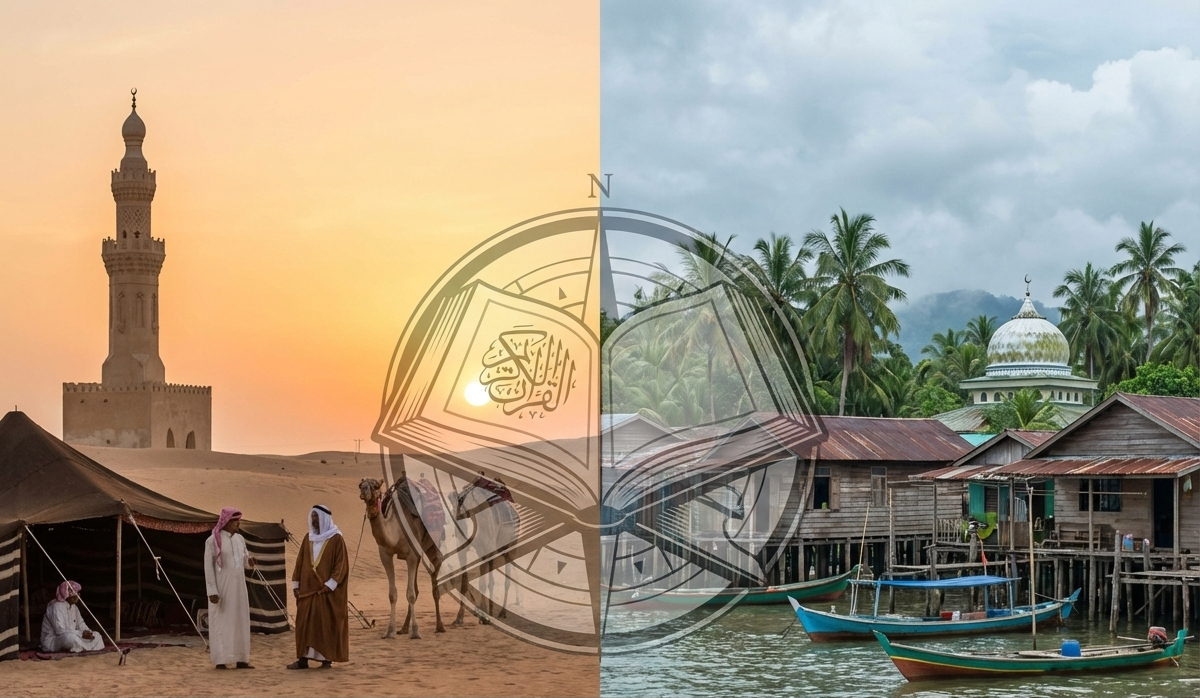
I was raised in the kampung core of Tanjung Priok, a district in Jakarta often dismissed as pinggiran (the margins) yet in practice far more cosmopolitan than the manicured neighborhoods that dominate the city’s official self-image. Within this space, I grew up immersed in a Bugis–Makassar social bubble. It was a universe sustained not by formal theology or written doctrine, but by habitual practices that required no explanation. Taboos (pantang larang), inherited memory, and the cadence of Bugis–Makassar custom structured everyday life long before academics arrived to categorize or theorize it.
Leaving this environment during my teenage years, I encountered a jarring contrast when I began studying in a pesantren (Islamic boarding school). There, Islamic discourse was oriented overwhelmingly toward the desert: toward romanticized notions of “Bedouin authenticity,” Qur’anic admonitions about tribal obstinacy, and scholarly claims that Arabia’s arid landscape constituted the sole legitimate foundation of Islamic identity. The tension felt deeply personal. How could the Bedouin be portrayed simultaneously as the primordial source of the ummah and as its most morally precarious element? And why was my own living, evolving tradition so easily dismissed as a residual pre-Islamic layer, clinging beneath a supposedly superficial Arab-Islamic surface?
A way out of this conceptual impasse emerged through the work of Mohd Taib Osman. His scholarship articulated something I had long sensed but lacked the vocabulary to express: indigeneity is not a fossilized stratum buried under Islam, but a dynamic system that struggles, adapts, and reconfigures itself through Islamic frameworks. The real analytical distinction, then, is not between “pure Islam” and “local belief,” but between different indigenous worlds negotiating Islam in their own terms.
This essay grows out of that realization. It juxtaposes the Bedouin world and the Malay world; not to erase their differences, but to illuminate the parallel ways both have been evaluated, disciplined, and reshaped through Islamic discourse. By doing so, it questions the enduring colonial and reformist tendency to frame Southeast Asian Islam as a deviation from an imagined Arab norm. Decolonizing Islamic history requires precisely this kind of comparative encounter.
Bedouin Indigeneity in the Qur’anic Horizon
The Qur’an does not speak of “indigeneity” as a modern analytical category, yet it addresses the concept through a moral vocabulary that is far more complex than contemporary labels allow. The al-aʿrāb (Bedouin) appear as a persistent paradox: custodians of linguistic clarity and ancestral continuity, yet also described as “stronger in unbelief and hypocrisy,” molded by ecological conditions that privilege autonomy, suspicion, and unwavering kin loyalty.
This ambivalent portrayal was later systematized by classical thinkers, most notably Ibn Khaldun. In the Muqaddimah (1377), his distinction between ahl al-badiya (desert dwellers) and ahl al-hadar (urban populations) cast Bedouin society as the source of raw political energy, forged through hardship and collective solidarity. Yet the same qualities that generated power also required ethical discipline. For Ibn Khaldun, urban life, not nomadism, provided the social environment in which religious norms could be stabilized and moral refinement could occur.
Within this framework, Bedouin indigeneity functions as Islam’s internal “other”: essential to its historical emergence, yet perpetually subject to critique and redirection. Islam neither annihilated Bedouin identity nor left it untouched; it reoriented it through revelation. This pattern of confrontation, negotiation, and transformation would later shape Islam’s encounters with other indigenous worlds.
Colonial Constructions of Indigeneity
When Islam arrived in the Malay world, it entered a cosmological landscape radically unlike Arabia’s. This was a world dense with spirits, ancestral forces, ritual specialists, and sacral kingship. Colonial scholars, however, sought to reduce this complexity into static models.
Winstedt (1947) famously described Malay religion as a “layered” structure: animism at its base, Hindu-Buddhist elements above it, and Islam as a thin external coating. Snouck Hurgronje detected syncretism everywhere, a term that, in colonial usage, functioned less as description than as judgment (Witkam, 2021). Wilkinson (1906) similarly portrayed Malay belief as a sequence of external overlays imposed upon a primitive indigenous core, rendering local communities’ passive recipients of foreign civilizations.
Walter Skeat (1900) treated rituals, spirits, and healing practices as “survivals” from an irrational past, effectively freezing Malay cosmology in a timeless register of superstition. Maxwell, writing from within the colonial administrative apparatus, framed adat and ritual life as impediments to rational governance, interpreting indigenous cosmology as psychological disorder incompatible with legal modernity (Gullick, 1991).
Despite their differences, these approaches shared a common assumption: Islam in Southeast Asia was shallow, foreign, and secondary, while indigeneity was static and untouched. Malay Muslims appeared not as active interpreters of Islam, but as custodians of a thinly Islamized tradition. This portrait bore little resemblance to lived reality.
Reclaiming the Indigenous Mind
Mohd Taib Osman’s Malay Folk Beliefs (1989) marked a decisive departure from colonial anthropology. He argued that Malay indigeneity should not be understood as a pre-Islamic remnant or an archaic residue, but as a flexible and adaptive worldview continuously responding to new moral languages.
A bomoh who recites Qur’anic verses, Osman insisted, does not exemplify religious mixture. Rather, he reflects a cosmology already reorganized through Islam; one in which nature spirits are reframed as jinn, fortune is reinterpreted as rezeki, and communal rituals acquire ethical grounding through concepts such as silaturahim.
In this formulation, indigenous beliefs persist not by resisting Islam, but by internalizing it. Islam supplies the conceptual grammar, while indigenous imagination provides the narrative substance. Rituals endure because they are re-legitimized through Islamic categories. They survive not as relics, but as transformed practices.
This insight fundamentally alters the analytical landscape. Indigeneity ceases to be Islam’s adversary; it becomes the medium through which Islam becomes intelligible and socially rooted.
Two Worlds, One Process of Negotiation
Placing the Bedouin and Malay experiences in dialogue reveals distinct cultural terrains governed by a shared logic. Islam encountered Bedouin society from within, and Malay society from without. One world revolved around lineage, honor, and survival; the other around spirits, ancestral power, and ritual mediation.
Yet both required translations. Both were subject to critique. Both transformed. In Arabia, prophetic reform redirected Bedouin virtues toward universal ethical horizons. In the Malay world, Islam recoded spirits as jinn, sacral sites as keramat associated with saints, and ritual practices as acts justified through Qur’anic reasoning. In both contexts, indigeneity remained a site of tension: Bedouin autonomy resisted moral discipline; Malay ritual life provoked reformist purification. These tensions do not signal Islam’s failure. They reveal Islam’s historical mode of operation, working through interpretation rather than erasure.
This recurring process, visible from the Maghrib to the Swahili coast to Southeast Asia, explains how Islam can be simultaneously universal and profoundly local. The Qur’an itself affirms this diversity: “O humankind, We created you from a male and a female and made you into peoples and tribes so that you may know one another” (Q. 49:13).
Indigeneity, then, is not what Islam overcomes. It is what Islam reshapes. Reading the Bedouin world alongside the Malay world reveals Islam’s engagement with indigeneity in its full historical depth. The Bedouin provided the initial linguistic, ethical, and social milieu to which the Qur’an directly spoke. The Malay world presented a layered cosmology that compelled Islam to negotiate meaning symbol by symbol, practice by practice.
Colonial scholarship misread this encounter, reducing Southeast Asian Islam to a superficial layer over animism. Mohd Taib Osman overturned this narrative, revealing a world where rituals persist through reinterpretation, where indigenous imagination is revitalized through Islamic concepts, and where revelation and culture remain in constant dialogue.
By placing these two worlds in conversation, we see that indigeneity in Islam is neither a threat nor a deviation. It is a hermeneutical space; the ground where divine message encounters human memory, where meaning is continuously negotiated, and where communities repeatedly redefine how they live before God.
Islam does not abolish indigeneity. It translates it. And through that act of translation, Islam becomes both universal and unmistakably local, across deserts, across islands, and across the shifting landscapes of human experience.

Auf A. Said is an independent researcher and a writer in The Coretanist. His main interest is Southeast Asian transregional connections and postcolonial studies. He holds B.A. in Islamic history.
This article reinterprets the contemporary “Blue Pacific” concept through La...
This article offers a comparative reflection on how Islam has...
This article examines how historical plunder in the Global South...
This article re-examines Bangsamoro autonomy by demonstrating how it functions...
This article shows how the 1969 riots pushed Malaysia’s leaders...



Leave A Comment